
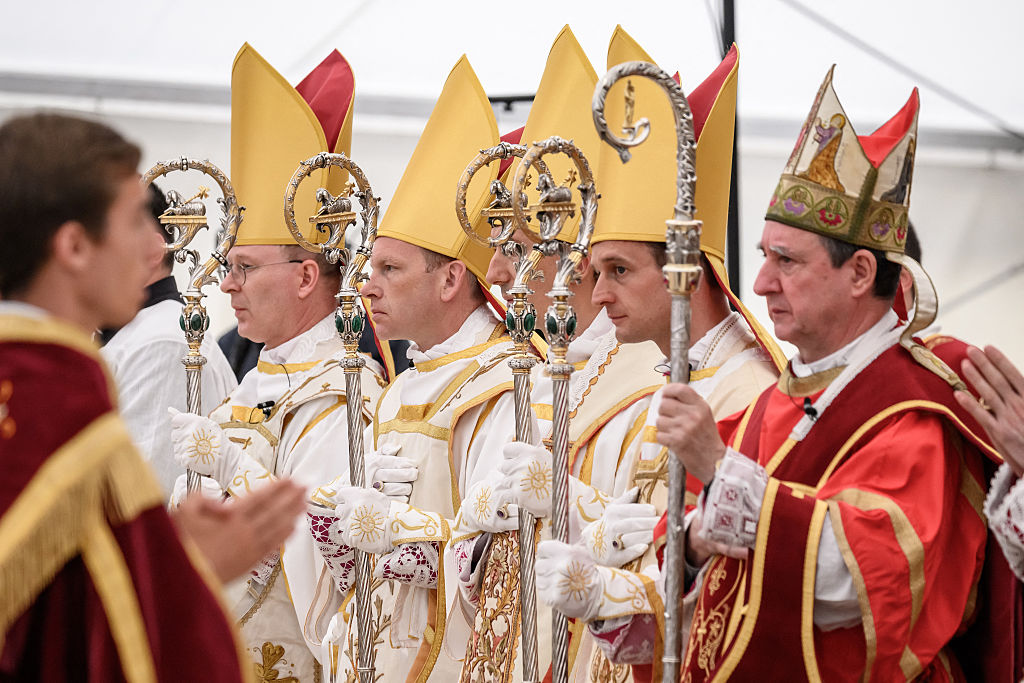
On Wednesday, the largest traditional Catholic order of priests in the world, the Society of Saint Pius X, consecrated four bishops without a papal mandate.
The Vatican’s response was swift and brutal. Today, it announced that not only have the four new bishops and the two consecrators been excommunicated but, shockingly, so will all the priests and faithful who continue to adhere to the Society’s work – an edict that will likely affect more than a million Catholics worldwide.
Over a million traditional Catholics could now be cut off from the Church for the crime of wanting to practice the faith as it was before the Second Vatican Council
This comes across as startlingly harsh, especially as the penalty of excommunication for consecrating bishops without a mandate has only existed since 1951. Pius XII established it to prevent the Chinese Communist party from appointing bishops loyal to Beijing. Ironically, today the CCP appoints bishops without a mandate for the explicit purpose of guaranteeing loyalty to communism and receives the Vatican’s automatic blessing. By contrast, over a million traditional Catholics have now been cut off from the Church for the crime of wanting to practice the faith as it was before the Second Vatican Council.
The morning sun was shining when the consecration began at the seminary of Econe, Switzerland, in the presence of 16,600 adult faithful and too many children to count. But a burst of heavy rain struck just before Communion was to be distributed. Outside the ceremonial tent, the drenched crowds sang “Ave Marias” and prayed the rosary in honor of the Blessed Virgin Mary, until the downpour lightened enough to continue (by the end all was sunshine, organ and pealing bells).
It was a symbolic moment for the Society. It has particularly championed the Blessed Virgin since November, when the Vatican issued a document downplaying her role in salvation. The Society cited this document as influential in their decision to proceed with the consecrations.

Excommunication is the most severe punishment the Catholic Church can carry out. But the Society insists that canon law makes provision for the extraordinary consecration of bishops at times of crisis.
They uphold the Pope’s authority as Vicar of Christ and pray for him at Mass. But they say that even the Pope (who, as the old adage has it, is the vicar of Christ, not His successor) has no right to cut off the faithful from the traditional Catholic liturgy, doctrine and sacraments.
The traditional Mass is, with severe restrictions, available within the mainstream Church. But the Society of Saint Pius X and its affiliates are the only formal groups who offer exclusively traditional Catholic doctrine and liturgy as they were before the Second Vatican Council. Without bishops, their work will eventually end, and the faithful who want to practice Catholicism in its pre-conciliar form will have nowhere to turn.
This would undoubtedly be the Vatican’s preferred outcome. What makes things awkward for Rome is that the Church has always claimed to be the guardian of an unchangeable truth. More can be learned about the truth, but what was already known can never be contradicted. For this reason Rome cannot condemn the Society’s members as heretics for practicing the pre-conciliar Catholic faith (though, as Pope Leo admitted to journalists a couple of weeks ago, the changes of Vatican II are the fundamental issues at stake).
This isn’t the first time the Society has been sanctioned by the Church. In 1988, Archbishop Marcel Lefebvre, founder of the Society of Saint Pius X, after engaging in endless, fruitless negotiations to obtain a bishop, realized he would soon die, and decided that the preservation of the pre-conciliar faith justified an extraordinary action. He consecrated four bishops, without jurisdiction, whose sole purpose was to provide for the sacramental life of the faithful.
Excommunication followed and the Society was called schismatic, though it steadfastly denied the charge. Although the Society did not recant, Pope Benedict lifted the excommunication in 2008 and Pope Francis, who respected the Society for its work with the poor in Buenos Aires, allowed it to hear confessions and perform marriages.
An odd kind of schism, if it even was one. And now, without having changed its position one iota since 1988, the Society has been excommunicated and declared schismatic again. In a move that is particularly cruel for the faithful, the Vatican has explicitly removed the faculties for marriages and confessions granted by Pope Francis.
Those who have watched the Society’s recent documentary Traditio about its apostolate, have in many cases been profoundly moved by the matter-of-fact way in which the Society’s priests go about the world, working themselves to the bone, doing what the Catholic Church has always done: teaching, baptizing, absolving, marrying, burying, and praying for the souls of others.
They acknowledge the authority of the Pope in all that is not sin. But they think that to wash their hands like Pilate, to stand back and let the Church’s pre-conciliar faith die out, would be a sin.
Their sincerity is clear – and the harshness of Pope Leo unconscionable. He has excommunicated an entire loyal branch of the Church after steadfastly refusing to let them come to him to explain their position. Since his election they have tried to approach him for an audience; in vain. Instead, they were offered dialogue that explicitly excluded the consecration of bishops and the points of disagreement with the Second Vatican Council. But these were the only things that needed to be discussed.
The Catholic faithful have been forced to uphold Vatican II for too long. It is time for the Church to allow Catholics to practice the old faith.
The Pope meets with soccer players and pop stars; he speaks up for migrants and blesses a block of ice to show his love for the earth. But the children of his house are excommunicated, attacked as schismatic, starved of the traditional sacraments and punished for wanting what the Church has always given. The injustice of it cries out to heaven.


Comments