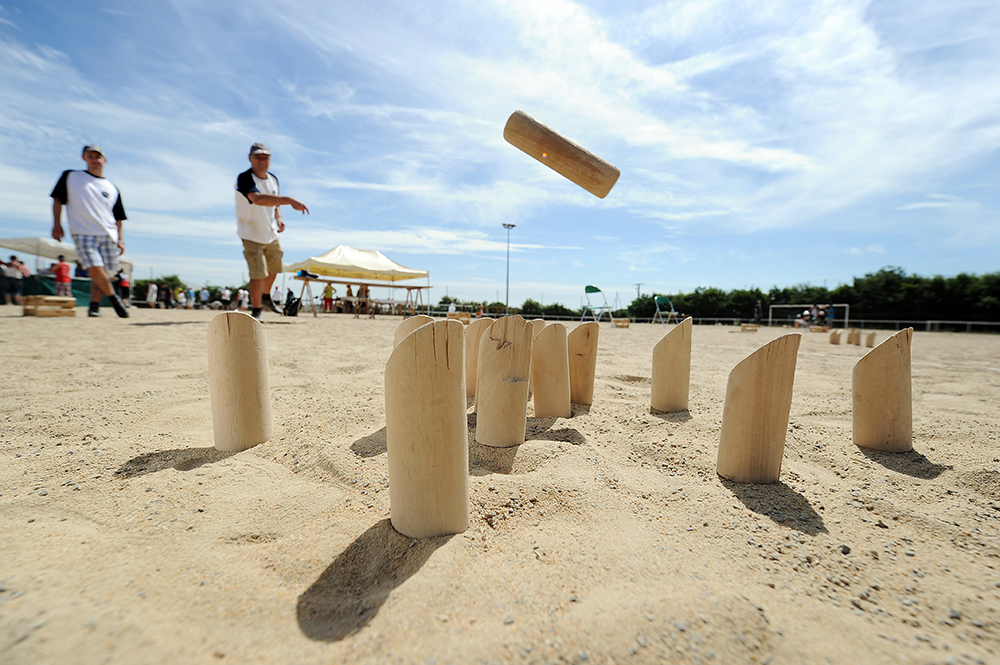
It cannot have escaped the notice of readers of even this most refined of journals that once again the country is enjoying and enduring a legendary summer of sport. As happens every year, there is a World Cup of this, a grand prix of that and a nail-biting tie breaker of something or other. It takes a brave man, or a foolhardy one, to toss his quoit into this bubbling cauldron of balls, especially when the quoit in question is a stick of sustainable, though not inflammable, Finnish wood. But cometh the hour, cometh the memoir. Neil Squires’s amusing account of his year on the Mölkky circuit offers a salutary reminder that he who dares usually loses.
Organised sport is notorious for its financial misdeeds, doping scandals and political usefulness. As far as I am aware, Mölkky has yet to fall prey to such corruptions. The game’s reputation remains spotless, if only because few people outside Finland have heard of it. So, at the risk of doing Big Mölkky’s work for it, let me give you a few facts and statistics.
Mölkky was created by the Finnish company Tuoterengas, now Lahden Paikka, in 1996. It is based on the traditional game Kyykkä, a pastime not unlike bowls or pétanque. Karelia is a historical province of Finland. It is also a centuries-old glint in the eye of neighbouring Russia, which has invaded or occupied it on several occasions. Prior to the rise of Mölkky, Karelia’s most notable contribution to world culture was as the inspiration for Jean Sibelius’s ‘Karelia Suite’, part of the composer’s larger Karelia Music. But in the 21st century, this historic region has become synonymous with two teams chucking little wooden skittles at each other. That’s showbiz!

Which is where Squires and his teammates come in. In the middle of life’s journey, they find themselves in a Finnish sustainable wood – or, if you want to get literal about it, in Japan, representing Great Britain at the Mölkky World Championship. And like many a midlife crisis, it doesn’t end well:
When I was young, I dreamed of playing for my country at a World Cup. It’s the same for millions. You watch the football, or the rugby, or whatever, and imagine yourself there. At that age, there is no barrier to entry. It’s an attainable goal… For the vast majority, the realisation eventually comes that either you’re not good enough or time has beaten you. Or both. There’s no shame in that, no cowardly surrender, it’s just a fact of life. There isn’t much grey hair in a Panini sticker album.
At this point I must declare an interest. At the turn of the millennium I represented Team GB at the World Miniature Golf Championship in Riga, Latvia. As with Mölkky, one could qualify just by turning up. I finished the tournament in last place by a huge margin, leading me to be dubbed ‘the Eddie the Eagle of miniature golf’ by media outlets across Europe. When I came home, I wrote about the experience at length. My intention was to examine whether the myths of sport – its character-revealing properties and redemptive arcs, its sheer bloody drama – were transferable to a sport few British readers would even acknowledge as such. The reputation of miniature golf, a precision game of skill and tactics, has suffered in the UK, uniquely, because of how the inhabitants of these islands refer to it – i.e. as ‘crazy golf’. A quarter of a century later, I remain convinced of my chosen sport’s integrity, even if I failed to sway many others.
Squires’s account of his Mölkky odyssey, then, recalls the challenges of such an enterprise. First, there is the sporting challenge of the game itself, which may require months, if not years, of genuine application and engagement. The second goal, no less demanding of time and effort, is to file a 70,000-word match report of sufficient seriousness that the reader feels invested in the subject, yet not so earnest as to suggest the author has lost his marbles in pursuit of it. And yes, there is a World Marbles Championship, though as yet no book.
The Fall and Rise of the Mölkky Bar Kids benefits hugely from Squires’s understanding of, and love for, so-called ‘real’ sports like cricket and football. His background as a sports journalist and as a ghost writer for Jonny Wilkinson – no, me neither – doesn’t hurt either. He knows how to wear his credentials lightly, on and off the court. I found myself rooting for these plucky British underdogs and laughing along with them as they achieved practically nothing except the deep satisfaction of being there. ‘If we can do something like this, anyone can,’ concludes Squires. ‘Next time you reach a crossroads in life, at least consider the road signposted “Ridiculous Adventure”. Take it from me – you won’t regret it.’





Comments