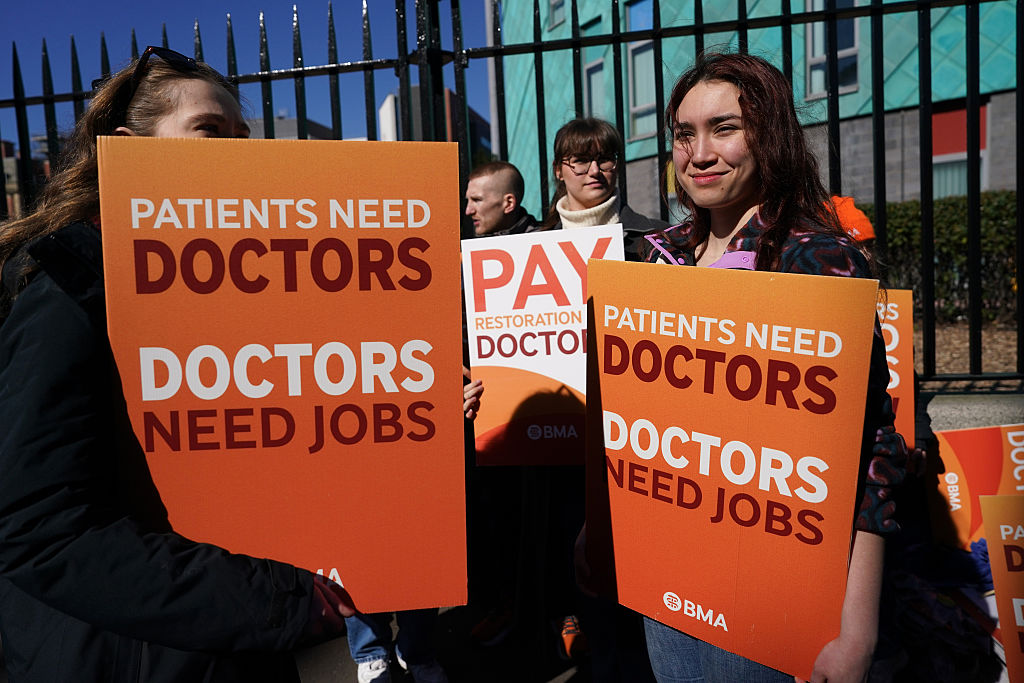
After three years, and a cost to taxpayers of over £3 billion, the junior doctor strikes are finally over. For now.
The vote was narrow. Of those who voted, only 53 per cent backed the deal. The BMA reports the pay rise comes to 6.6 per cent by April 2027, with more to follow. Pay progression will be faster. The government will now pay doctors’ postgraduate examination fees, which the Royal Colleges run, as well as their college membership fees, a deal which guarantees the price of both will swiftly rise.
A government with some steel would see the complaints of doctors as an opportunity. Workers’ rights too often mean the opposite, supporting the rights of those who work least
In addition, the government has promised an extra 4,500 training posts. Not because the NHS needs them, but because importing foreign doctors we didn’t need meant many of our own trainees were left without jobs. Most would have won them fairly, in open competition, but out of fear of discrimination we developed a system of allocating posts that couldn’t discriminate on merit.
NHS productivity is poor, and outcomes have failed to keep up with massive injections of extra money. In return for their concessions, it is reasonable to expect the government has extracted something for the benefit of the nation, something that will improve productivity and provide value for the taxpayer.
All the government got was more threats. The juniors regard this as only the start, and rather than welcoming the deal they have made it plain that the strikes will begin again unless pay rises further. And the new Employment Rights Act means they will find it easier to do: the turnout thresholds are set to disappear. Once that happens, a legal mandate for a national walkout could rest on a tiny fraction of the profession – in principle if only three doctors vote, the views of two of them would give a legal warrant for a walkout. In Northern Ireland juniors are on strike now, and the consultants were last week. The government hasn’t secured a truce with much more longevity than that in the Strait of Hormuz.
Milton Friedman gave his Wabash lectures 70 years ago this month. They became his book, Capitalism and Freedom, which so influenced both Thatcher and Reagan. Friedman was scathing about many things, but one that concerned him in particular was the way in which a state monopsony tended to standardise pay and suppress standards.
‘Poor teachers are grossly overpaid and good teachers grossly underpaid,’ he said. ‘Salary schedules tend to be uniform and determined far more by seniority, degrees received, and teaching certificates acquired than by merit.’ He saw this as a problem which inevitably became worse as the unit of organisation involved grew bigger. Standard salary scales became poison. ‘In any area, whether it be carpentry or plumbing or teaching, the majority of workers favour standard salary scales and oppose merit differentials, for the obvious reason that the specially talented are always few.’
That the NHS is failing is obvious, and the pay and conditions of its staff could be radically reformed. One might even be able to stuff the mouths of doctors, once again, with gold, so long as they accepted reform. Train more doctors than are needed and let them compete for posts. End the assumption of a job for life. Allow managers to hire, fire and vary wages, which is the minimum condition of actually being able to manage. There would be wailing and gnashing of teeth. Some people would suffer, as some people always suffer when freedom replaces shelter, but overall the NHS might become cheaper and more productive. We teach medical students that there is no such thing as a safe drug. The goal is not to find one without side effects, but to identify those that do more good than harm.
Friedman thought workplace structures offering secure jobs, flat salaries and guaranteed pay progression, were deadly. They repelled the imaginative, the daring, the industrious and the innovative. They rewarded the complacent and those who would fail in any system where they had to compete. That medical students have to compete hard for a place at university is an odd excuse to give them guaranteed career progression ever after.
A government with some steel would see the complaints of doctors as an opportunity. Workers’ rights too often mean the opposite, supporting the rights of those who work least. Open up doctors and other public sector staff to the risks of having to compete for their pay, and let them enjoy some of the benefits when they do.
Specialties with private work have long shown some of these benefits. Reputation drives referrals, and consultants wanting private money have a reason to be conspicuously good NHS colleagues. High-earning surgeons are often not hiding from their day jobs on the golf course but sweating to make a good impression with local GPs. In a field without private practice, I have never worked so hard as when I was competing for my consultant post. Perhaps medics should be paid more – but perhaps their lives, in return, should be less comfortable.





Comments