
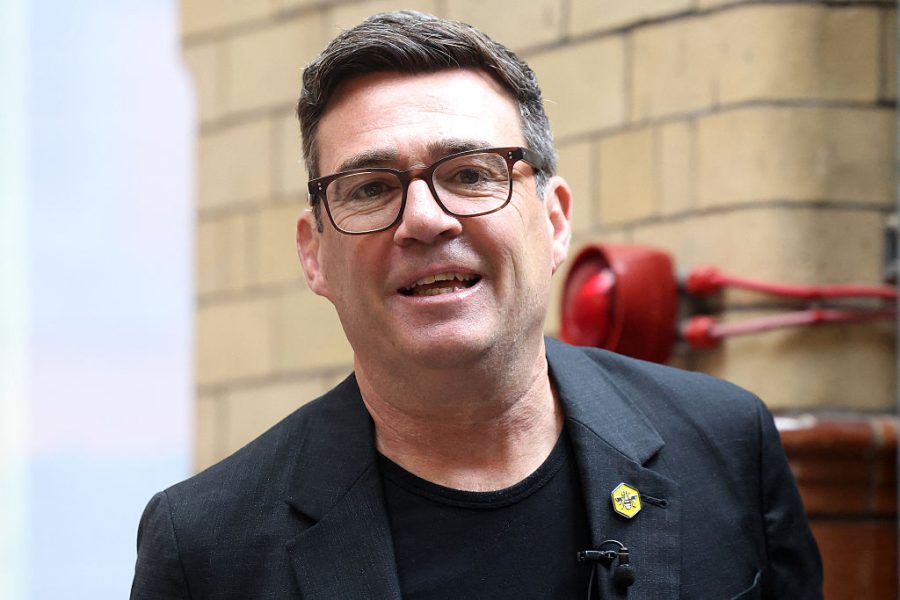
Andy Burnham is not prime minister yet, but he has already outdone John Major. Whoever thought of putting him in a grey outfit against the backdrop of a grey door for this morning’s speech in Manchester certainly wasn’t thinking of injecting a bit of colour into national life. It was like watching Harold Wilson: the last PM before colour TV was introduced to Britain.
Burnham’s big mission for the country – to devolve power to the regions and localities – also wasn’t exactly calculated to set pulses racing. Rightly or wrongly, few things can be relied upon to provoke a yawn in British life than local government. Just look at the turnout in local elections and the increasing tendency for the electorate to use them as little more than a referendum on national government. It was, after all, the local elections which finally did for Keir Starmer and put Burnham in the position he is now.
It was like listening to Harold Wilson, back in the days before council blocks became a symbol of urban decay
If Burnham can really make the British public excited about local government, he will have achieved something genuinely impressive, but I would say he has an uphill task. However much the new MP for Makerfield might feel that the people of Manchester are behind him, the wider electorate has signalled again and again that they are not very keen on the idea of devolving power to the regions or the districts. Since 2001, there have been 55 referendums on whether to introduce an elected mayor, and in 38 of them the idea was rejected. In four of the 17 cases where the public did vote for an elected mayoralty, the post was later abolished in a subsequent referendum.
It is very easy when you are not in national government to champion the idea of devolving power to the regions. David Cameron did the same with his great ‘localism’ drive, which fizzled into very little once he had become prime minister. Will Burnham be so keen on devolution when, say, he has a Reform mayor in the Lincolnshire fens challenging many of his national policies?
That is the lesson from countries like France, which have very strong local government: they often become rival power bases which undermine the national government. It was a bit odd to hear Burnham champion the devolution of government powers but then say that his new Britain was going to have lots more high-rise development and mass council housing. Shouldn’t that be a decision for local people, through his newly empowered mayors, to decide what kind of housing they want, in terms of tenure and style?
Promising lots more high-rise council estates isn’t an obvious attraction. Again, it was like listening to Harold Wilson, back in the days before high-rise, concrete council blocks became a symbol of urban decay.
Nor, I fear, are Burnham’s ministers – whoever he appoints – going to appreciate his ‘No. 10 North’: an expanded Prime Minister’s office to be based in Manchester. Burnham might see it as a way to boost the fortunes of his adopted city; other ministers might see it as a way of taking power away from their own ministries and investing them in an office far away from Westminster, where it is hard to challenge them.
Burnham seems to have been a popular mayor of Manchester; although the enthusiasm has been somewhat muted on the Left by his liking for handing enormous loans to private developers of high-rise luxury flats. But on today’s evidence I would question whether he is quite ready for a shift to the top job on the national stage.






Comments