The biggest battle of the American Revolutionary War was fought in Brooklyn, just after the signing of the Declaration of Independence, in the summer of 1776. The Americans were outnumbered two to one, lost badly and were lucky to be able to extricate themselves from what could have been a war-ending disaster. George Washington, in command, learned that his troops must be better armed, better led and better disciplined to take on the Redcoats and that, whenever possible, he should avoid European-style pitched battles. Acting on these lessons for the next seven years, he found a way to survive and, eventually, to prevail.
Washington is quite unlike most of history’s military heroes – and nothing like Cromwell, Napoleon, Grant or Eisenhower, whose fame was based on achieving one victory after another. Washington, by contrast, was destined to lose every pitched battle he fought except the last one, Yorktown, and by then his army would be bolstered by powerful French allies. Nevertheless, his own generation saw him as the essential man, whose resolute conduct assured American independence. He never gave up, and he always managed to free at least some of his force from each encounter with the British.
Many of Washington’s men had no sense of discipline, lacked training and were insubordinate
The Continental Congress had appointed him commander of the Continental Army in the summer of 1775. He was then a 43-year-old veteran of the French and Indian War, familiar from the inside with British weapons, methods and tactics. He was dismayed on first meeting the men he must command. Most of them belonged to militia companies that had no sense of discipline, elected their own officers, lacked formal training, were rowdy, insubordinate, sometimes drunk on duty, fired their weapons in camp and knew nothing about how to supply, feed and regulate a large force. On the other hand, he knew that many of them had fought bravely at Lexington and Concord in April and again at the Battle of Bunker Hill in June. Over the winter of 1775-1776, they trapped a British force inside Boston, eventually forcing it to quit the city.
Lord North’s government in Britain, annoyed by the news from America, sent an expedition to seize New York City and its harbor, the strategic key to the 13 colonies. Commanded by a pair of brothers, Admiral Lord Richard Howe and General William Howe, the expedition consisted of 400 ships and 32,000 soldiers, making it, up to that date, the largest British force ever deployed overseas. Both brothers, Richard in the House of Lords and William in the House of Commons, had previously criticized British policy toward the rebellious colonies, foreseeing many of the difficulties they were later to experience firsthand.

The Howes were commissioned not just to subdue the rebellious colonists but, if possible, to reconcile them diplomatically. They sent the American leader a request for negotiations in an envelope marked “George Washington, Esq.” Washington refused to open it on the grounds that it did not recognize his rank and position. They tried again, addressing “George Washington, Esq., etc. etc.” He sent it back unopened and only on the third try, when the envelope was addressed to “General George Washington,” did he open it. The ensuing talks made no progress because the British offered nothing more than pardons to the American leaders and a return to the old status quo. It was much too late for that; Washington commented that “those who have committed no fault want no pardon.”
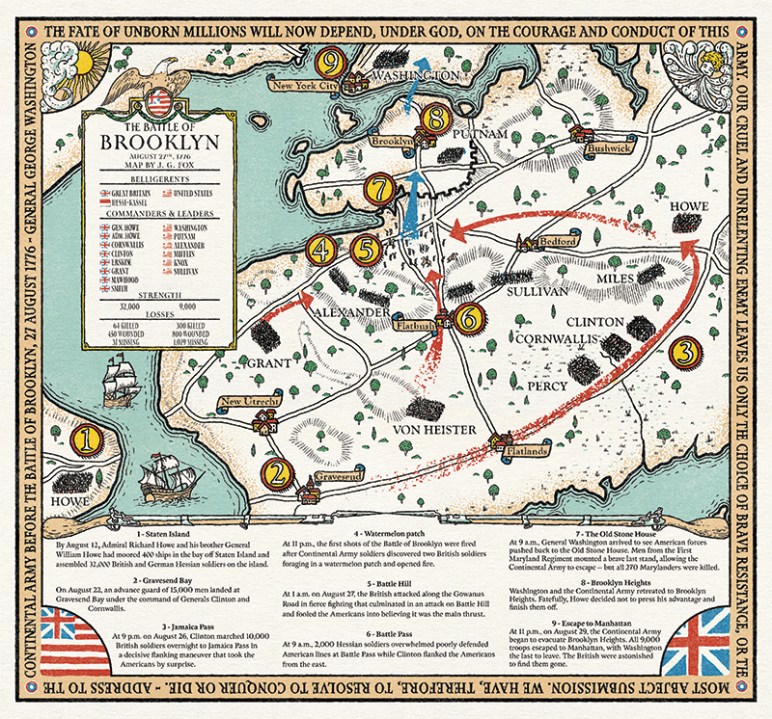
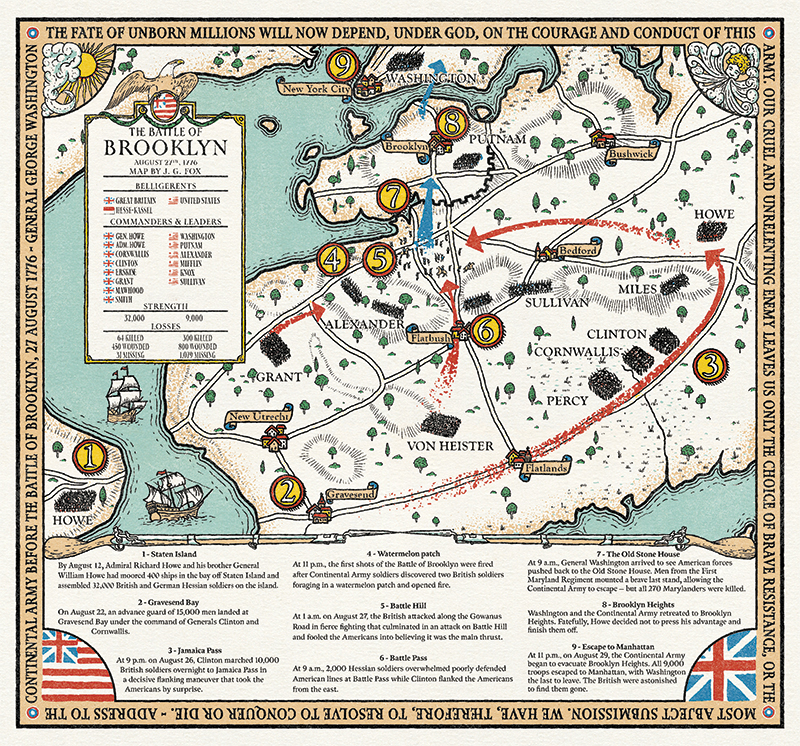
The British Army crossed from Staten Island, where the Verrazzano-Narrows Bridge now stands, and landed unopposed on Long Island, most of which at the time was still woodland. Washington, not knowing whether this was a feint, and fearing an attack on Manhattan itself, split his force. Even when thousands of British troops and their Hessian auxiliaries had landed, he remained doubtful. The Americans prepared redoubts on Brooklyn Heights, foreseeing an attack up one or more of the three roads – gaps in the woods – that led north from the Narrows toward them. American troops guarded each of these roads but they neglected to fortify a fourth route, Jamaica Pass, a few miles further east.
Sir Henry Clinton, a British officer who had fought at Bunker Hill, learned from local pro-British farmers that Jamaica Pass might be the key to victory. General William Howe, who had also witnessed the carnage of that direct assault the previous year, agreed; he authorized a column of 10,000 men to march east by night, then to turn north, then west, so that its unexpected assault on the American left wing the next morning, from behind, might destroy the American force. In this flanking column marched the three British army commanders of the Revolutionary War: Howe himself, Clinton, who would later replace him, and Charles Cornwallis, who would ultimately replace Clinton.
The armies were a study in contrasts. The Americans, many of them short-term enlistees, were often the friends and relatives of their officers. Nearly all of them were literate, they knew what they were fighting for and had followed the previous year’s political developments with keen interest. The British Army, by contrast, was officered by men from the very top rank of society, many of them members of aristocratic families. One, Hugh Percy, would later become Duke of Northumberland. The men they commanded came from the very bottom of society, were mostly illiterate, did not know or care about the politics of the war, were inured to brutal army discipline, but were well trained to fight in the ranks.
In oppressive summer heat,lines of men clad in heavy woolen uniforms converged
On August 27, the armies engaged. In oppressive summer heat, lines of men clad in heavy woolen uniforms converged. The British left, near the seashore, advanced against the American right; the British center bombarded the American center. Then a pair of heavy cannon shots announced the presence of the British flanking force behind the American left. The surrounded Americans panicked as attackers came at them from front and back. American officers of the center and right realized what was happening and wheeled around to face the oncoming British force. One of them, General John Sullivan, was soon captured.
Another American general, William Alexander, who styled himself “Lord Stirling” and whom his biographer described as an “overweight, rheumatic, vain, pompous, gluttonous inebriate,” nevertheless led a succession of daring bayonet charges against the British at the head of a group of 400 men from Maryland. His force was all but annihilated before he too was captured, but “the Four Hundred” had bought the rest of the retreating Americans more time to escape. Washington, witnessing the scene from a mile away, is said to have declared: “Great God! What must my brave boys suffer today?”
Americans who got out of the British pincers fell back toward the forts on Brooklyn Heights, but getting there entailed crossing a swamp under heavy fire. Many were shot down as they waded; others drowned. Joseph Plumb Martin, a 15-year-old Connecticut volunteer, witnessed the scene: “By the time we arrived the enemy had driven our men into the creek… where such as could swim got across.” When they came out of the water, “looking like water rats, it was a truly pitiful sight. Many of them were killed in the pond and more were drowned.”
Martin’s own memory of the battle was one of acute fear and even more acute hunger. He had nothing to eat for 48 hours and was finally given only a blackened ear of corn to gnaw on.
By then nearly 1,000 Americans had been killed or wounded and another 1,200 taken prisoner. One British officer boasted that he had seen Hessians and Scottish Highlanders killing wounded Americans: “It was a fine sight to see with what alacrity they dispatched the rebels with their bayonets.” He justified it on the grounds that they were such “vile enemies to their King and country.” British casualties stood at around 450.
Washington, with his back to the East River, braced for another assault – but it did not come. He was outnumbered three to one. Was General Howe coping with his own losses and regrouping, or was he implicitly offering the Americans another chance to give up, after learning that they could not win on the battlefield? Was his own force simply exhausted after an all-night march followed by a day of fighting? Historians have debated these questions ever since. By not pressing his advantage, which could have resulted in an overwhelming victory, Howe probably missed the best chance Britain ever had to win the war. Instead of advancing, he ordered his men to dig trenches and to prepare a formal siege of Brooklyn Heights. Meanwhile, hundreds of bodies, decaying in the summer heat, raised an appalling stench over the scene.
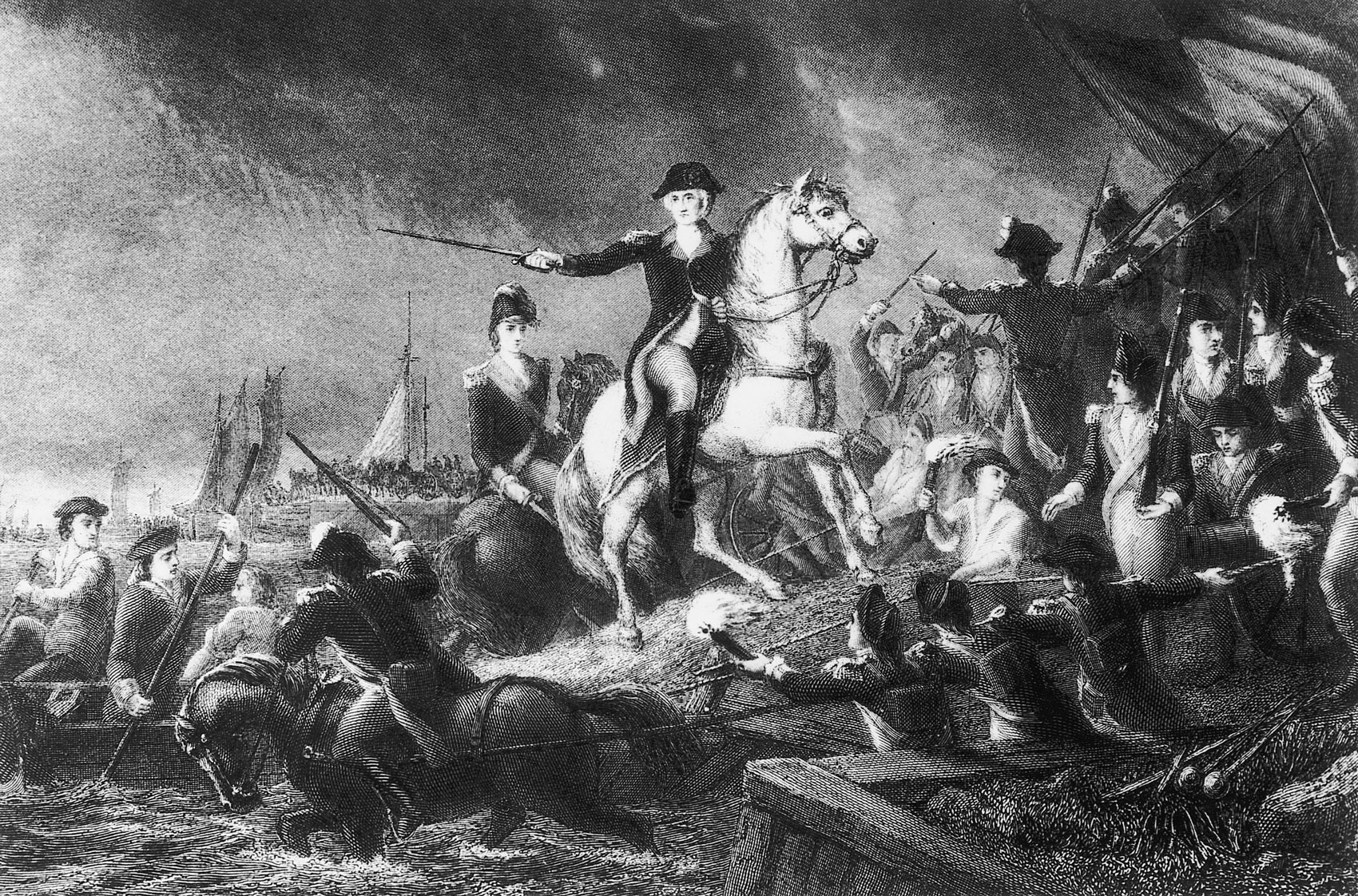
Washington stood on the wharf supervising this strategic retreat and was one of the last to leave
A lucky change in the weather two days later gave Washington the opportunity to disengage. Fog and rain replaced the burning sunshine, and on the night of August 29 he began to supervise a retreat across the East River. The 9,000 surviving Americans, leaving their campfires burning, moved quietly away from their positions to board boats that ferried them across to Manhattan. Washington stood on the wharf supervising this strategic retreat and was one of the last to leave. It was, in effect, an American Dunkirk. Washington in 1776, like Churchill in 1940, earned a second chance through a combination of skill and luck.
The ensuing months brought more defeats to the Continental Army, which was forced to abandon New York altogether in November. But the slow-moving Howe missed more opportunities to encircle and capture the whole American force. The Americans won a consolation prize that Christmas by crossing the ice-choked Delaware River and making a surprise attack on the Hessian garrison at Trenton. The military effect of Trenton was small but its propaganda value was great, signaling that the Revolutionary cause had not fizzled out.



Comments