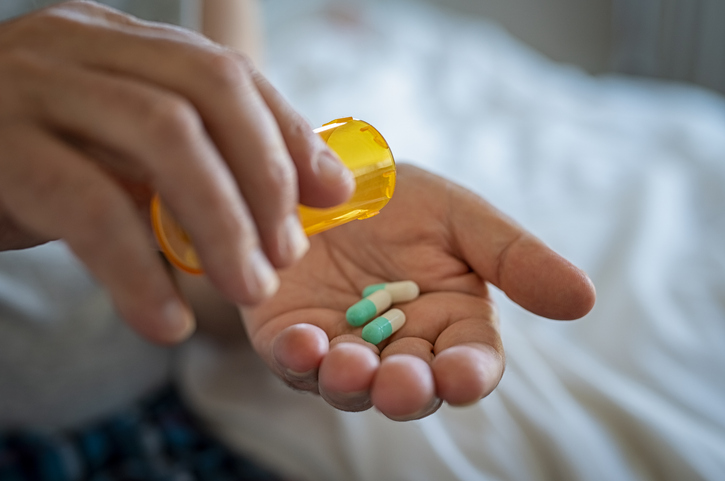
Across Britain today, people will take prescriptions to pharmacies and be told they can’t be fulfilled. After hearing a lifetime of speeches about the miracle of the NHS, they’ll find the miracle is out of stock. The National Pharmacy Association (NPA) warned earlier this month that we are short of medicines, with the shortages ‘some of the most severe the UK has experienced’.
Life is a muddle, and the best we can do is battle endlessly against imperfect trade-offs. That’s the lesson to be read in the NPA’s announcement, if it’s one you’re willing to see. Little in the world is an undiluted good, not even the modern decline of premature mortality. There are people who would find the downside to an England victory in the World Cup, although probably only Scots and Welsh.
Only politics, from which we suffer a surplus, deals with the fiction of radical simplicity. Solutions are proposed as though they have no drawbacks, opposing alternatives as though they offer no benefits.
Drug shortages can be abolished only through overproduction and stockpiling
Privately, of course, politicians speak of the art of the possible, and it is certainly to the art of the possible that administrators and regulators, like entrepreneurs and workers, need to look. Modern shortages aren’t unprecedented – not least because before the first antibiotics in the 1930s, our domestic medicine cabinets were free of anything much that actually helped, besides laxatives and opium – but the problems are real.
The NPA, which represents 6,000 independent community pharmacies, has made its claim on the back of a survey showing the vast majority now reporting problems. Patients go from one to another without being able to find the drugs they need, and pharmacists too often find themselves unable to help. ‘At a time when GPs and pharmacists are working under significant pressures,’ said the President of the Royal College of General Practitioners, ‘medicine shortages only add to this.’

One could ask whether pharmacists and GPs ever worked without pressures, and whether such a state would even be desirable, but certainly there are actions to be taken that might help. All come with costs. Policy, like medication, is never free of side effects. The issue is whether, overall, it does more good than harm.
Giving pharmacists more power to alter a prescription is one such step, and both the benefits and the drawbacks are fairly immediately apparent. Dispensing a cream, not an ointment (oil-to-water ratio makes the difference), or a tablet rather than a capsule, should be fairly straightforward. Swapping one drug for the equivalent dose of another in the same class is less, but it should not be beyond the wit of man to figure out when it is more broadly safe and helpful.
Whilst painkillers and creams offer the potential for substitutions, drugs like those used for epilepsy – which require careful titration and where some people respond only to certain very specific agents and doses – are harder to deal with. Like Creon, which is essential for aiding digestion in those whose pancreas has been damaged by cystic fibrosis or other disease, these drugs are currently amongst those most affected by shortages. Enthusiasts of weight loss agents will also be familiar with problems of supply, reflected both in the price and in the plain absence of the drugs from pharmacies. The medicine supply is not one problem. Wegovy and Mounjaro are hard to manufacture and wanted by half the world. Creon is caught in a European shortage made worse by the withdrawal of a competitor.
One of the unsung successes of the NHS has been its ability, as a monopsony purchaser, to buy drugs on the cheap. The trade-off is that when the shortages are global, we’re not first in the queue.
The other fundamental issue is that as a nation we’ve become poor at making our own drugs. This isn’t surprising – we’ve become bad at manufacturing overall – but we are one of the historical homes of the pharmaceutical industry, and it’s an area where we remain strong. Manufacturing, however, has slipped abroad. We don’t have the supply chains and we don’t have affordable energy. Less visible, but no less important, our regulations are punitive and our regulators inefficient and slow.
Improving these problems also requires trade-offs. Regulators have a native fondness for inefficiency, but funding ours better would help – at a price. And while punitive regulations dampen industry, and diminish innovation, they prioritise safety.
Modern drug regulation took a step forward in 1938, when the American FDA was transformed in the wake of the Massengill Company’s manufacturing error. Their sulfanilamide, an early antibiotic, was dissolved not in ethanol – alcohol – but in diethylene glycol. This was known to be poisonous, but not to the company’s chief chemist, Harold Watkins. Some 106 people died – 105 from the toxic effects of the drug, the last from a bullet, when Watkins shot himself.
Much generic production takes place in India, safely and efficiently. But in 2022, 70 Gambian children died from Indian-produced cough syrup. In an overlooked part of the supply chain, ethanol, to save money, was once more replaced with ethylene and diethylene glycol.
All life is the art of the possible. Drug shortages can be abolished only through overproduction and stockpiling. Today’s problems, in the scheme of things, are small. But to the people who can’t get the drugs they need, they’re not small at all. We can do better, we just shouldn’t hope for perfection.






Comments