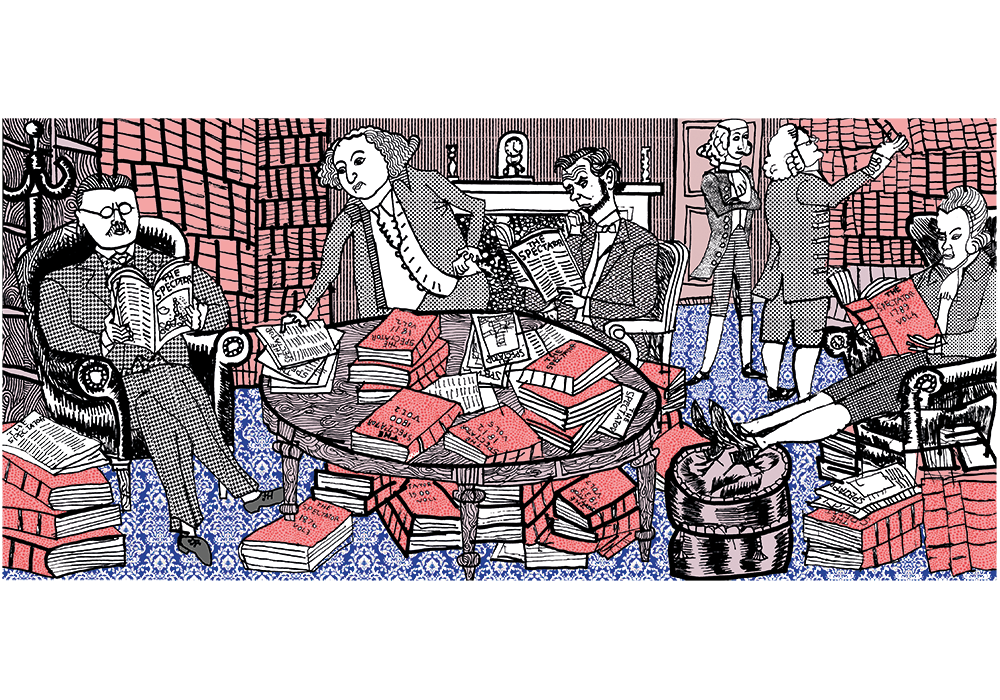

The Spectator was there at the founding of America. George Washington had six copies of the original 18th-century Spectator at his Mount Vernon estate and read them often. He shared with Joseph Addison, The Spectator’s co-publisher, an interest in how to educate ideal citizens: men and women with wit and grit.
Young Washington read The Spectator in the hope of bettering himself, too. Both of his older half-brothers had been educated in England and he wished also for the manners and polish of an English gentleman. For the pioneering, self-improving men who would go on to create an independent America, the 18th-century Spectator was both an education and a guide. ‘I bought it, read it over and over, and was much delighted with it,’ wrote Benjamin Franklin in his autobiography. ‘I thought the Writing excellent, and wish’d if possible to imitate it.’
That’s quite an understatement. Franklin would copy out Spectator articles, memorise them, even put them into verse. In his curriculum for the Philadelphia Academy, ‘Sketch of an English School’, he stated that younger boys ought to read ‘some of the easier Spectators’, while the older students were to learn the ‘sentiments of a Spectator’ and be able to write in its style.
Benjamin Franklin would copy out Spectator articles, memorise them, even put them into verse
President John Adams copied passages from The Spectator into his Harvard notebook and, by all accounts, Thomas Jefferson had copies at the family home in Shadwell, Virginia, though his library was lost in a fire. Jefferson recommended The Spectator to his brother-in-law in a letter advising which books to buy.
Jefferson, Franklin and Adams were all members of the Committee of Five, which drafted the Declaration of Independence. Franklin was responsible for one of the most famous lines in all American history. He changed the phrase ‘sacred and undeniable’ to the wording we know today: ‘We hold these truths to be self-evident.’ When the committee wrote of man created equal and endowed by his creator with certain unalienable rights, it’s no stretch to say that The Spectator played a part in forming the man they envisaged: the American of the future.
The original Spectator, founded in 1711 by Joseph Addison and Richard Steele, was a single sheet, printed six days a week in London, containing one continuous article. The mission was to ‘enliven Morality with Wit, and to temper Wit with Morality’.
In 1712, the magazine folded and lay dormant before being revived, in 1828, by an enterprising printer, Robert Rintoul. But The Spectator, in its new incarnation, continued to influence America. Rintoul was a Scot and liberal reformer, a friend of Lord Cockburn, a member of the same Scottish clan as Sir George Cockburn who ordered the 1814 Burning of Washington. Rintoul was a committed individualist who believed that, once given a suitable education and brought up decently, people should be allowed to live as they wished.
His attitude toward the US was one of tempered optimism. In 1829, the magazine stated that America ‘happily enjoys political institutions in many respects worthy of imitation’, but criticised the policy of tariffs, which hurt British exports.

Much of the early commentary by The Spectator was defined by this mixture of alarm and admiration. In 1844, the magazine spoke out against the annexation of Texas in criticism that was prescient. ‘A monarchy may thus govern foreign dependencies; but a democratic republic cannot, without adopting more or less of the monarchical principle. The acquisition of Texas, Oregon, or Canada, will inevitably be the first step to a revolution in the United States.’ Texas was one of the driving forces of the eventual civil war. It exacerbated the divide between North and South and forced the question of slavery.
In 1859, The Spectator’s relationship with America grew closer still. It was secretly bought (through proxies) by the US ambassador to Britain, an American railway financier and Benjamin Moran, an assistant secretary to vice president George Dallas. Moran wanted a propaganda outlet for the Buchanan presidency in the Old World, but it didn’t go altogether well. Readers were turned off by the flagrant toadying, circulation fell, perhaps to below 2,000 subscribers, and the magazine was sold two years later at half the price the Americans had paid. It was a lesson well learned: it is the reader, not the political class, that a magazine serves. And proper friendship requires frank criticism as well as admiration.
Despite this brief and unhappy financial entanglement, The Spectator maintained its enthusiasm for the United States. When civil war did finally arrive, the magazine was almost alone in Britain in being a staunch defender of the North. The paper had been bought by two Englishmen, Meredith Townsend and Richard Holt Hutton. Townsend was desperate to see the Union survive because of his unequivocal belief in the American project, while Hutton, an Anglican convert, wanted to see slavery abolished in all its forms.
The pair published regular reports on the war from ‘A Yankee’, who was, in reality, the New York Shakespearean scholar Richard Grant White. The anonymous columnist was soon joined by another, ‘An English Traveller’, Edward Dicey, who followed the campaigns. ‘The long-expected move has come at last,’ the English Traveller wrote in March 1862. ‘From break of day, the camps round Washington have been deserted. The roads leading to the Potomac are crammed with one long line of troops, artillery, and baggage wagons. While I write, I can hear the clashing of the bands, as regiment after regiment comes marching southwards.’
The British were, by and large, supportive of the South and The Spectator’s position, in favour of the North, lost it readers and brought it close to bankruptcy. Charles Darwin complained that the magazine was declining in quality, but others were more supportive. The philosopher John Stuart Mill wrote privately to the editors, thanking them for their support of the abolitionist cause. ‘The Spectator fought for you at the risk of absolute ruin,’ wrote one buttonholing English author in the New York Tribune.
Nevertheless, The Spectator remained unbowed. When Abraham Lincoln was assassinated in April 1865, itseditorial stated that he would be considered ‘for ever among the noblest rulers of the world’.
The magazine survived, as did its relationship with America. Theodore Roosevelt was a regular reader and used to send letters to its proprietor, John St Loe Strachey, praising the pieces he approved of and questioning the ones he didn’t. He eventually invited Strachey to stay with him at the White House. ‘My dressing-room was the little sanctum upstairs into which Lincoln, in the crises of the war, used to retire for consultation with his Generals,’ Strachey wrote in his diaries.
Roosevelt was a regular reader and sent letters to its proprietor praising articles he approved of
Roosevelt invited Strachey to sit with him in the newly built West Wing, listening in as the president spoke with senators, congressmen, judges, cabinet members and military men. ‘It was very remarkable to see the way in which he managed his interlocutors,’ noted Strachey.
When the first world war began, Strachey arranged for American journalists to meet senior British officials. The prime minister, Herbert Asquith, joined these ‘American tea parties’, which were held at Strachey’s home just down the street from our current London offices. Correspondents from the American Associated Press, Chicago Daily News and the New York Times were able to ask whatever they wanted. ‘There was to be no coldness or official reticence or shyness, but a perfectly easy atmosphere,’ Strachey later wrote. ‘Mr Asquith was very frank.’
After the war, Strachey sold his controlling stake in the magazine to Sir Evelyn Wrench, another Americophile. He founded the English-Speaking Union to promote ‘comradeship between the British Commonwealth and the United States’. In the second world war, the Union played host to thousands of US troops in Britain, putting on lectures, dances and parties for their entertainment.
The second half of the 20th century was defined by Cold War Atlanticism. The Spectator was not always an admirer of America’s actions but continued to argue in favour of western power and personal liberty. As the Soviet Union collapsed, one correspondent made clear the reasons for American victory: ‘Enterprise, organisational skill, idealism, ingenuity, and sheer can-do spunk.’
In the words of Henry Fairlie, a brilliant Spectator writer who left Britain for the States: ‘America has – if one opens oneself to it – a bewitching power.’



Comments