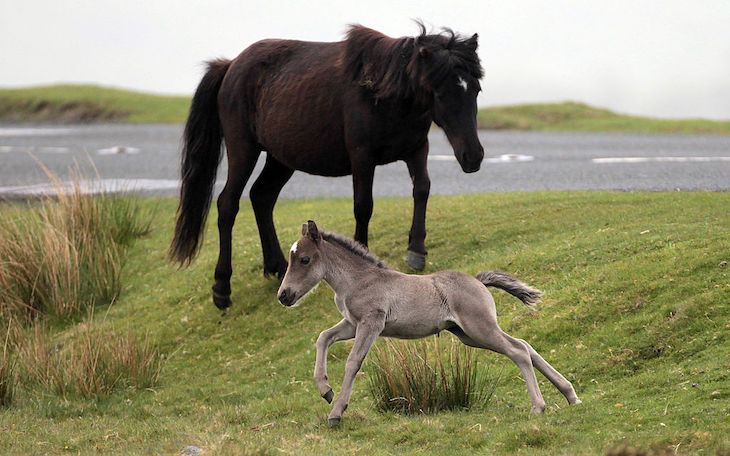
‘Rain squalls drifted across their russet face, and the heavy, slate-coloured clouds hung low over the landscape, trailing in grey wreaths down the sides of the fantastic hills.’ This was how Arthur Conan Doyle described Dartmoor following his visit in June 1901, and that was what I expected to find 125 years after his research for what would become The Hound Of The Baskervilles.
Those who live with Dartmoor Hill Ponies call them semi-wild, but the reality is more interesting
In its place, I found the bright, beautiful light of Devon in summer, revealing a landscape which is almost voluptuously organic, an excess of life, great trees and stones coated in rich mosses, criss-crossed with streams and rivers rushing into rapids. Suitably, I was shown Dartmoor by a pair of hounds I was tasked with caring for, Shelka, a blond German Shepherd who resembles a pretty white wolf, and her wildling daughter, Bolero, whose father was a Carpathian wolf-dog hybrid.
As we walked among the herds of sheep and cattle in that sunlit wilderness there was another, shyer, less civilised animal standing in small groups eyeing me and my lupo-canine companions. They intrigued both the horse-breeder in me and the former biology student. These are the semi-wild Dartmoor Hill Ponies. These creatures have lived here for thousands of years, but they are facing an existential threat thanks to Natural England, a quango that could consign these animals to history.
Those who live with Dartmoor Hill Ponies call them semi-wild, but the reality is more interesting: they arrived from 2,500 BC onwards with the Britons of the Bronze Age. Just as these Celts almost entirely replaced the Neolithic aboriginal people’s of the British Isles, so their horses took over from the vanishing population of wild indigenous horses.
Across the rest of the country, our first ancestors’ settlements were built over, their culture overwritten by Roman and Angle, Saxon and Jute, Viking and Norman – although with remarkably little genetic impact. Their most prized possession, horses, were fully genetically recoded by injections of Roman, Anglo-Saxon and Norse stock.

However, on Dartmoor, this isn’t what happened. As the climate changed from around 1,500 BC on, becoming cooler, wetter, stormier and with a rising water table, the land became untenably boggy. The people who had built the 5,000 ruined hut circles that remain today, simply upped and left. Some of their horses remained. These became the wild ponies of the moors where the River Dart rises, the most ancient and indigenous breeding population left in Britain today.
And these, as the owner of the dogs and one of the wild pony’s strongest supporters, Sophie Windsor Clive, explained to me, are what the paradoxically-named Natural England have elected to drive to the verge of extinction.
Natural England has effectively demanded that all livestock grazing on the moor is reduced substantially, by up to 75 per cent, to protect other habitats, plants and species. The government’s environmental quango claims that this will help protect the diversity of Dartmoor. It also insists that decisions about which animals graze on Dartmoor rests with individual landowners. But the wild ponies – of which there are about 900 – will inevitably pay the price.
What is their animus against the Dartmoor Hill Pony? As one would expect from a “non-departmental public body”, nothing at all: it isn’t personal. They have simply decided that the moors are being overgrazed and it is damaging biodiversity. And so, they are planning on reducing “grazing units”. That bureaucratic term bundles together 100,000 sheep with minor historical links to the land, 10,000 cattle with none, and fewer than a thousand of these hardy little equines. So, despite the hard scientific fact that horses, as non-ruminant, highly mobile grazers are infinitely better for biodiversity as opposed to the scorched earth approach to feeding of their even-toed distant cousins, it will be the unprofitable horses, who lack the lobby group support of everyone from the National Union of Farmers on down, who will suffer.
The thing that scares any true biologist are the numbers: with fewer than 1,000 ponies left on the moor, the combination of herd structure and breeding mathematics is already close to lethality. The real bottleneck with horses is stallions, not mares. Once you begin squeezing the number of active breeding males, you can push a population into long-term genetic narrowing astonishingly fast. Exmoor shows what happens afterwards: the animals survive, yes, but as a managed remnant population with obvious bottleneck signatures in the genetics.
Britain, in its infinite managerial wisdom, may now be in the process of destroying a most ancient and indigenous upland equine population
You do not immediately get five-legged foals and screaming deformity; you simply burn genetic capital quietly until one day you wake up and realise your “wild” pony is now effectively a conservation exhibit. It brings to mind the last thylacine, the so-called marsupial wolf which the Dingo replaced, who died alone in a zoo in 1936. Or the last aurochs, the truly wild ancestral cattle, who died alone in a Polish Royal forest in 1627. This is not because the animal is intrinsically doomed, but because bureaucratic tidying and agricultural lobbying are accidentally and nonchalantly shoving it over the edge.
So who can save the Dartmoor Hill Pony? The heads of the major political parties have all announced they will, because it is a costless and priceless vote winning statement to make which can be forgotten in time for the next news cycle. I would suggest another route.
In the early 20th century, when the then Prince of Wales, later King Edward VIII, began making the nascent sport of polo glamorous and popular, he decided to create a new type of pony for the game. He wanted to bring in Arabians for their speed and agility, but had to get them under the then required pony height limit and wanted more hardiness and stamina. So he cross bred them with Dartmoor Hill Ponies, and in doing so created the Dartmoor Pony official breed.
Our present Prince of Wales, like his father, is no stranger to polo or conservation, and is presently embarking on a host of environmental projects on Dartmoor as one of its largest landowners in his role as Duke of Cornwall. In fact, he is visiting one as I write. Perhaps, he would care to bring the Dartmoor Hill Pony under his protection as one of them. By which I do not mean the sensitive selection of Royal patronage between rival charities, or political interventions or even public corrections of bureaucratic crudeness. Instead, the minor addition of the distinguishing words “conservation” and “agricultural” before the phrase “grazing units” to denote horses as a different class to sheep and cattle, suggested to Natural England by Dartmoor’s largest landowner, the Duchy of Cornwall, preventing this unwarranted cull with the stroke of a pen.
For without such a Royal intervention, Britain, in its infinite managerial wisdom, may now be in the process of destroying a most ancient and indigenous upland horse population, and not because anyone hates them, but because the system cannot distinguish between a sheep, a cow and a living fragment of historical ecology.




Comments