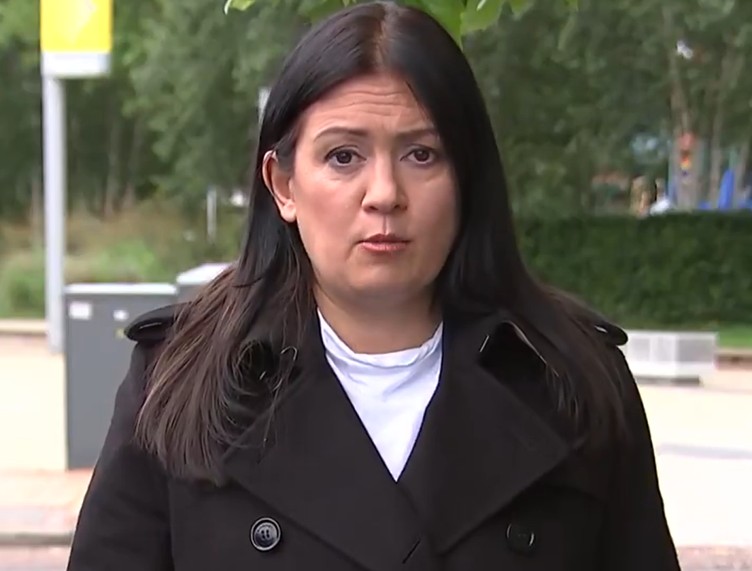
Lisa Nandy insists government will ‘meet that moment’ with defence budget
Keir Starmer’s premiership is now under enormous strain, after John Healey, the former Defence Secretary, resigned weeks before the Nato summit in Ankara. In his resignation letter, Healey said he could not ‘accept a defence investment plan… that does not give our forces the resources they need’. On Sky News this morning, Lisa Nandy, the Culture Secretary, told Wilfred Frost that new Defence Secretary Dan Jarvis would be taking his role ‘very seriously’, and that Starmer had asked the Cabinet to find cuts in their departments in order to find more money for defence. When asked to clarify if that meant Jarvis would be provided more money than had been offered to Healey, Nandy was evasive, but said the Government would be announcing higher spending when they publish their defence plan.
Nigel Farage claims the UK is anti-white
In his first Substack essay, Nigel Farage declared today that Britain is a ‘two tier state against white people’, and that a Reform government would ‘repeal the Equality Act’. On Sky News, Wilfred Frost asked Reform’s Suella Braverman, who had previously made claims about two tier policing while Home Secretary, why she had never said the country itself was ‘anti white’. Braverman said Reform are arguing that Britain’s institutions ‘treat white people less fairly than non-white people’, and that the purpose of scrapping the Equality Act is to create a country where everyone is treated ‘on meritocratic grounds’. She claimed that the justice system currently treats non-white people ‘less harshly’ than white people.
Suella Braverman: ‘It’s indefensible that this man was in the country’
Disturbing footage of a knife attack in Belfast on Monday led to multiple days of violent protest and disorder across the city, and subsequently an anti-racism rally on Saturday. The man charged with attempted murder is Hadi Alodid, who is originally from Sudan. Speaking to Suella Braverman, Wilfred Frost noted that Alodid had been granted asylum in the country through a fast-track scheme that came into effect while Braverman was Home Secretary. The scheme meant that Alodid did not have to go through face to face questioning in his application. Braverman said the man should ‘never have been granted asylum’, and claimed there are thousands of other ‘undocumented dangerous foreign men’ in the country. Frost asked if Bravermen took responsibility for it. Braverman said she had begged the Conservative government to leave the ECHR in order to ‘fix our borders’, and claimed she had been ‘blocked, undermined, and sidelined’.
Do the Conservatives’ plans for welfare cuts and defence spending add up?
In a letter to the prime minister (and his possible successors), Conservative leader Kemi Badenoch said it was ‘time to get serious’ with defence spending, and offered the support of Conservative MPs to deliver welfare cuts for an increased defence budget. On the BBC, Laura Kuenssberg pointed out to James Cartlidge, the Shadow Defence Secretary, that the Institute for Fiscal Studies has said Conservative plans to cut welfare and boost defence spending are on ‘shaky ground’. Cartlidge said the Conservatives had begun the process of working out how to get to 3 per cent of GDP on defence this parliament, whereas Labour only plan to reach that goal next parliament.
However, he admitted that his party don’t yet ‘have every aspect’ of how they would find the money. Cartlidge added that cutting welfare was about creating a ‘stronger country that’s more resilient’. Kuenssberg noted that the Conservatives’ ‘golden economic rule’, which requires half of any savings made to go towards reducing the deficit, means that the cuts outlined so far are ‘nowhere near’ enough for the defence target. Cartlidge insisted that it is possible to make the sort of savings required, and argued that it is essential to reduce the deficit to stop interest payments from spiralling.
Lisa Nandy: ‘There hasn’t been enough [social media] regulation’
The Government has been deliberating whether or not to introduce a social media ban for under-16s, following a consultation which came to a conclusion in May. Such a ban is in place in Australia, with mixed results. Speaking to Laura Kuenssberg, Lisa Nandy said she wouldn’t preempt the prime minister’s announcement, but revealed that most people in the consultation did support a ban, with some young people feeling they were ‘being pulled into something quite toxic’ by social media. Nandy said that the evidence from Australia shows that while some young people are able to get around the restrictions, the ban ‘changes the presumption’ that everyone will be on those apps, and that changes the culture of social media usage.



Comments