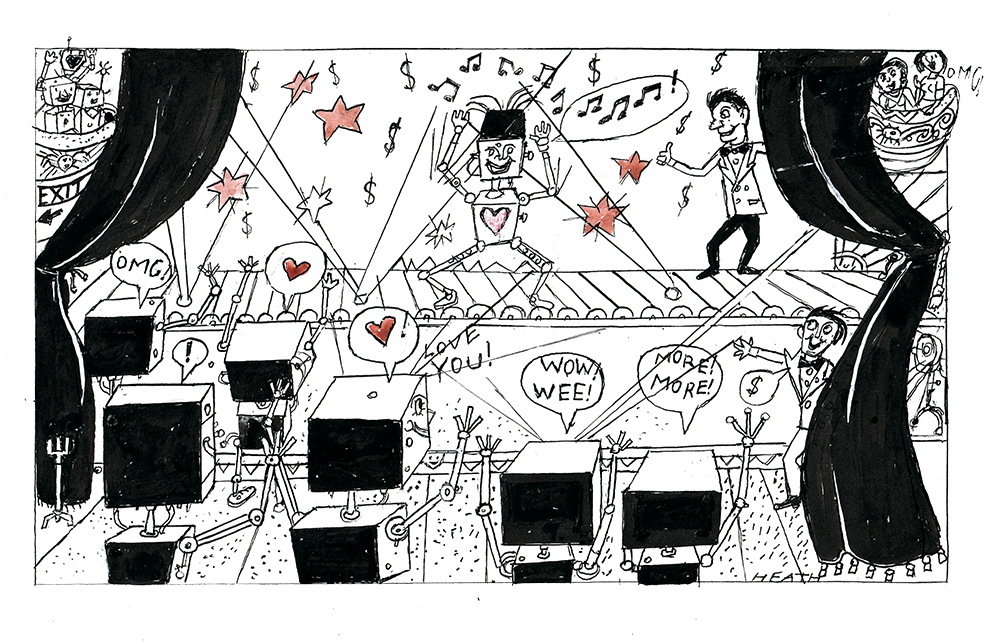
The true horror of how entirely AI-saturated our world has become was revealed to me earlier this month, when I was driving in the car with my mother-in-law. She had a new favorite singer she’s discovered on YouTube. She’d watched footage of this singer playing live concerts in large venues and wanted to know whether I could find her tickets to a gig. But to my confusion, more than 20 minutes of searching online brought up nothing in the way of a live event, though I have seen the videos myself.
It took a little while longer before I understood the truth: this popular singer had never actually performed any of her famous “live concerts” and, moreover, she had never actually been alive in any sense because she was a completely AI-generated performer.
My mother-in-law is not alone in being taken in. There’s a whole pantheon of entirely AI singers out there. One of the most popular is Eddie Dalton, an AI-generated blues musician who has racked up more than a million monthly listeners on Spotify. Eddie’s headshot suggests him to be a handsome, weary-looking middle-aged African-American singer, stylish in an old-fashioned way. The sort of man who’d wear a hat to church.
It turns out that Eddie Dalton is, in fact, only one year old: a soul singer with no soul at all
But it turns out Dalton is, in fact, only one year old: a soul singer with no soul at all. His most popular track, “Another Day Old,” has been played seven million times on the platform, and I personally could not tell much of a difference between “his” music and anything else you’d hear in a New Jersey dive bar. And unless they’re all bots themselves, most of Dalton’s fans still seem to be in the dark about his real age and status. Here’s a selection of comments under “Another Day Old”: “I’m 70… and this song speaks loudly to me! I thank God that I am still a purposeful piece in His magnificent design!”; “I really love this brother song them really made my day keep on singing brother God bless you thanks much appreciated”; “I love it, I’m 73 and having some issues, but the song picks me up, life is short and beautiful.” And it goes on.
In a piece about Eddie Dalton, the Washington Times said that he “is believed to be the work of Dallas Little, of Crusty Records, a content creator based in Greenville, South Carolina, who has been producing AI music and videos under a roster of fictional artist names.” The report goes on to name other acts linked to Crusty Records that are also suspected of being AI-generated – Cade Winslow and “Cody Crotchburn.” Cody Crotchburn!

Dalton may have taken in millions of humans around the world, but Cody seems to be an obvious AI joke. His hits include “She Loves My Butt,” “Ride Me Cowboy” and “We Ain’t Gay Today.” I was surprised the Washington Times seemed to take Crotchburn so seriously until I saw who wrote the report: “This article was constructed with the assistance of artificial intelligence.” A review of AI music written by AI – that about sums it up.
No music platform is free from AI music anymore, even if there’s no AI avatar pretending to sing it. Every day, countless numbers of AI-generated songs are uploaded to Spotify, the world’s largest music streaming service, and only a small minority of listeners can reliably sort the real from the fake. We all like to imagine we can, but most of us can’t. I can’t. AI-generated tracks appear on my playlist – and I am utterly unable to spot them, which is frustrating.
If you only want to listen to music from your childhood on Spotify, that’s probably still OK. You can stick to listening to the Beatles on repeat – at least we still know they’re real. (Well, apart from the conspiracy that Paul McCartney died in 1966 and MI5 replaced him with a lookalike.) But for anyone who likes discovering new artists through the recommendation algorithm, it’s frustrating and bewildering.
Ideally we’d want fully AI-generated music to be labeled as such, just as food packaging now warns you about additives and food dyes. But so far, detection software lags significantly behind AI. This is partly just the nature of the beast: AI content is built on a vast, appropriated treasure of all human creation, making it difficult to distinguish from the real thing because, well, it sort of is the real thing – just squished together and repurposed, cut and pasted in infinitely new ways.
Listeners might find themselves at a loss, but you can see who the winners are from the AI music boom. Although they might be hemorrhaging trust with their user bases, platforms such Spotify will no longer need to pay their human artists even the pittance they do now if most listeners are happy with AI-generated tracks instead. And just look at those comments still piling up under Eddie Dalton’s tracks. They sure seem happy.
Listeners might find themselves at a loss, but you can see who the winners are from the AI boom
In the end, it might make sense for human artists to join in the AI fun themselves: why not generate endless synthetic versions of the same well-loved music for a fanbase which wants nothing but reworked nostalgia forever and ever? The rapper Drake was recently in trouble with the estate of Tupac Shakur after using AI to generate an artificial version of the dead singer as part of a social media feud he had with a rival. Even Ozzy Osbourne is set to come back from the dead: his family announced the late Black Sabbath frontman will tour again in the form of a hologram. This uncanny mixed reality will only get more confusing.
Ye, the artist formerly known as Kanye West, recently said that there was no real way to stop AI’s transformation of the industry. He has even admitted that he has previously used the software in the writing and recording process – though two months ago he changed his mind again, cryptically announcing on X that his new album, Bully, may have once contained some AI but now, in fact, contains none – because he decided he hated it. It’s hard to tell whether it would matter for his career anyway. That single tweet garnered more than 34 million views. Ye’s fan base would probably listen to anything with his name attached to it, synthetic or not.
For less well-known rappers it’s a different picture. In a way, they’re more obviously vulnerable. Eminem famously studied dictionaries and thesauruses to have rhymes at his disposal. But any chatbot can instantly summon any number of words. So can AI write a good bar? Sort of. YouTube is already full of human vs AI battles, as well as completely generated ones involving Obi-Wan facing off against Anakin Skywalker. Yes, it’s good – and a little funny. But the novelty wears off. There are no real stakes here, no actual life stories retold in rhyme. It’s hard to see the point.
Although the flood of AI slop threatens both musicians and listeners’ individual ability to stay sane, I’m not actually pessimistic. Crusty Records has a tagline: “Progress isn’t the enemy – stagnation is.” And AI is, in the end, a form of progress – just another way of making music and not necessarily a replacement for human creatives.
Most anthropologists agree that music evolved as a kind of social adhesive, binding us together
Computers first beat a world-class human in an official chess tournament in 1997, but people still play (and indeed watch) the game, not only because the act of winning is intrinsically interesting, but because they’re vicariously inhabiting the mental world of its competitors. It doesn’t matter that machines can beat humans at any number of tasks; what’s interesting is watching a human play an exquisite move, or run really fast, or solve a Rubik’s Cube. More than the act of genius, it’s the human feeling that’s absorbing. We rejoice in a human victory and take sides during real human rivalry, feel for human singers when they pour their hearts out.
The reasons for this are locked deep inside our evolutionary history as a species. Most anthropologists agree that music evolved as a kind of social adhesive, an adaptation which helped bind us together into groups as soon as our primate ancestors got too numerous for the kinds of physical grooming which keeps chimpanzees and gorillas together.
With the adoption of singing and chanting, we stumbled upon a way to bond with each other – hence the power of religious hymns and patriotic songs that bring tears to our eyes and persuade us to die for our countries in pointless wars. Real music, composed by and sung by humans, is so deeply embedded in us that I can’t imagine it won’t find a way to thrive.
A few months ago I was in Thailand with my wife. As we sat in a café on Koh Phi Phi, I noticed a television playing country music on YouTube. During our meal – mango sticky rice – I mentioned that I thought the song was probably AI. Only after researching this current piece did I realize that it was indeed an AI-generated “musician” called Cain Walker, who has also racked up millions of views. But nobody in the café was actually listening to Cain Walker. He’s just background noise in massage parlors and overpriced cafés the world over.





Comments