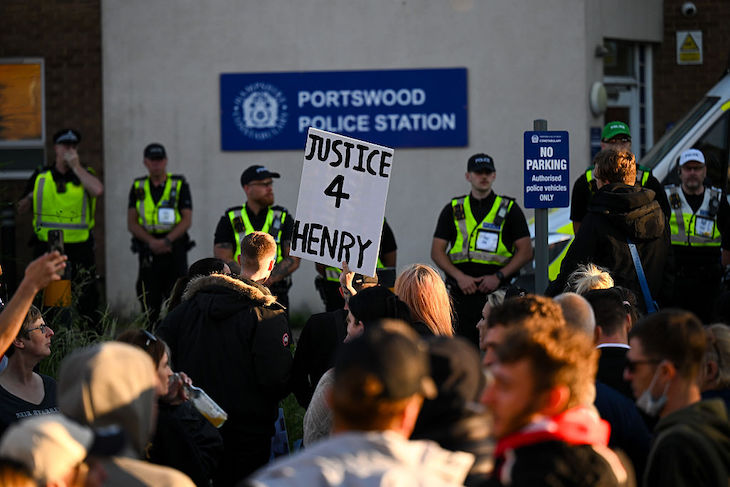


What has been remarkable about Henry Nowak’s case was not the story itself, tragic though it is, but the potency of it to spark public anxiety. The anxiety is born of an in-built and nascent popular resistance to the idea that certain groups, the victims of unconscious bias, need special consideration in order to counteract that potential disadvantage.
The expression ‘two-tier’ has in the Nowak case been applied to policing, but the principle is more general, and lies behind (for instance) campaigns to nudge public attitudes (and sometimes public policy) towards the disabled, older jobseekers, plus a ‘group’ which in fact comprises half of us: women. You can call it positive discrimination.
I’ve been unable to make myself watch the bodycam footage of the moments before Nowak’s death. An inquiry is under way and we can expect the story to resurface. It has become a catalyst for a wider public debate on the application of positive discrimination to policing: so called ‘two-tier’ policing.
Two-tier policing may be a reality, but I remain to be persuaded that the immediate police response following the deadly attack on Nowak was, in fact, a case of it. It was night, there were at least two claimed witnesses to the incident, and it was they who had called the emergency services. Even if they had been white, I’m not sure the police would at first have chosen to disbelieve them. Nor is it obvious that if Nowak had been black, officers would have been quicker to notice he was dying. In a murky and confused situation, the police got the massively wrong end of the stick, and it seems to me quite possible that this whole thing was a ghastly blunder that could have occurred whatever the skin colour of those involved.
But from the point of view of public policy, there’s a sense in which the facts of this particular case do not matter. One police misjudgment may or may not prove to be a good example of something undoubtedly causing wide and deep disquiet in our country – but when the tinder is dry, any spark will ignite.
Never overlook the importance of how a claimed happening – true or false – catches the spotlight. In this case, disquiet about positive discrimination is what has been lit up.
Ever since the first Race Relations Act of 1965 and the succession of amendments that led to the Race Relations (Amendment) Act of 2000, there has hovered a great un-resolved question about race relations and the law. Should the law and officers of the state see only the individual, or the group too? In order to combat discrimination against a group, should any arm of the state be empowered to discriminate in their favour?
Many readers will respond with an unqualified ‘no’. Others will feel sure the answer is ‘yes’. Both sides, though, seem to think there’s a question of principle here, to which a clear yes or no needs to be given.
I disagree. There’s no issue of principle. But any two-tier approach – positive discrimination’ – needs to be handled very, very carefully. Its ability to turn rancid, especially when wielded by public authorities, is acute.
The moment you make two-tiering a stated policy, codified in rules or regulation, you generate resentment
We all, in fact, believe in positive discrimination. Imagine you have two children of equal intelligence. One is breezily confident and undismayed by slights or setbacks. The other lacks that confidence, and is thin-skinned and easily discouraged. Would you not, as a parent, take special care to praise and help the child whose confidence needed lifting? As a schoolteacher, would you not devote ‘disproportionate’ time and attention to a child in danger of getting left behind?
Of course you would. And although the state cannot usually see individuals, it can sometimes identify groups in danger of disfavour, disrespect or isolation, and nudge public servants to be mindful of that, and compensate.
There’s nothing intrinsically ‘left-’ or ‘right-’wing about this. When I used to moderate Conservative candidate selection meetings, the party was clear we needed more women in parliament, and to that end rigged the process to get more women onto shortlists for selection. Undoubtedly a case of positive discrimination, it was controversial at the time. But far fewer women than men had been seeing themselves as potential MPs, and local Tory associations had been markedly less inclined to see women as potential candidates; and a push the other way was needed. This was two-tier candidate selection. It worked. I must report, though (and older readers will remember) that the policy encountered serious resistance from party members, from some male would-be candidates, and even from some female MPs worried that women beneficiaries might be thought second-class because the path into parliament had been made easier for them.
Two-tiering can work at every level, from the parenting of an overly timid sibling to a boss’s determination to see that a disabled employee gets extra consideration in the workplace. But in all these cases the decision to operate the strategy will be ad-hoc, private and undisclosed: taken by an individual with autonomy, and seldom advertised or open to challenge. The moment, however, that you make two-tiering a stated policy, codified in law, regulation or party rules, you begin to generate resentment. People’s idea of fairness kicks in.
In apartheid South Africa, statutory job reservation met massive international outrage. In South America, the indigenous minority has for centuries suffered from a milder form, quietly imposed by the Latin majority and unremarked: two-tier hiring. But you will not find a word of this in statute.
Historically, the Sikh community has worked hard to earn respect, and argued patiently for the exemptions their religion affords them in (for instance) the workplace or on motorbikes. Now they face the danger of public tolerance being kicked away through the perceived misapplication of some official, clumsily worded police advice.
I’m afraid the advice for the two-tiering of which we approve and that of which we don’t is the same. Don’t write it down.





Comments