I am sitting in the Ottoman courtyard at Ruin Adalya in the old town of Antalya, drinking a tulip glass of black sweet tea and munching near-perfect baklava, and twenty feet beneath me the Romans are still there. That is to say, the Ottoman courtyard is paved with Lycian limestone but sections of it are now made of glass, and through the glass I can see the old Roman road.
Which, as metaphorical launchpads go, will do very nicely. Yes, Antalya has, as many Brits know, fine beaches, serious resorts, agreeably cheap food and wine, and the odd Roman temple. But the history of this stretch of Mediterranean coast goes back further than that, and deeper, so much deeper. And I want to trace that extraordinary depth.
First, though, I tour Antalya itself, which suffers a drab, outlying sprawl, but boasts a lovable medieval core with a dainty, restaurant-lined marina (try the sea bass after your meze). Best of all is the view from its clifftop gardens, across a glittery deep-blue Mediterranean to the shining ice-peaked Taurus mountains. This view is so absurdly lovely you can see why a classical king, in search of paradise, chose this place to build. It looks like Cadaques crossed with Lake Como, yet with the call to prayer as a soundtrack. I’d happily linger here for hours, with a jug of freshly squeezed, deliciously tart pomegranate juice, but I have those layers to descend.
Half an hour east: the ancient city of Perge. Mythically founded in the twelfth century BC by Greeks returning from the Trojan War, various Macedonians, Hittites and Romans all built and worshipped here, even as Perge’s Hellenistic mathematicians defined the ellipse and the parabola. The center of Perge’s main street is still dominated by a sequence of basins which were once a parade of majestic fountains, fed by a stream at the top of the hill. It is arguably more impressive, in terms of domestic planning, than anything built in Britain since about 1910. Then the river silted up, the Arab raiders came, and by the thirteenth century Perge was a ghost of a place, on its sun-blessed plain.
On to Aspendos, where the acoustics of Turkey’s best-preserved classical theatre are so miraculous that an emperor up in the best seats is said to have sold his daughter to the architect – after hearing him whisper from the stage. If you can, catch a concert here by moonlight. Then it’s on to Side, pronounced See-day, where the ruins tumble to the sea, like a tipsy Pompeii on spring break in Florida. The seafront is a touch touristique; this is where you buy your Atatürk T-shirts and evil eye ornaments. My advice: skip the tat and eat fresh grilled octopus at Orfoz, as you watch slightly richer people drinking the same aperitifs on their yachts.
Next day we head west, through gloriously pristine coastal forests (it’s a national park); and this is where history really begins to deepen. Our destination is hushed, delicate Phaselis, another Greek town – but this time nested on a promontory between three turquoise coves and defended by dark stands of Turkish pine. Here you can picnic by 3000-year-old shops, and dive into pure clear waters from the temple steps of Apollo. Indeed, you should do exactly that.
The ruins tumble to the sea, like a tipsy Pompeii on spring break
Some of the marble is inscribed with refined Hellenic capitals. A few, tantalizingly, show traces of Luwian script, the non-Indo-European language of the Hittites. It is said Alexander the Great passed by here in 333 BC. Apparently, he was persuaded by the beauty of the place, or the lavish gifts of dried fish, to pass by peacefully. Less peaceful was Alexander’s assault in the nearby hills, on a city called Termessos by the scholars, and “Turkey’s Machu Picchu” by the influencers. Can it possibly live up to its billing?
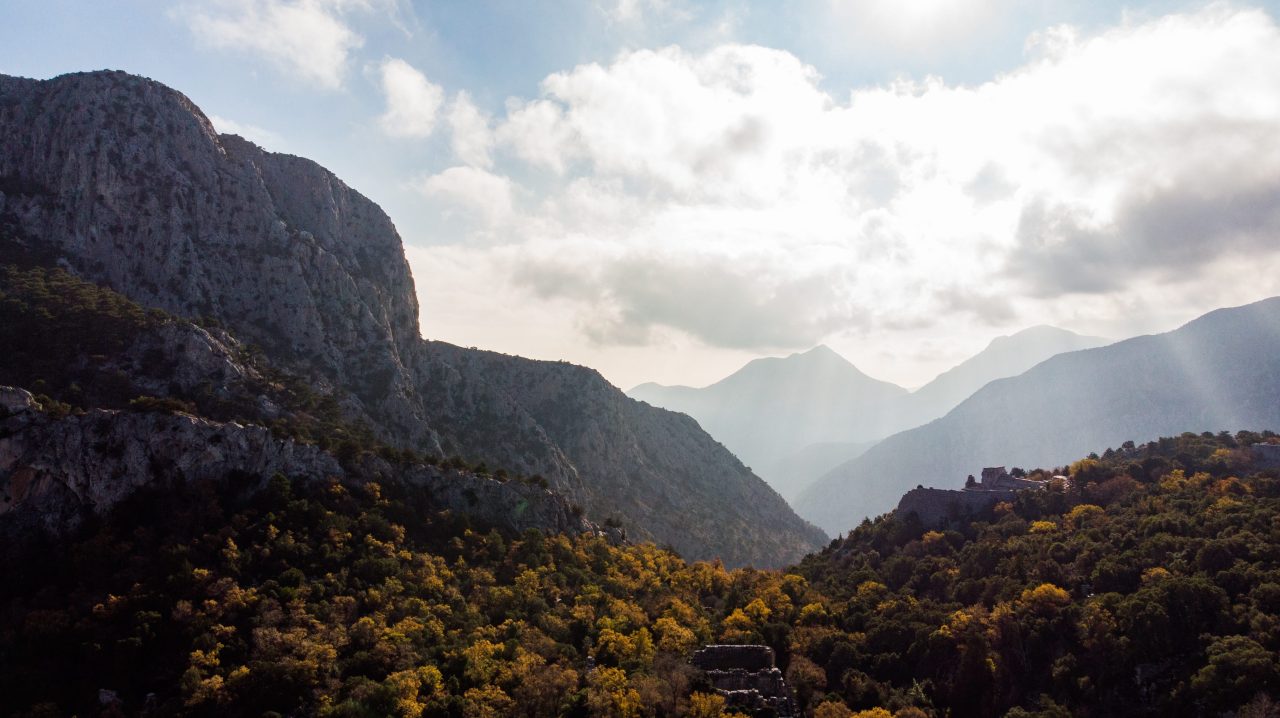
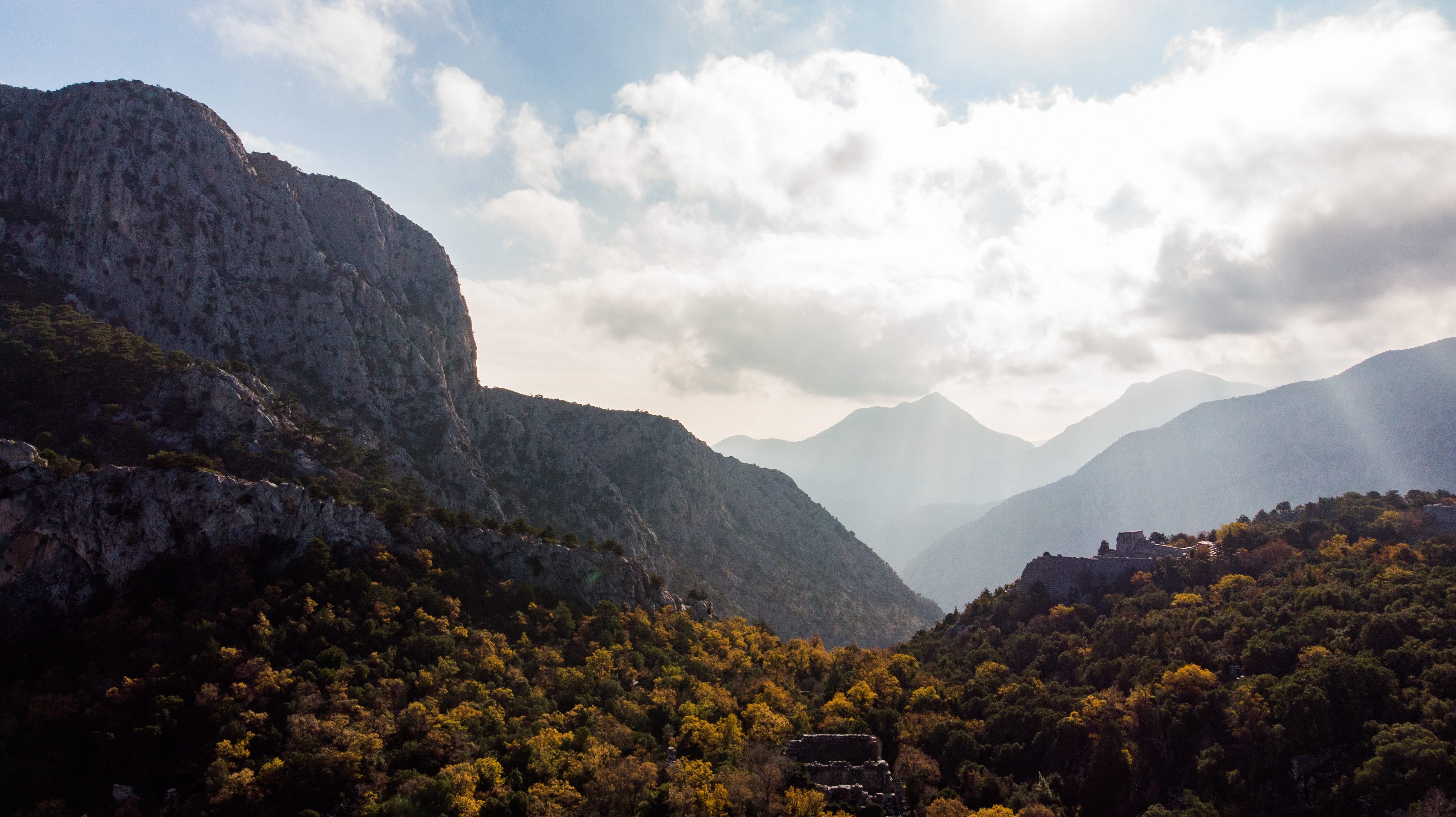
Yes, it can. The approach is the first of the marvels. After ogling the broken sepulchers of the faintly eerie necropolis, we climb through baked limestone hills, up a narrow if idyllic valley which is the only way in or out, and which famously defied Alexander’s army (after attempting a siege, he left without a victory, cursing it as an “eagle’s nest”).
Now we climb still further, past woods that thicken, and a light that sharpens, and just as I am beginning to think, “surely there can’t be anything up here,” I round a shoulder of rock and there it is: a grand classical city, complete with city walls, and monumental gates, and streets of toppled pillars, and enormous cisterns sunk into the rock, capable of holding 1,500 liquid tons of rainwater, because up here there was almost no natural water.
And then, finally, the theater. To call it the greatest-located theater on earth sounds like mad hyperbole, until you climb to the top tier of its four thousand stone seats, and turn around. The theater-stage faces somber and sacred Mount Solymeus, and this stage is cut straight into the cliff edge, so that the whole auditorium seems to float in mid-air among the peaks. Machu Picchu, indeed.
For a thousand years Termessos flourished in these airy summits, but then, in the fifth century AD, the water supply faltered, as earthquakes shattered the aqueducts, and cracked the cisterns, and now, apart from the odd gaggle of intrepid tourists, it is largely left to the circling eagles. We have time for one last lunch stop. Lost in the hills we halt at a scruffy and brilliant taverna with a glazed terrace surveying the forests, and we order excellent goat stew and superbly charred warm pide bread and saucers of spicy atom, that simple miracle of yogurt with chili, along with a bottle or two of cold Cankaya white: dry, fine and mineral. Which is a cheering reminder that Turkey now makes excellent wine.
This would, in fact, be a perfect place to end. With wine, goat and still warm flat bread, plus the greatest ancient theater on earth. What more can you ask? But there is another destination, back down towards the coast, and it changes the scale of everything. It is called Karain Cave, and you’ll find it high up a cliff, above the olive groves – from where you can see the distant power stations of Antalya. Hornets thrum obsessively at the yawning black cave entrance; a mask of Cybele, carved by ancient Greeks, also leers fiendishly at the threshold. Perhaps it is all meant to be off-putting. If so, it hasn’t worked, because people have been coming in here for at least half a million years.
Yes. Half a million years. Perge is 2500 years old; Termessos, somewhat older. But Karain has seen five hundred thousand years of continuous human occupation; indeed Karain cave is so old the humans were not all the same species. The cave has yielded evidence of at least three hominids: Homo erectus, Homo neanderthalensis, and Homo sapiens. It has also given up bones of hippopotamus, giraffe, elephant, cave bear, and lion. On top of all that it contains some of the Med’s earliest evidence for the controlled use of fire. People lit blazes in this cave, visibly blackening the cave ceiling, at a time when there were still elephants outside it.
Even more wildly, it is now thought that at least two of those hominid species overlapped. In other words, Neanderthals and modern humans probably subsisted in this same cave at the same time. The Neanderthals then died out; humans went on to dominate the planet. But before the dying species vanished, it gave something of itself to us. Every non-African human alive today carries a few per cent of Neanderthal DNA, likely exchanged in Karain, and places like it. What did those genes mean for us? The use of language? Tolerance of cold? A certain cast of mind?
Science suggests that the couplings were mainly between brawny, heavy-set, large-brained Neanderthal males and smaller, more gracile, more “feminine” Homo sapiens females. The mind boggles at the implications of this. Were the couplings rape, or were they consensual? Were there intensely awkward conversations about errant wives? We will probably never know. But there is no doubt the fucking happened, and the genes were passed, and here we are.
The day is dying; Karain is darkening. Above me, dozens of cavern bats wheel and squeal, gray and barely visible, like tiny maniacal ghosts. They shriek in apparent anger, as if to say: the humans have been here long enough, it is time to go.
And so, we go. Down the mountain, past the blessed fountains of Perge, past the silent temples of Phaselis, past the grandiose theater at Aspendos, towards sweet pink cocktails by the sea.
Sean Thomas was a guest of the Turkish Tourism Board (www.goturkiye.com)



Comments