
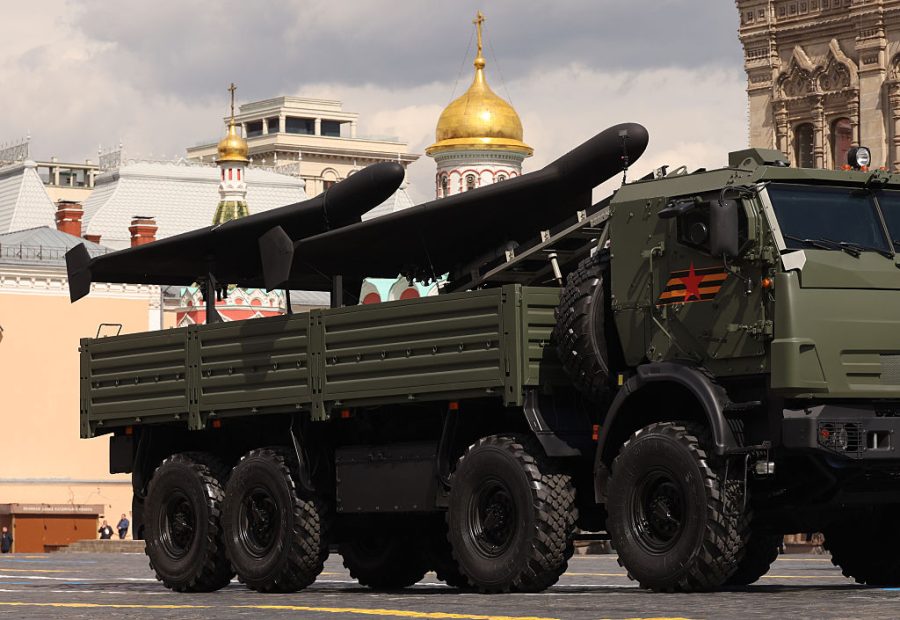
Earlier this week, Ukraine was subjected to one of the largest aerial assaults by Russia since the start of Vladimir Putin’s invasion over four years ago. Overnight from Monday into Tuesday, Russia sent 73 missiles and 656 drones into Ukraine, killing at least 21 and injuring dozens across the country.
According to the Russian Ministry of Defense, this strike was retaliation for a Ukrainian attack on a vocational school in the occupied region of Luhansk on May 22. But, as the Kremlin’s war grinds on well into its fifth year, it also appears to signal a step change in how the Russian armed forces are choosing to fight.
Data published by the Russian Federal Statistics Service has revealed that the Russian aircraft sector – responsible for producing both manned military aircraft and unmanned aerial vehicles (UAVs) – is booming. Output in the industry increased 117 percent in April (the month for which the latest numbers are available) compared to the year before, with a growth spike of 78 percent in the first four months of this year alone.
Russia has, in other words, drastically expanded its domestic drone production in the past year. According to the Ukrainian armed forces chief Oleksandr Syrskyi, Russia is planning to manufacture 7.3 million first-person view drones and 7.8 million warheads for unmanned aerial vehicles of various types by the end of the year. If the aircraft sector meets these targets, that would equate to producing 20,000 new drones a day.
The use of drones has fundamentally changed the nature of the conflict between Russia and Ukraine
To match this boom in production, the Russian military has been on an intensive recruitment drive since late last year. Last November, a separate new branch of the armed forces dedicated solely to drone warfare – the Unmanned Systems Forces (VBS) – was founded by Moscow.
Intended to operate on land, air and sea, the VBS is already estimated to number nearly 120,000 active personnel, with reported plans to grow to 230,000 troops by 2030. According to Russian Ministry of Defense information accidentally published by several regional authorities, the Kremlin’s aim appears to be to recruit 78,800 people into the VBS this year, suggesting an end-of-year target of approximately 160,000 soldiers.
In the last few years, the use of drones has fundamentally changed the nature of the conflict between Russia and Ukraine. The appeal is obvious: drones are cheap and easy to produce at scale compared to other types of weaponry and munitions. They make strikes deep behind enemy lines easier and less fraught with jeopardy for the soldiers carrying out the attack. On the other hand, frequent drone attacks by both sides have also made the clustering of troops, vehicles or weaponry on the receiving end of strikes very risky on the battlefield.
As earlier this week has shown, Moscow has also been using drones to target Ukraine’s critical and civilian infrastructure in an effort to tank the population’s morale and inflict maximum damage on the country. Ukrainians were, for example, forced to endure much of the past winter without heating or electricity after Russia deliberately targeted heat and power plants across the country.
But while this new focus by the Kremlin on drone warfare might at first glance suggest that the Russian war machine is going from strength to strength, the reality seems rather different. The concentration on drone warfare actually appears symptomatic of wider problems Russia is experiencing in this war, both domestically and on the front line.
The context of this pivot to cheap drone production is a cooling off in the defense sector more broadly. Despite the Kremlin having moved the majority of the Russian economy to a war footing, the defense industry currently faces acute labor shortages as well as state funding restrictions.
On Monday, it was reported that Putin has actually been warned by senior government officials that the current level of projected defense expenditure is unaffordable for the country. The Russian president was reportedly told that if current spending levels continue, the state budget deficit will grow to unmanageable levels. Putin instructed officials to find budget cuts in other departments before curtailing defense spending.
Neither are young Russian men willingly skipping to join the VBS. Reports have emerged that the Russian authorities have, since the start of the year, been enforcing quotas requiring universities and colleges to recruit at least 2 percent of their students into the new unmanned forces as contract soldiers.
At least 200 universities across the country are believed to have been issued this diktat to essentially press-gang young men into joining the VBS for at least a year. Official data suggests there are approximately 2.2 million men enrolled at Russian universities at the moment, meaning that, at least theoretically, 44,000 new recruits could be found for the VBS this way.
At the end of May, GCHQ chief Anne Keast-Butler revealed in a speech that they had “new intelligence showing that almost half a million Russian soldiers have now been killed since the conflict began” in 2022. Yesterday, on a trip to Kyiv, NATO Secretary-General Mark Rutte confirmed that Russian losses on the front line are believed to exceed 30,000 per month: “This means losing more men in one month than the Soviet Union did in ten years in the 1980s in Afghanistan.”
Addressing Russian recruits directly, Rutte warned that those signing up were being sold a “raw deal,” lacking training and provided with “substandard equipment.” “There is a very high chance you’ll die or be wounded while you’re out there – and odds are that if you are wounded, you’ll be left to suffer in the mud and die.”
Rutte’s words were designed to shock – but he’s not wrong. With the Kremlin war machine under increasing economic and manpower pressure, however, his words are unlikely to make much difference to those Russians who read or hear them. It will take more than this to break the system forcing young university students into flying drones on the Russian front line.






Comments