
It takes a lot to ruin a state as lovely as California, and just as much to ruin the state’s largest city, Los Angeles. But left-wing Democrats have been up to that important task, backed by voters who have willingly endorsed their own downfall.
Those voters and their contemporaries in Portland, Seattle, Minneapolis, Chicago, New York and Boston are like the fraternity pledges who bend over for a spanking during “initiation week.” The voters, like the fraternity pledges, have consistently responded: “Yes, sir! May I have another?” It hasn’t been hard to find left-wing candidates, many of them openly socialist, who are more than willing to administer the punishment.

What about citizens who are tired of being whacked? They have voted with their feet – and their pocketbooks. They have left those cities and states in droves. They are tired of homeless druggies in the parks, fed up with police and courts that refuse to punish criminals, and sick of costly schools that deliver lousy results and serve mainly as cash cows for public-sector unions.
Those problems and more are painfully obvious across “blue” cities and states. They are certainly visible in California and its largest city. Those problems were the central question for voters in yesterday’s primaries. Did they want to do anything about these failing public policies?
Voters really faced three options: move further left, move right, or opt for more of the same. For governor, for example, the top candidates were Tom Steyer (move left), Steve Hilton (move right), and Xavier Becerra (more of the same). Los Angeles voters were offered a similar menu. For their next mayor they could choose between Nithya Raman (move left), Spencer Pratt (move right), and incumbent Mayor Karen Bass (more of the same).
In both races, the preliminary results are that the runoffs will pit “more of the same” against “move right.”
Why are the results still preliminary so long after the polls closed? The answer is not just sluggish counting. It’s state law. California has hundreds of thousands of mail-in ballots and state laws requires counting those ballots if they were mailed on or before Election Day, even if they arrive up to a week later.
That’s not the only possible delay. If the vote totals are very close, election officials are given time to “remedy” ballots that are poorly marked. The results, predictably, are slow. Right now, the state has just declared that Harry Truman defeated Thomas Dewey.
Despite these slow, complicated procedures, we can now be pretty sure that the gubernatorial runoff will pit Xavier Becerra, a former official in President Biden’s cabinet, against Steve Hilton, an English immigrant and former commentator on Fox News.
The governor’s slot was wide open because the incumbent Gavin Newsom is term-limited. Some 60 Democrats jumped in. Two prominent Republicans joined them. They all vied together for two run-off spots in a “jungle primary,” where candidates from both parties compete on a single ballot.
Most of those candidates were marginal; a few prominent ones, notably Eric Swalwell, melted down; and Becerra emerged as a safe, establishment choice among Democrats. Hilton ran a very competent race, highlighting the state’s policy failures, and emerged in second place, even though he’s a Republican in a “deep blue” state. Democratic candidates received far more votes, but they were divided among lots of candidates. Steyer, who spent lavishly from his personal fortune, run a far-left campaign and finished third. Becerra is the heavy favorite in the runoff.
The preliminary results are that the runoffs will pit ‘more of the same’ against ‘move right’
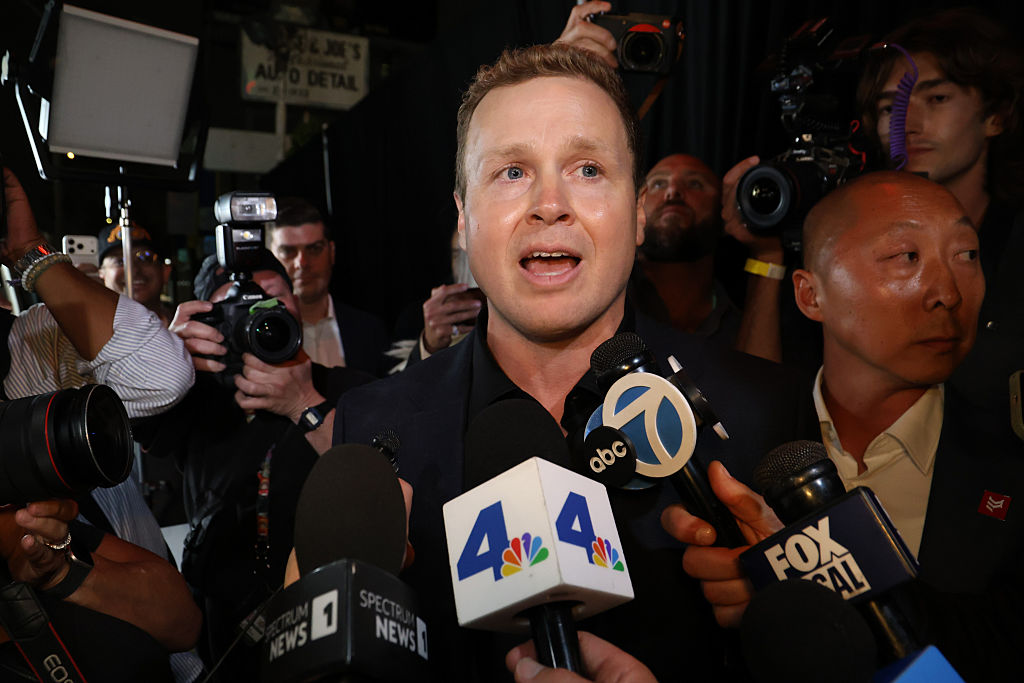
The story in Los Angeles is not that the incumbent mayor finished first, or that most voters still voted against her. (Her failure to win 50 percent of the vote is why there’s will be a runoff.) It’s not that the left-wing vote was split between Bass and her close friend, Raman. It’s that Spencer Pratt ran the most innovative campaign in modern politics. His AI-generated videos, many produced by volunteers, were amazingly effective at highlighting Los Angeles’s troubles and laying them at the feet of Karen Bass. The second round of Pratt’s videos sent the message, “Don’t worry about the reputational cost of voting for a Republican. A lot of your friends and neighbors will be voting for Spencer Pratt, too. They just don’t want to say it out loud.” Turns out, he was right. A lot of them did vote for Pratt.
Those votes make it very likely Pratt will face off against Bass for mayor. The key to victory will be turning out partisan voters and capturing Ramen’s supporters. Are they mostly far-left or do they just want something different from today’s failing policies?
It’s amazing that Pratt, a Republican, has any chance at all in such a heavily Democratic city. His survival is a testament to a truly innovative campaign, designed to capitalize on the city’s genuine problems.
Despite the great AI videos, Pratt is still a long shot. But his campaign hasn’t just shaken up California politics. It has hacked a path for future campaigns across the country. They will take a lesson from Pratt and his techie supporters. They will rely on effective, low-cost videos made thanks to California’s most successful export: the high-technology coming out of Silicon Valley.





Comments