
It takes a moment to grasp what I am watching. A cluster of bodies underwater, each pair on opposite sides of a chessboard which sits at the bottom of the pool. They float horizontally and peer down at the board through their goggles. The player to move presses upwards repeatedly with his palms, as if hyping up an imaginary crowd, but actually resisting the buoyancy that would return him to the surface. He reaches down, makes his move, and rises to the surface to take a breath. The pieces are magnetic, lest they float away, and the captured pieces are discarded in a small metal tray.
This is the world championship of Diving Chess, held last month in Tarnowo Podgórne, in Poland. Paulius Pultinevicius, a 24-year-old Lithuanian grandmaster, is its new champion thanks to a crucial win against Indian grandmaster Harshit Raja (see below). The quirky event has been taking place for 14 years, with a slowly growing following, though the concept has even older roots. On his ‘Chess Notes’ website, the historian Edward Winter records the announcement by John E. Almond of San Francisco of the ‘very first world under-water chess championship’, published in CHESS magazine in September 1958.
It seems plausible that the ongoing tradition of playing chess at the Széchenyi Bath in Budapest may date back even further, since it was built in 1913. But there, in keeping with the ambience, games are conducted at a more languid pace. Nobody is fighting buoyancy. The iconic photos show suntanned gentlemen convening for leisurely games, standing chest deep in the water with their boards set atop a stone table, while the water steams gently in the background.
Chess has an established affinity for these unlikely contrasts – witness the peculiar phenomenon of chess-boxing, which dates back to 2003 and appears to have an enduring niche appeal. Competitors alternate between short timed rounds of boxing with making moves on the board. As Mike Tyson put it: ‘Everyone has a plan until they get punched in the face’.
In a rather elegant way, diving chess dispenses with the need for a timer altogether. Players can take as long as they wish, but they must make a move before they come up for air.
Harshit Raja-Paulius Pultinevicius
Diving Chess World Championship, May 2026
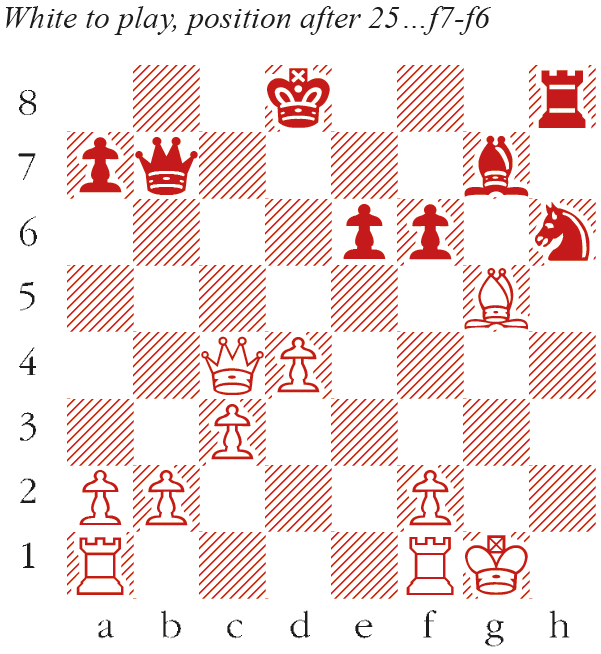
1 e4 c6 2 Nf3 d5 3 Nc3 dxe4 4 Nxe4 Nf6 5 Qe2 Bg4 5…Nbd7 6 Nd6 mate is an amusing trap. 6 h3 Bh5 7 Nxf6+ gxf6 8 g4 Bg6 9 d3 Nd7 10 Bg2 e6 11 O-O Bg7 12 Bf4 Qe7 13 Nh4 f5 14 Nxg6 hxg6 15 c3 Nf6 16 Be5 fxg4 17 hxg4 O-O-O 18 d4 Rh4 19 Bg3 Nxg4 Pultinevicius must have feared 19…Rxg4 20 Qe5, but 20…Kd7 is a surprisingly adequate defence, e.g. 21 Qc7+ Ke8, or 21 Bf3 Ne8! and the rook escapes to g5, with advantage. 20 Bxc6! Much stronger than grabbing the rook on h4. Now if 20…bxc6 21 Qa6+ Kd7 22 Qxa7+ Ke8 23 Qxe7+ Kxe7 24 Bxh4+ wins easily. Rdh8 21 Bg2 Nh6 22 Qc4+ Kd8 23 Bxb7 Qxb7 24 Bxh4+ g5 25 Bxg5+ f6 (see diagram) 26 Bxh6?? Spoiling an excellent game. 26 d5! fxg5 27 dxe6 followed by Ra1-d1+ would very likely have decided matters. Rxh6 The counterattack comes swiftly. 27 d5 Rg6+ 28 Kh2 Bf8! 29 Qh4 Rh6 30 Qxh6 Bxh6 31 dxe6 Bf4+ 32 Kg1 Qg7+ 33 Kh1 Qh7+ 34 Kg2 Qe4+ 35 f3 Qg6+ 36 Kf2 Qc2+ White resigns






Comments