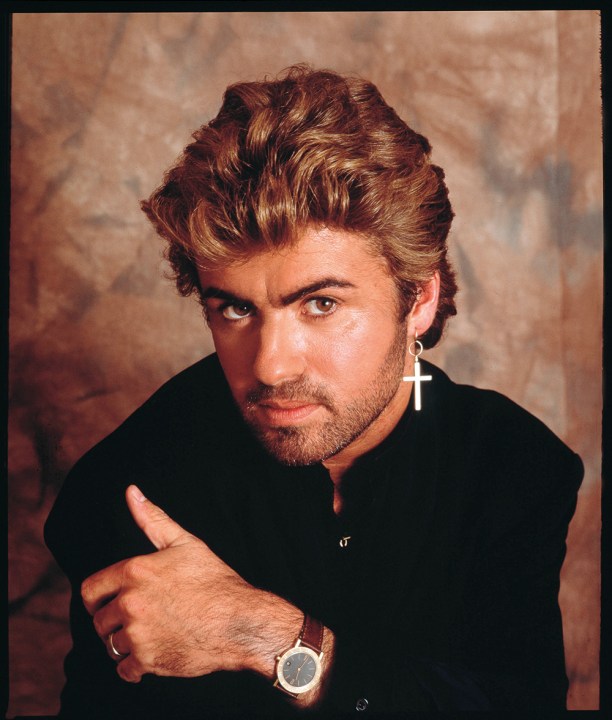
It turns out that the writer Sathnam Sanghera, ‘The Boy with the Topknot’, has been a besotted George Michael fan since the age of eight, when he started listening to his older sisters’ Wham! records. This was an unusual thing to be as a Sikh growing up in Wolverhampton and it got him teased at school. But he stuck with it. So when a friend suggested that he write something fun to compensate for the years of heavy historical research he’d put into his excellent book Empireland, he decided to set off on a sort of pilgrimage in search of his dead hero.
First stop was Mondial Cars, a showroom in Northwood, north London, which used to be the Bel Air restaurant, where the teenage Michael worked as a DJ. Sanghera takes the bus there, because it was on this bus route that Michael wrote his first great hit, ‘Careless Whisper’, aged 17, in 1981. When the car salesman asks Sanghera what he is looking for – presumably hoping it’s a new car – Sanghera launches into his own pitch about the wonders of George Michael and the origins of ‘Careless Whisper’. He goes on so long that the salesman starts glancing at his watch, remembering he has to ring another customer.
Sanghera never met Michael, though there were a couple of occasions when he might have. He also chickened out of meeting the singer’s father. But he talked at length to Andrew Ridgeley. In Wham! days, Ridgeley was always the extrovert, the party animal; now, according to Sanghera, ‘you’ll struggle to find a more cautious, circumspect, carefully dressed, fitness-obsessed middle-aged man’. The one record he released after Wham! was a flop and he then pretty much disappeared from public view. He could live on his Wham! royalties and that was enough.
Sanghera also interviewed Michael’s early manager, Simon Napier-Bell, who told him about the control freakery:
George had a way of making anyone who worked for him feel permanently, underlyingly apprehensive. You didn’t have to be at the same dinner table or in the same office or even on the same continent. Everyone who worked for him felt the same thing – a permanent frisson of tension in the air.
One of his backing band recalled that, at rehearsals,
he would keep the band on the stage for eight, nine hours while he went through stuff that didn’t necessarily involve us… what the lights should be doing and how the backdrop should work. If something didn’t work, he’d be slamming into people: get it right or get off.
He was so notorious for his perfectionism that ‘Never work with children, animals or George Michael’ became a mantra in the industry.
Michael once said that he went straight from school to being a pop star, ‘which isn’t real’. He tried to keep things real by employing a childhood friend, David Austin, as his assistant and never hiring bodyguards or domestic staff. He opened his own front door and parked his car on the street. But he confessed that he spent an entire year wearing sunglasses because he couldn’t bear to make eye contact with strangers. And he also admitted that one of the reasons he liked cruising was that it gave him a chance to meet ordinary people, which he never normally did.
Michael was officially outed when he was arrested by an undercover cop on 7 April 1998 for performing a ‘lewd act’ in a public toilet in Will Rogers Memorial Park, Los Angeles. He was charged under his real name, Georgios Kyriacos Panayiotou, which meant the press didn’t twig immediately, so he had time to tell his father (who was supportive) and prepare for the coming media storm. Then it was headlines such as ‘Zip Me Up Before You Go Go’ and a ton of homophobic abuse.
He refused to be apologetic. He admitted his behaviour had been stupid, but ‘I won’t even say it was the first time it ever happened.’ He even joked about it, writing on his 35th birthday invitations: ‘Go to the bathroom before you come as all conveniences will be locked to protect the host.’ Eighteen months later he released his brilliant album Outside, which Pete Paphides described as ‘a dazzling disco screw-you to every homophobe who suggested that George Michael needed to beg forgiveness for anything’. It was a hit in the UK and Europe, but got little air play in the US, where he was effectively cancelled.
Years later he said he wished he’d come out much earlier, and thinks he’d have been a happier man if he had. In fact he was already going to gay clubs when he was in Wham!, but for many years he was confused about his sexuality and only fell for men who were married or otherwise unavailable. His first great love was Anselmo Feleppa, a Brazilian fashion designer whom he met while performing at Rock in Rio in 1991: ‘I was happier than I’ve ever been in my life.’ But Feleppa developed Aids – and Michael nursed him till his death. His longest relationship was with the art dealer Kenny Goss, but he had already finished with Goss by the time he died. He was found dead in bed on Christmas Day 2016 by his then partner Fadi Fawaz. The initial inquest was inconclusive, but a later one found that he had died of natural causes – ‘dilated cardiomyopathy with myocarditis and fatty liver’, probably intensified by substance abuse.
‘If something didn’t work, he’d be slamming into people: get it right or get off’
Sanghera leaves discussion of Michael’s drug addiction to the penultimate chapter. But surely it explains a great swathe of his career. He always admitted to using marijuana, and even smoked it on camera, though he told the Guardian in 2009 that he’d ‘cut down from 25 spliffs a day to just seven or eight’. But in the last decade of his life he was repeatedly found in possession of a much stronger drug, GHB, which could explain the many occasions that he was found asleep at the wheel of his car. He was involved in countless traffic accidents and was given a five-year ban from driving, and jailed for eight weeks, in 2010. (My house is just down the hill from his in Highgate and when we found a line of parked cars all smashed up, someone immediately said: ‘Oh George Michael’s been down again.’) He was always in denial about his drug use, and was furious when Elton John tried to help him, saying: ‘Elton just needs to shut his mouth and get on with his own life.’
Sanghera refers to ‘the intermittent crisis I’ve been having about my George Michael fandom for a year and a half now. Not for the first time I wonder why I’m taking so much time out of my professional life for this topic.’ Quite. But then the singer attracted some unlikely fans. Our esteemed editor Michael Gove performed Wham Rap! on camera in 2015. I think what this book is really about is Sanghera finally getting over his crush and even coming to dislike Michael. He mentions that in the course of writing, he got engaged for the first time, in his forties, to a woman who had barely heard of George Michael. I wonder what his therapist had to say about that? Anyway, it all adds to the general delightful weirdness of this nerdy, passionate, extra-ordinary book.

Comments