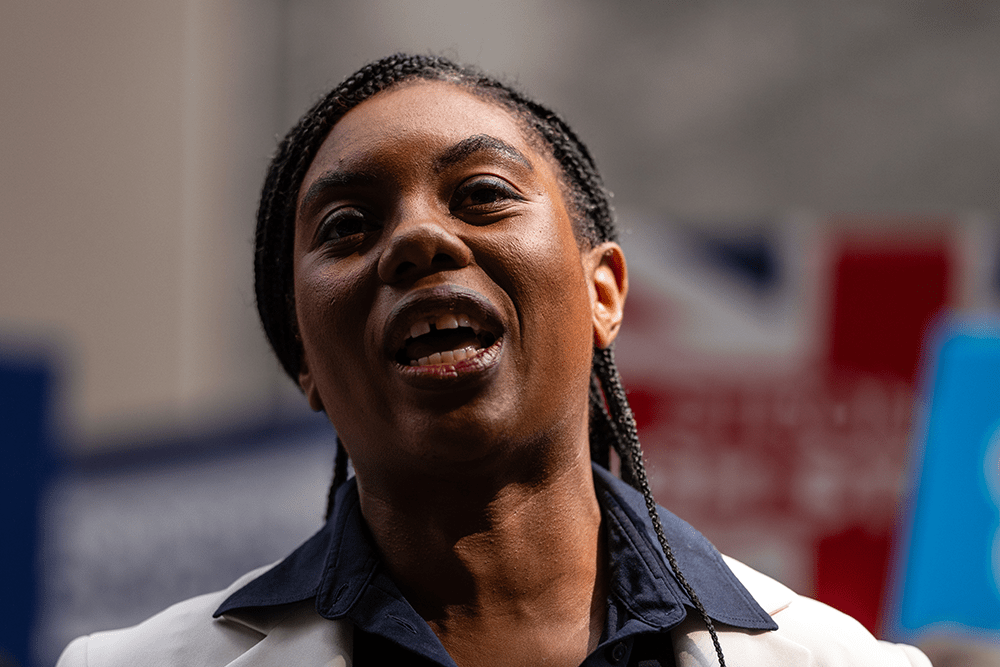


Instinct matters in politics. Overthink and you can underperform. Try to box too clever and you get punched in the mouth by an opponent who trusts their own unrestrained judgment. Kemi Badenoch’s newfound popularity within her party is the result of trusting her instincts. The Tory leader is finding that no argument is as persuasive as being herself.
Ahead of the King’s Speech debate, Badenoch had worked hard on a script with some well-honed attack points. But the most memorable line was unscripted. When Wes Streeting, still yet to resign as health secretary, rolled his eyes at one of her points, she replied: ‘There’s no point in him giving me dirty looks – we all know what he’s been up to…’ Cue laughter even from the Labour benches as the minister plotting his ascent was smacked down.
The revival in Badenoch’s popularity, and Tory morale, has been long in the making. This time last year, she was written off as a lost cause. Keir Starmer’s missteps on winter fuel payments and grooming gangs had left him wide open to attack. But Badenoch was nowhere to be seen.
Badenoch is now more popular than Starmer or Farage. The problem is that the Tory brand is still tarnished
Instead, she had made the strategic, albeit controversial, decision to spend her first year developing policy away from the limelight. The belief was that rushed announcements would either be overtaken by events or prove unable to withstand scrutiny. In the absence of a clear Tory campaign against a weak and ineffective Prime Minister, Nigel Farage was able to fill the void.
Those who work closely with Badenoch insist the ‘Kemi factor’ has always been there. She is a straight-talking, sassy andsteadfast politician, a natural performer from the opposition despatch box. Her problem has been the legacy of past Conservative governments, in which net migration soared, the military was starved of funding and the welfare bill ballooned. Badenoch’s emergence in her own right, her allies always argued, was going to take time.
By last October’s Tory conference, much of Westminster had concluded that the event would be her last. She had run out of time. But the conference became what her allies describe as the first of three turning points in her career: the moment ‘the commentators woke up’. Her set-piece speech on the final day made people think: ‘Maybe she can do this.’ Talk of a leadership challenge ‘all but disappeared’, according to another ally. In the speech, she pledged to leave the ECHR, scrap net zero and abolish stamp duty – and was able, finally, to ‘define herself as the new leader’.

The second turning point was her response to Rachel Reeves’s Budget in November. Badenoch accused the Chancellor of ‘wallowing in self-pity’ and being ‘spineless, shameless and completely aimless’. Reeves had been seen earlier that year crying in the Commons, and allies of the Chancellor said she had been the victim of sexist briefings. Badenoch’s criticism was unusually harsh: ‘Let me explain to the Chancellor, woman to woman, that people out there are not complaining because she is female – they are complaining because she is utterly incompetent.’ Her dissection of Reeves was clipped and viewed millions of times on social media.
‘It was very personal against Rachel,’ a Tory insider said, ‘but I think that caught the imagination of the country.’ Another party source said: ‘Ever since the Budget, people have been taking a different look at her and saying, “OK, well, sometimes I don’t agree with what she says, but I know she’s not doing a politician’s answer, I know she’s not bullshitting.”’
Badenoch’s third turning point came in January with Robert Jenrick. After learning of her former rival’s plans to defect to Reform, she decided to get ahead of the story and publicly fire him via an online video. ‘I think the reason people identified so strongly with that video was because she was acting decisively,’ an ally said. ‘Everyone has had a colleague like Robert Jenrick or has had to deal with somebody like that.’
Badenoch has refined her PMQs strategy, having learnt to trust her instincts. She dismissed earlier advice to act as a ‘barrister in a courtroom’, concluding that the weekly spectacle is a ‘performance’ and that she needs to put on a show. Badenoch writes around 90 per cent of her own gags – though her best remarks, like the Streeting line, are unscripted. ‘She doesn’t like repeating other people’s jokes,’ one insider tells me. ‘She always wants to be authentic.’
Badenoch is now more popular than Starmer, Farage and Zack Polanski. Her problem is that the Tory brand is still tarnished. ‘Words associated with Badenoch include “a leader” and “intelligent”,’ says the pollster Scarlett Maguire. ‘However, she has not yet managed to turn around the Conservative party brand. Just 25 per cent of adults say their view of the Conservatives has improved since the last election, and only 29 per cent say that the Conservatives can turn things around and win the next election.’
Team Badenoch has discussed a shadow cabinet reshuffle but concluded that nobody knows who former ‘big beasts’ such as Priti Patel or Mel Stride are anyway. Moving them aside for those untainted by the Tory record would be pointless. There has also been discussion of a rebrand, including a logo change. That too has been dismissed – for now. ‘The party itself is changing,’ an insidersays, ‘but people have to feel like it’s changed before you change the branding, because otherwise it’ll just be cosmetic.’
Almost no one within the party now talks about replacing her as leader. There is a recognition that she is performing well and seems to be enjoying herself. Badenoch has found her groove. The task ahead is convincing the public that her party has too.




Comments