


Forgive the doom-mongering, but the US, and especially the UK, may be dangerously on course for a sovereign debt crisis. Yet debt and deficits play a surprisingly minimal role in our countries’ politics. Overspending on borrowed money hardly featured in either nation’s elections of 2024.
Last week, a Labour MP hoping for Andy Burnham to challenge Keir Starmer for her party’s leadership told Times Radio that investors would see the UK as ‘the best place to be’ if only the government pursued ‘progressive policies that do speak to our communities’. She added darkly, ‘The markets will have to get into line’ – which was like brandishing a sabre at the heavens and threatening that the weather ‘will have to get into line’… or else! And when has a hedge fund manager ever opted to buy a strapped country’s bonds because its ‘progressive policies speak to its communities’? Meanwhile, conspicuously failing to get into line, in view of a Labour government’s prospective lurch further left, the yield on 30-year gilts jumped from 5.65 per cent to 5.85, the highest in 28 years. Britain had already been paying more to borrow than any other G7 country.

Why does debt and the cost of servicing it never seem to play a part in elections? I’ve theories. These stories concern numbers, and many voters are either outright innumerate or simply bored by arithmetic. Numbers aren’t easy to capture in pictures, and these days it’s video that packs a political punch. Bankrupting debt is a nonpartisan problem in partisan times; the issue scores no points for your team. The culprits behind unmanageable interest payments are many. Villains belong to both traditionally major parties and arguably include the voters themselves, making finger-pointing unsatisfying. Spending beyond one’s means produces irksomely mommy-ish, old-fashioned lessons. The over half of households that are net recipients of taxation think sovereign debt is a problem for the ‘rich’. Most of all, a debt crisis seems abstract. Few voters can conjure a picture of what happens to them personally when their government goes broke.
So what scenario are we talking about? Perhaps outright default: your government cannot cover its obligations, and investors won’t keep loaning to a deadbeat that won’t return their money. Alternatively, a debt spiral, whereby the government keeps escalating the funds it borrows simply to pay the interest on the funds it’s already borrowed, which makes bond-buyers demand even higher interest to compensate for the risk, so the government borrows even more to pay the interest, after which bond-buyers demand even higher interest… You get the idea. Famously, the UK last had a debt crisis in 1976, but today the IMF hasn’t enough money to bail out the UK a second time.
When your government can’t cover its bills, you can’t cover yours. Think ‘affordability’ is bad now? Just wait
What does a debt crisis mean for ordinary people? Because both the US and UK control their own currencies, in a fiscal emergency either central bank will doubtless run the printing presses overtime. Inflation, then – lots of it. This will seem like soaring prices but will in truth be evidence of a rotting currency. Wages lag inflation. Next, we get a wage-price spiral. The cost of imports soars: in the UK, not only of Italian olive oil, but of most fruit, half the vegetables, pork, even butter. When your government can’t cover its bills, you can’t cover yours. Think ‘affordability’ is bad now? Just wait.
Because Britain now imports 44 per cent of its energy, one thing Brits can’t afford is heat. Elderly parents freeze to death. You slip into public libraries to charge your phone. Traffic clears up, as few Londoners can afford to drive, but cycling in the capital is dangerous and unbearable because everyone is on two wheels in swarms.
Savings rapidly become worthless. Pensions implode and cannot pay out. Mortgage rates are hiked. Can’t meet the payments? Your house is repossessed. Banks won’t loan to individuals or businesses. So if you don’t own a house to lose, you can’t buy one either. A pity, because the real estate market has tanked, and you might otherwise have picked up a bargain.
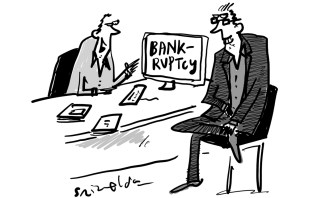
Bring on massive layoffs – for once in not only the private but also the public sector, so no one’s job is safe, pretty much whatever you do. For at a certain point, ‘unsustainable’ government spending isn’t, um, sustained. A long overdue cull of the civil service might be a rare upside to this scenario – except that we’d also cull teachers, nurses and police officers, who’d get far stingier out-of-work benefits, on which it becomes challenging to survive. Grown children with no prospects and those with any assets the state hasn’t seized yet leave the country.
Healthcare funding is cut (Americans’ also: despite their aversion to ‘socialised medicine’, about half of US healthcare expenditure is covered by the government), meaning even longer NHS queues and denial of access to expensive cancer drugs. Historically, citizens of countries that go into receivership have seen life expectancy reduced by over a year.
Infrastructure investment dries up. Britain’s pothole problem goes third world; American bridges collapse. All arts funding evaporates: bye-bye, National Theatre. Benefits are tightened; no more free money for being worried (perhaps one other upside). Taxes rise even higher; multiple businesses go belly-up. Crime worsens, and at last people are shoplifting because they truly can’t feed their families.
Sounds fun? During the fiscal year to March, Labour borrowed £132 billion, of which an astonishing £110 billion went to debt interest. In 2025, the US borrowed more than $2 trillion, half of which, nearly a fifth of the federal budget, went to debt interest. So let’s quit the hankie-twisting over a climate we don’t control, nix net zero, and vote any party whose reps lecture the market to ‘get into line’ permanently out of office.




Comments