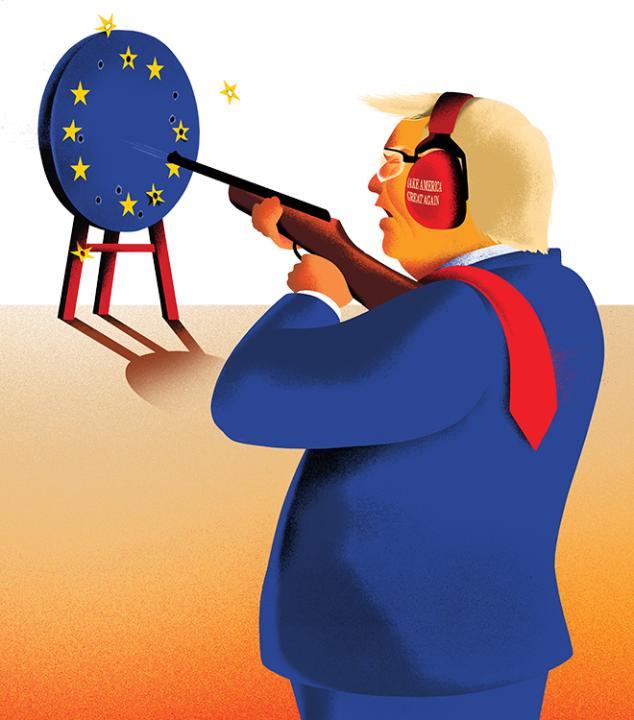


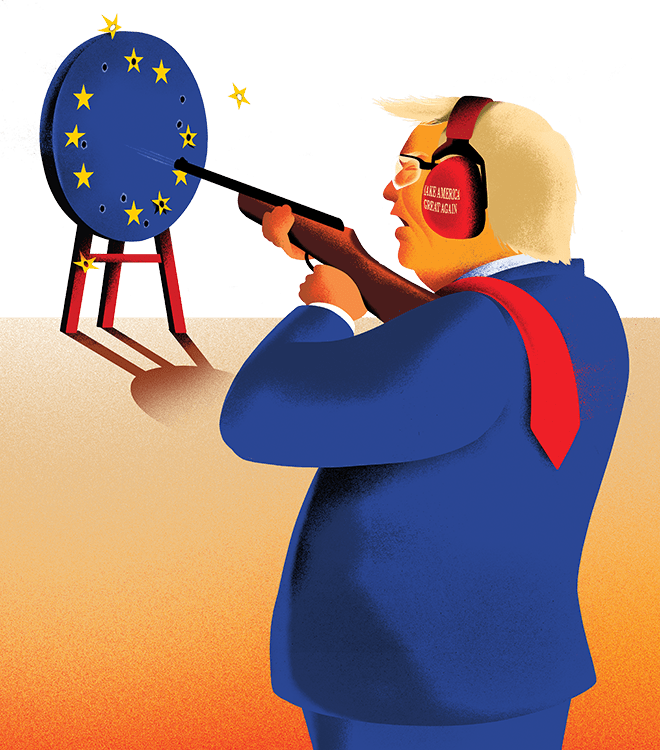
German Chancellor Friedrich Merz suggests to a classroom full of youngsters that Donald Trump has been “humiliated” by his war in Iran – and the President cancels deployment of the long-range missile systems around which Germany had planned its defense strategy for the coming decades. Spanish Prime Minister Pedro Sánchez observes a strict neutrality on Iran, declaring his country’s bases out of bounds – and Trump urges Spain be kicked out of NATO. British Prime Minister Keir Starmer hesitates to sacrifice his country’s navy in a war on which he wasn’t consulted – and Trump mocks him in public for a week. No casual observer of the Atlantic alliance in the 18 months since Donald Trump returned to power would believe his White House thinks of Europe as the bedrock of American military and economic security.
But, strangely, it does.
Two factors have combined to make a disaster of the transatlantic relationship. The first is psychiatric. Donald Trump lacks the mental discipline to do what he thinks he is best at: cut deals. The second is world-historic. The Europeans have long been restless. Declaring their independence from an overbearing and arbitrary ally is a project of decades’ standing. This is particularly true of those politicians keen to suck the vitality out of Europe’s historic nations in order to build up a European Union with its capital in Brussels. Right now, the temporary, tactical danger that Trump poses is driving Europeans toward the more permanent, strategic danger that Brussels poses.
There is a delusion at the heart of the EU. Its leaders believe that they played a huge part in saving Western civilization during the Cold War (which is quite true) and that they did so by constructing the EU (which is demonstrably false, since the Maastricht Treaty which established the Union was not even passed until years after the Cold War had ended). As the Trump administration sees it, NATO’s victory was a real achievement of nation states; the EU is an academic utopia that serves no one except the politicians who run it. Even when Trump is baying at the moon, he gets the better of this particular argument.
The Europeans wanted to base their collective defense on ‘shared democratic values’
The rupture can be described in another way. J.D. Vance laid out the basic Trumpian project at the Munich security conference in 2025: protecting the West against invasion, political correctness and electoral corruption. Vance’s speech horrified NATO’s leaders. In a recent essay, two policy analysts at the German Marshall Fund, Jackson Janes and Markus Ziener, explained why: it sounded like Washington was offering alliance members “a civilizational club based on shared ancestry,” whereas the Europeans wanted to base their collective defense on “shared democratic values.”
These are notes that Brussels has been sounding for a long time. They’re not sufficient to explain the present impasse, or any sustained disagreement. “Values” is just a name for ideology. Asked to choose between an ideology and a civilization, most free people would choose the civilization. That’s how the West won the Cold War: our civilization beat their ideology. Civilizations are bigger than values. What’s more, it’s okay if they’re based on shared ancestry. The North Atlantic Treaty Organization is not a World Treaty Organization – though it has, at its most irresponsible, behaved like one. The “North Atlantic” in its name reflected that the United States understood itself as a displaced European civilization.
That began to change with President Lyndon Johnson’s immigration reforms in the mid-1960s, which repudiated European identity. Johnson called the ethnic criteria in US immigration policy “a cruel and enduring wrong in the conduct of the American Nation.” As LBJ saw it, “The land flourished because it was fed from so many sources.” That’s a misunderstanding, although you can see what he’s getting at. The land flourished because it was originally fed by the one particular current of European civilization – 18th-century English Whiggery – that was genuinely open to the commercially minded and hard-working people of all nations.
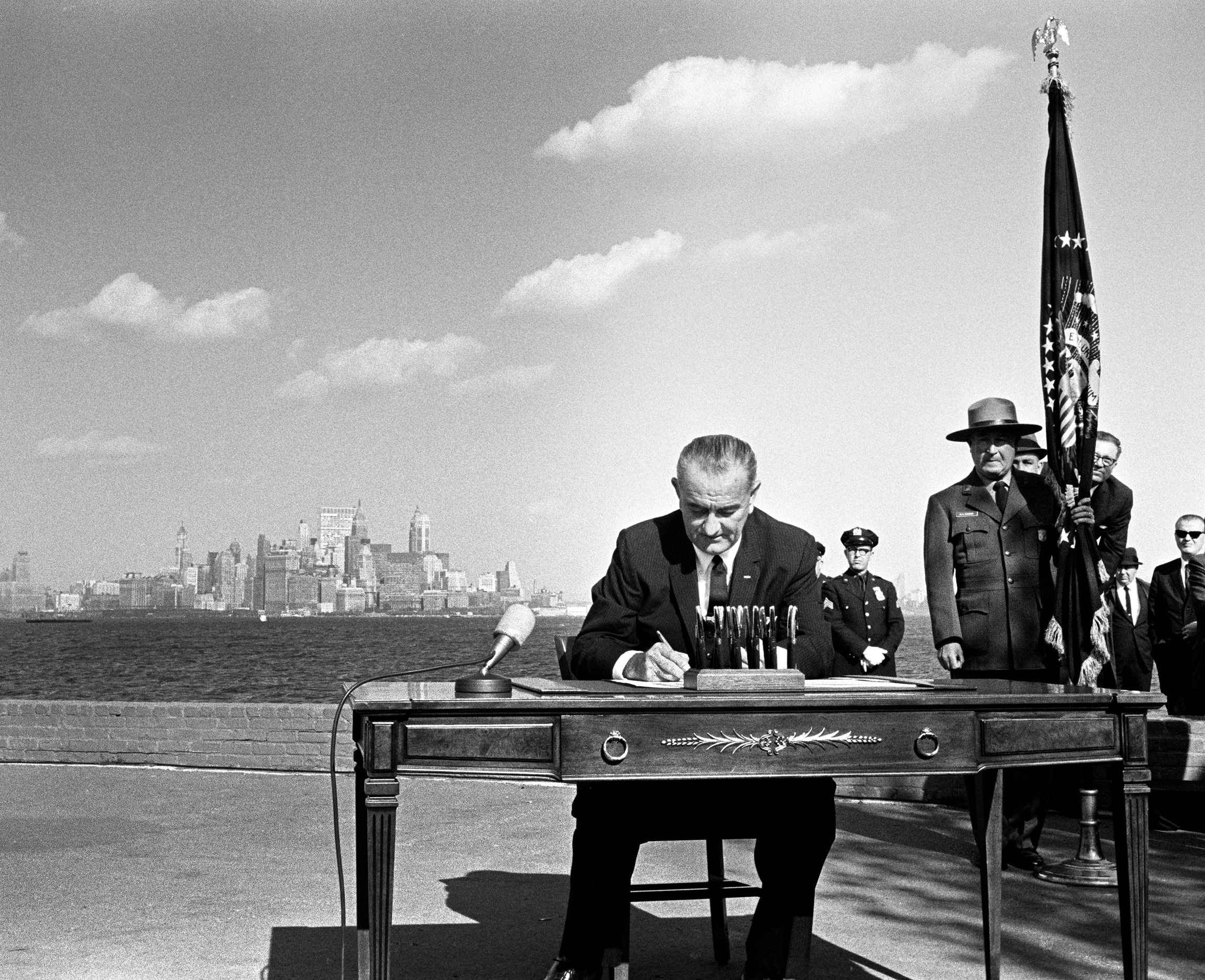
The neutral national identity LBJ proposed was not popular. Indirectly, it brought Donald Trump to power in 2016. Europeans don’t like “values”-based migration policies either. Trump’s electoral insurrection was similar to the one Britain underwent earlier this month in its local elections. From the two council seats it had won in 2022, the anti-immigration Reform party saw its representation increase to 1,454, bringing a collapse in the two establishment parties. Old-school parties on the continent are not faring much better, with Merz in Germany polling at historic lows. The Alternative for Germany may well capitalize on Trump’s Iran blunder to take power in Sachsen-Anhalt next September.

Europe, moreover, is mercurial. One of the great mysteries of modern diplomacy is how European leaders, reluctant warriors back when Joe Biden was trying to rally them to the defense of Ukraine against Russia in early 2022, have become a band of Rambos. At their summits, they vent their rage that Trump will not do more for Kyiv. They have a formal, propagandistic name for what Russia did to Ukraine, which they almost never deviate from. They call it the “full-scale invasion” – as if invading Ukraine were something Russians do to some extent every day.
Ukraine is mostly a pretext. The seismic lurch away from consensus and toward coercion did not come out of the blue in February of 2022. After the Cold War, tremendous opportunities fell to the entire West. The United States began budgeting for a global-empire-sized role, not a regional-hegemon-sized one. It was Bill Clinton, not Vladimir Putin, who reintroduced the European continent to interstate warfare for the first time since 1945, with a 1999 bombardment of Belgrade that aimed to wrest Kosovo from the hands of Christian Orthodox Serbia and deliver it to Muslim Albania. Western European peoples weren’t clamoring for that. Americans couldn’t find the Balkans on the map. Congress, pressed by Clinton to approve the operation, refused. But there was a class of establishment politicians and intellectuals who were well served by such empire-building.
Today it is the Baltic countries that are the most gung-ho for the ruthless prosecution of the Ukraine war. Not out of national interest: It does not make sense for Estonia, which has fewer people than Maine, to provoke and insult Russia across their common border. But it may make sense for Estonia’s politicians, like the EU’s top diplomat Kaja Kallas. Whenever defense matters come up, Estonia is not a pipsqueak country but a co-equal member of NATO and the EU, and Estonia’s leaders are the peers of Merz and Starmer and Macron. The Ukraine war has brought about this “Balticization” on a larger scale – a way for Merz and Starmer and Macron to pass themselves off as Trump and Xi.
It might have worked had Trump been an ordinary negotiator. But, in Janes and Ziener’s memorable phrase, the President has turned the United States into a “subscription-based security provider.” And even that oversells what Trump is offering. Who would be fool enough to make any deal with him at all? He threatens the people he negotiates with. He forgets his promises before he leaves the negotiating table. When he remembers them, he reneges on them.
The world is thus in a period of acute danger. But to say that the danger is acute is to say that it will pass. There is no sizable constituency for Trump’s non-stop adventurism. No American expected it from him, and nobody likes it now that he’s doing it. The raid to abduct Nicolás Maduro and his wife from Caracas, for all Trump’s prideful boasting, did not move his popularity ratings in the slightest. Iran has cost Trump not just his popularity but his presidency. And should he decide to further rough up a Cuba that he is trying to starve into reform, no one outside of South Florida will thank him for it.
The President has turned the United States into a ‘subscription-based security provider’
In the future, Americans will likely repress their memory of Trump – even those who think of him as a necessary corrective to a period of decadence and drift. It was one of Trump’s most steadfast defenders, the classicist Victor Davis Hanson, who in his book The Case for Trump (2019) laid out the most likely account of what the president’s long-term position in the hearts of his country will be. Americans will be embarrassed by the crudity and corruption they had to ignore in the course of putting things back on the right track, and will not want it called up as a precedent. So they will purge him from memory, the way the townspeople forget their reliance on their deadly protector in the old Western movie Shane. It’s not unlike what Spain did with Franco or Chile with Pinochet. The Euro-American divergence in “values” may heal on its own, making evident that “civilization” was what mattered all along.
Eventually the European Union will have to face up to a paradox that has been central to its construction. Europe has historically been great as a collection of fractious sovereign states. It is not great as a confederation dedicated to upholding bureaucratic mush. If it is to have a single purpose, yes, someone must lead it. But there is too much sibling rivalry among its nations to permit any of them to lead from within. It can only be led from without, the way Christianity did for centuries of strife and glory, or the way the United States did in the Cold War, with results that, one must admit, look ever more equivocal.






Comments