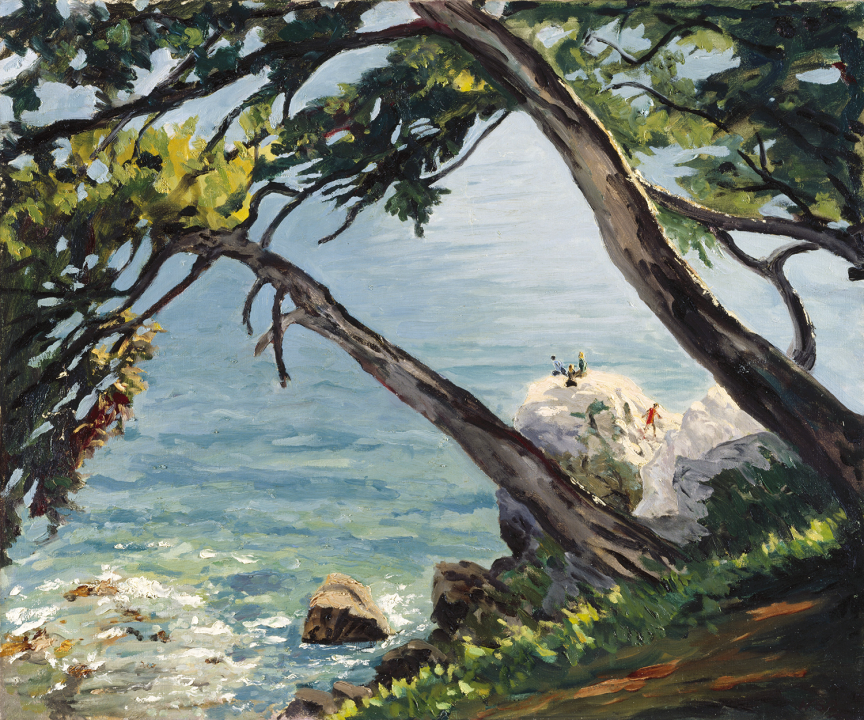
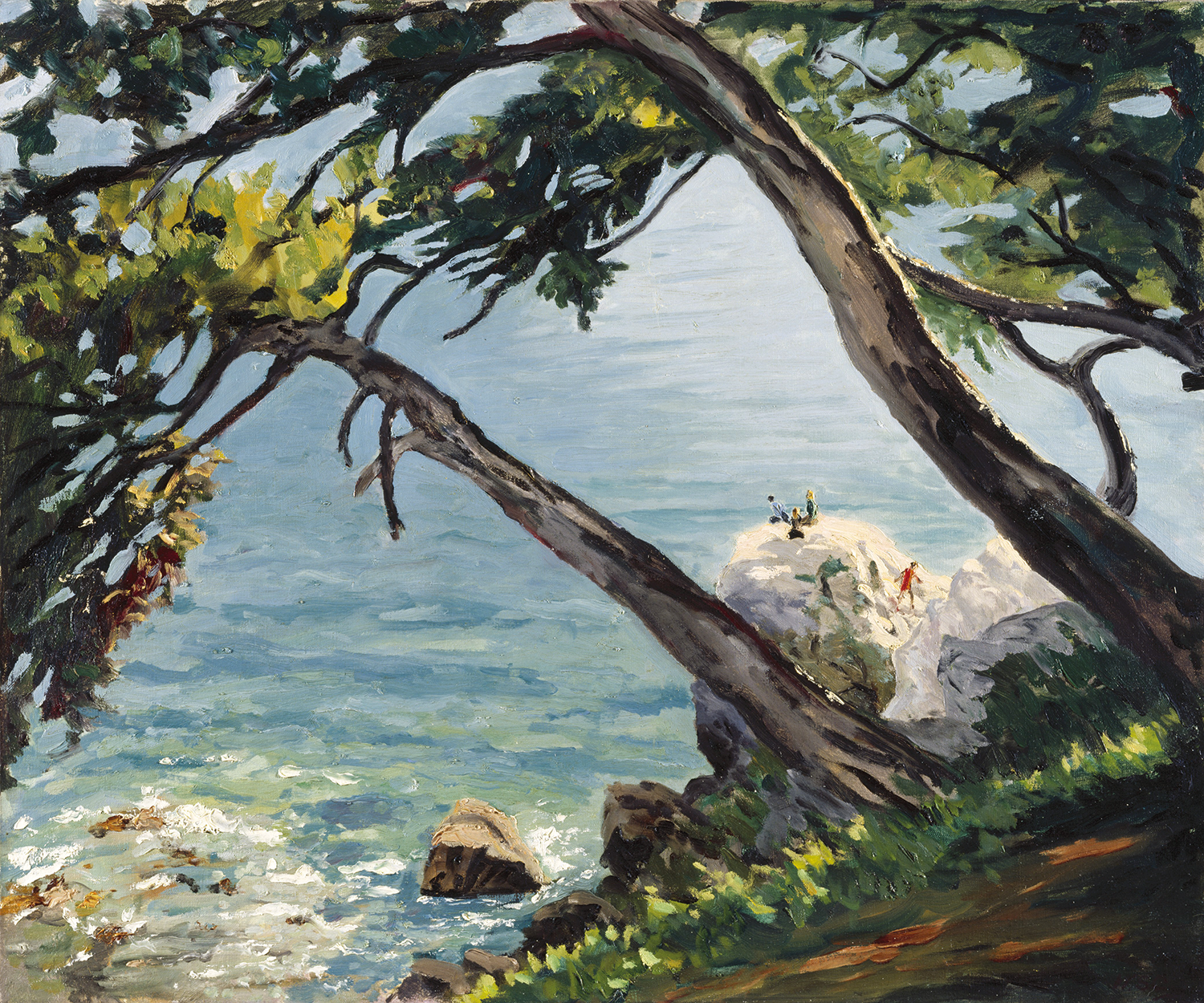
At Chartwell, Sir Winston Churchill’s home of 42 years, now owned by the National Trust, lies his painting studio. Reached by a path through the green-gold gardens, it is a standalone building with a little doorway and a soaring ceiling, clearly a place of refuge, and recreation, but also of serious commitment. The walls display a hundred or so paintings, lit by a big window that gives on to the garden and the purple horizon of the Weald of Kent; his armchair is set at the easel, near his twisted paint-tubes, housed in a former cigar humidor. His bespoke painting overcoat is flung over the armchair, his drink of ‘mouthwash’ (a splash of whisky and a lot of soda) set ready.
It was here that Xavier Bray, director of the Wallace Collection, had his revelation. ‘He’s actually really, really good. I saw it when I stepped inside his studio, one day in the summer of 2020,’ says Bray. ‘I just felt an overwhelming sense of the man as an artist, seeing there all around me so many examples of his glorious eye for colour and his post-impressionist evocation of place and mood.’

‘I rejoice with the brilliant colours, and I am genuinely sorry for the poor browns’
There has never been a real retrospective of Churchill’s art, Bray explains, although Chartwell has, since its opening in 1966, been a permanent place to see some of his work in context. In 1958-9, his paintings went on a world tour to Australia, New Zealand, the US, and the RA in London – almost three-quarters of a million people saw them. ‘But the tour was only his very best paintings. I wanted to put on a show that traced his development and influences, told the whole story.’ The Wallace Collection was well placed to do it. In 1942 it hosted the exhibition Artists Aid Russia, set up by Clementine Churchill. And there’s the friendship between Churchill and Odette Pol-Roger, née Wallace, who was not only doyenne of his favourite champagne house (‘In victory, I deserve it; in defeat, I need it!’) but also the great-granddaughter of the collection’s founder, Sir Richard Wallace. And so, with the support of the Churchill family, Bray undertook a five-year process of diplomacy to bring 57 canvases together.
Churchill began painting at 40, when, after the disastrous campaign in the Dardanelles in May 1915, he found himself out of the Admiralty. ‘Like a sea-beast fished up from the depths, or a diver too suddenly hoisted, my veins threatened to burst from the fall in pressure,’ he writes in Painting as a Pastime (1948). ‘I had great anxiety and no means of relieving it… I had long hours of utterly unwonted leisure in which to contemplate the frightful unfolding of the war… And then it was that the Muse of Painting came to my rescue.’
His first daubs were with the nursery paints of his young children Diana and Randolph. This led him ‘to procure the next morning a complete outfit for painting in oils’. He set up outside – always drawn to paint en plein air – but was cowed by the ‘affronted’ snow-white canvas, until Hazel, ‘the gifted wife’ of Sir John Lavery, the great Irish painter, appeared in a motor car, got out, and splashed in the turpentine, walloped the blue and white paint on, and soon he was away. ‘I have never felt any awe of a canvas since.’
Lavery was his first mentor, and in 1915 at Lavery’s studio, 5 Cromwell Place, Churchill made a portrait of himself as an artist, palette in hand: a statement of intent. What a serious face this beginner shows: clenched with effort and determination. Although the black background is an Edwardian stylistic decision, influenced by Sargent and Lavery, you can also read it psychologically: he is painting himself out of the darkness.
Returning to the front line the next year as battalion commander, he made three paintings – during interludes in fighting – at Plug Street (the Brits’ nickname for Ploegsteert), fascinating pieces of reportage that capture honestly the boredom as well as the devastation that comes suddenly, out of a clear blue sky. They are all the more touching for being technically immature. He wrote to Clementine: ‘I think that [painting] will be a g[rea]t pleasure & resource to me – if I come through all right.’ Even on the front line, he managed to get some time learning alongside the Anglo-French painter Paul Maze.
Painting was a constant through the vicissitudes of politics and family life, when he was out of office again in 1922 and when the Churchills’ daughter Marigold died aged two of sepsis. In 1925, his anonymous entry in a painting competition won first place. The judges were Oswald Birley, Kenneth Clarke and Lord Joseph Duveen. That painting, now titled ‘Winter Sunshine, Chartwell’, so bold, loose and impressionistic with its confident handling of paint, was also accepted by the RA summer exhibition, submitted under the pseudonym ‘David Winter’. There was a career opening had he wanted it; as Picasso would later comment: ‘If that man were a painter by profession, he would have no trouble earning a good living.’
Instead he enjoyed all the privileges of an amateur, always modest, always learning. ‘He learned from other artists in a serious, artisanal way,’ notes Xavier Bray. ‘How to use a grid, how to work from a magic lantern, which he learned from Walter Sickert…’ – as well as how to tame his instinctively riotous feeling for colour. His favourite painters were Turner, the impressionists, Matisse and Cézanne. ‘I must say, I like bright colours,’ he wrote. ‘I rejoice with the brilliant ones, and I am genuinely sorry for the poor browns.’
In the 1930s, Sir William Nicholson was a frequent guest and teacher at Chartwell, and you can see his impact in the increasingly subtle still lifes Churchill produced. Clementine wrote to her husband: ‘I hope you are keeping your colours nice and cool, à la Nicholson…’ Working side-by-side one day, they attempted the same flower arrangement. Both are in the Wallace show, Churchill’s vase slightly squat and realistically heavy, beside Nicholson’s more ethereal version.
Churchill habitually gave away his paintings, whether to heads of state as ‘soft diplomacy’ or on personal impulses to his doctor, accountant, bodyguard (or even, once, a BBC interviewer visiting Chartwell, who foolishly forgot to take it with him, according to Andrew Roberts’s enjoyable essay in the accompanying book). But the principle of generosity seems to have worked because his paintings are well distributed, treasured by individuals and institutions across the globe. From the Churchill Museum in Fulton Missouri comes ‘The Beach at Walmer’ (1938), a blunt, tense political allegory in tube-fresh cerulean, in which a Napoleonic-era canon stands guard over blithe swimmers. Churchill is in the sea with them, but set apart, as if only he can see what is over the horizon. He seems unwilling to temper his colours in this gathering emergency, as if putting away his painterly self.
Churchill’s paintings are well distributed, treasured by individuals and institutions across the globe
From the Royal Collection comes the earlier, far more subtle ‘Palladian Bridge, Wilton’ (1925). When Churchill presented this to HM Queen Elizabeth in 1960, she wrote: ‘What a truly lovely place Wilton is and you have captured the feeling and pleasure of being there so well that all can feel it too.’
‘People will probably come along curious to see how his paintings are given his historic standing,’ says Bray. ‘And I think they will leave convinced.’ There is to be a hand-held digital gallery guide with audio by Gary Oldman and Pathé footage. Charismatic ephemera on display will include Churchill’s spectacles, his projector which he used to beam transparencies on to the canvas, and his bespoke travel easel, its legs spiked so it stands on grass.
Bray has even sourced ‘Tower of the Koutoubia Mosque’ (1943), that vivid vision of Marrakech at dusk, which Churchill presented to Roosevelt. It was then owned by Angelina Jolie and Brad Pitt, who sold it at auction in 2021 for £8.25 million; a private collector has now loaned it to the Wallace’s show anonymously. A lilac, peach, and terracotta-toned fantasia of the Atlas mountains, it feels like Churchill at ease with his own bold feeling for colour, not trying to emulate any of his teachers, but having what he called his ‘joyride in a paintbox’.
Winston Churchill: The Painter is at the Wallace Collection from 23 May until 29 November.




Comments