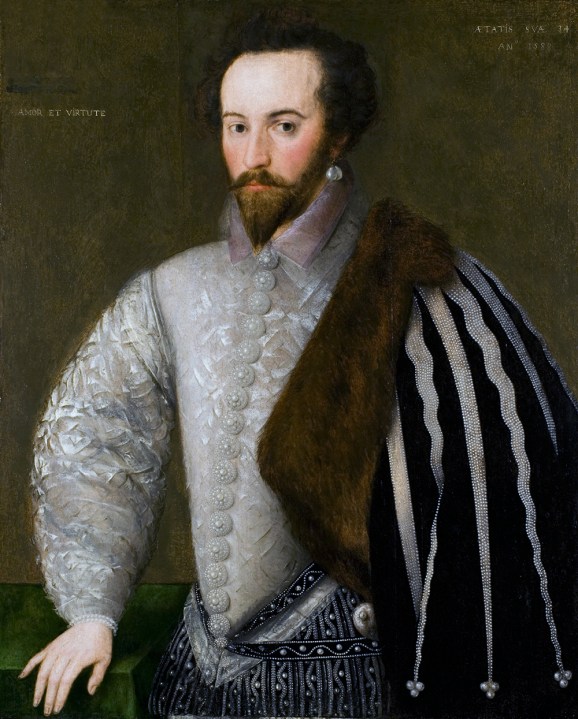
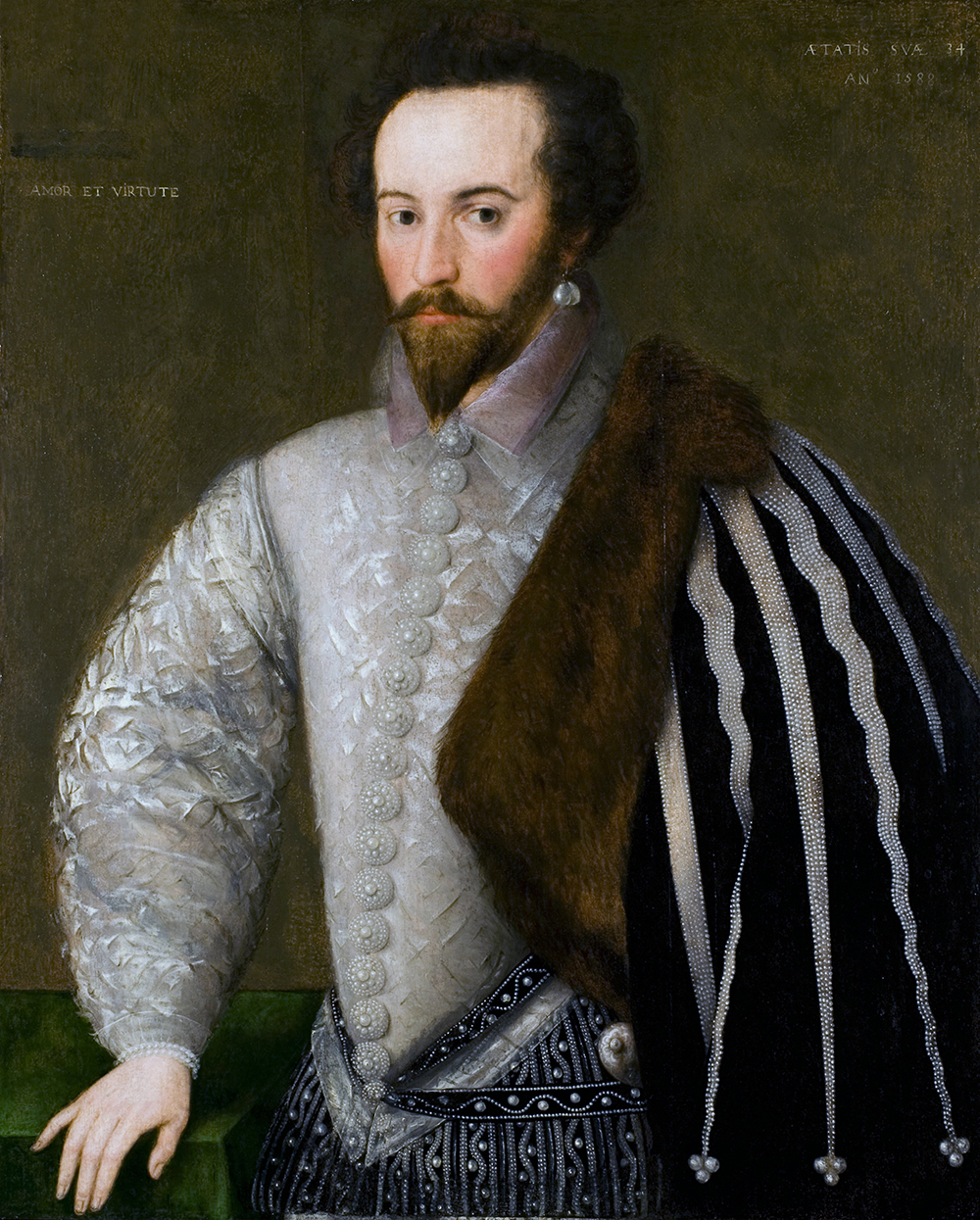
I remember little of my two years at boarding school, where I arrived aged eight, apart from the cloaks. Red, green, blue and yellow, for the houses of Ralegh, Nicholson, Gordon and Wellesley. They were called after generals, we were told, and of the four, Ralegh’s name is the best known. But why? I take a short survey of my colleagues. They all know the name but not why they know it. It is a curious fame to have, and perhaps David Gibbins’s book will do something to give it substance.
Sir Walter Ralegh (Gibbins’s choice of spelling, as opposed to Raleigh, Rawleigh, Ralley and other versions in the elastic Elizabethan way with names) was more than a military commander. He was a politician and an adventurer – one of Elizabeth I’s ‘sea dogs’, the men known variously, according to the geopolitical realties of the time, as explorers, privateers or pirates. A Devon man, he commanded ships and fleets that were free to pillage and plunder as long as the target was an official enemy. At the height of his fame, this usually meant the Spanish and Portuguese. He was also imprisoned in the Tower of London three times.

Gibbins is a maritime archaeologist and justifies his need to write this book – an account of Ralegh’s failed search for the fabled city of El Dorado – through the somewhat arch device of a silver coin he found on a wreck off Cornwall.
Long since turned into ‘Eldorado’ and a standard feature of westerns, the place was believed to be a city whose inhabitants dressed richly and were laden with gold. It was somewhere in the backlands of Guiana, in a region inland from the Orinoco and Essequibo rivers that now encompasses parts of south Venezuela, Guyana, Suriname, French Guiana and north-west Brazil. If Ralegh could find it, he would make the Queen and himself a fortune.
He comes across as a likeable man on the whole. In Sir Francis Bacon’s words, he was ‘an actiue, wittie and valiant Gentleman’. (Gibbins retains Elizabethan spelling for his contemporary quotes.) He was learned and wrote well. But this civility did not prevent him from wreaking appalling violence. The casual slaughter of entire ships’ crews or towns’ populations always shocks. His favour with Queen Elizabeth soared after the capture of the Portuguese treasure ship Madre de Deus, then the largest vessel in the world, by a fleet under his remote command in 1592. Finally seized after ‘an hour and a half of hand-to-hand fighting’, a phrase that does not convey the awfulness of the carnage, the Madre de Deus yielded many riches, including 300 tons of pepper, the entire value of which – £80,000 then, up to £34 million today – Ralegh sensibly gave the Queen.
A blip followed, when his secret marriage to Bess Throckmorton, a lady-in-waiting, was discovered; but even so, two years later, he could raise the equivalent of £13 million to fund an expedition to find El Dorado and restore his favour at court.
We and Ralegh finally set off to Guiana on page 88 (sometimes the padding in this book is worthy of an Elizabeth doublet). The small fleet arrived first in Trinidad; eventually, in smaller vessels with a shallower draft, the party headed up the Orinoco and its tributaries, seeking the golden city which Ralegh believed from earlier accounts of explorers to be called Manao and to be near a lake called Parime. Conditions were rough: the hot sun and diet of fish was a trial for his men. ‘I will vndertake there was neuer any prison in England,’ wrote Ralegh, ‘that coulde be founde more vnsauory and lothsome.’
It is a testament to his talent as a leader, writes Gibbins, that having travelled 400 miles up the ‘thick and troubled waters of the river’, he brought all his men back alive. Also, far from clashing with the indigenous people, he seems to have made alliances with them. But Ralegh returned empty-handed, apart from a few rocks that might have glints of gold in them and some ‘Indians’ who had agreed to come to England. The expedition was a failure – except in Ralegh’s later writing. The Discoverie of the Large, Rich and Bewtiful Empyre of Gviana (1596) suggested that finding El Dorado simply required another expedition.
This journey would not happen for another 20 years, mostly because Ralegh spent 13 of them as a prisoner in the Tower, having been found guilty of plotting against James I shortly after his accession in 1603. Gibbins’s book is billed as a tale of exploration; but Ralegh’s adventures navigating the power struggles of his times are also fascinating. His release was dependent on a second expedition – but this turned out to be a disaster. His lieutenant decided to sack a Spanish settlement, despite England now being friends with Spain, and Ralegh’s eldest son Wat was killed.
Ralegh returned to England sick in mind and body. At his trial in 1603 he had been condemned to death, and this had never been rescinded. Provoking the Spanish, returning without gold and thus infuriating King James – Ralegh knew what this meant. In a letter to Bess about their son, he wrote: ‘I shall sorrowe for us both and I shall sorrowe the lesse because I have not long to sorrowe because not long to live.’
Gibbins gives no source for the words Ralegh is supposed to have spoken while heading to the scaffold, so I can only hope they are true, because it makes me like him more. He passed his servant, Peter, who told his master that he should at least comb his hair. ‘Let them kem it who are to have it,’ said Ralegh, and then: ‘Dost thou know, Peter, of any plaister that will set a man’s head on again when it is off?’ A mensch, Sir Walter Ralegh, even if he never did find his golden city.




Comments