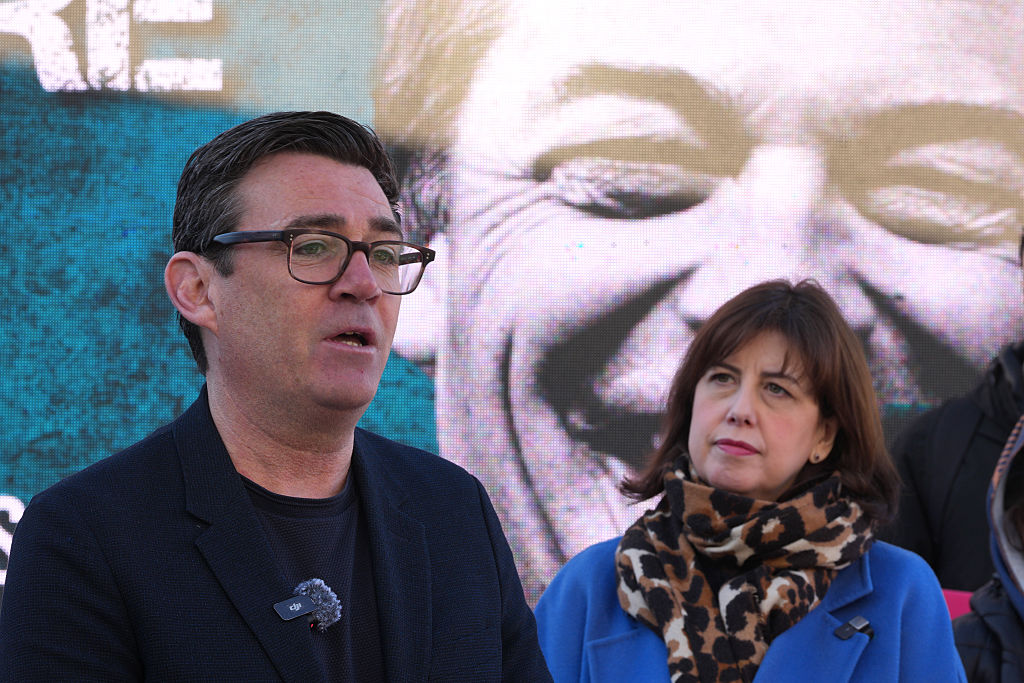
As the Prime Minister’s reset speech seems to have failed to reassure Labour MPs, all eyes are once again on Andy Burnham. In fact, it seems we are trapped in a loop. Burnham appears to be the most popular replacement for Starmer – both among Labour MPs and the public as a whole – but he’s still not in Parliament and Keir Starmer seems determined to keep him out.
While some might suspect that Starmer and Labour’s National Executive Committee had ignoble motivations when they stopped Burnham from standing in the Gorton and Denton by-election (and any mooted future contests), their public rationale is that doing so would require Burnham to resign as mayor of Greater Manchester and risk Reform gaining power in England’s second city. But how real is that threat?
Across Greater Manchester, Reform topped the poll on Thursday – taking 31 per cent, followed by Labour on 24 per cent and the Greens on 19 per cent
Last week’s local election results certainly were ugly for Labour in Greater Manchester. Reform won every single ward up for election in Wigan, and 18 out of 19 seats in Tameside, with 50-point swings from Labour to Reform. Labour were humbled in places like Oldham and Rochdale, while in the centre of the city, it was the Greens who triumphed, winning more than twice as many seats up for election than Labour.
This does not mean Burnham would lose a future by-election in the area. Having spoken to hundreds of voters across Greater Manchester in focus groups, I can confirm the Burnham factor is real, and not just Westminster bubble hype. What is most striking is the depth and breadth of his appeal – he has the support of die-hard Conservatives in Hale, young Green voters in Mosley, Reform-tempted waverers in Heywood, and Labour loyalists across the borough. Of course he has detractors as every politician does, but many people not only like their mayor, but can point to his tangible achievements on transport, development and homelessness. As one voter put it to me, ‘When it comes to being from the North, he is a loud and persistent voice that’s chipping away at the London-centric Old Boys Network. So I have a lot of time for him.’
Those conversations are borne out in opinion polls. Across the north west region, Burnham has a net-positive approval rating of +19, compared to Starmer’s -38. The anger in focus groups when he was blocked from running for Parliament was palpable. Many thought it reflected weakness on the part of the PM. More than that, many felt it was typical of the modern Labour party’s dismissive attitude towards the north of England. I suspect Peter Kyle’s intervention on Monday, telling Burnham to stay in Manchester, will have done little to dispel that interpretation.
So why did Labour do so badly in Greater Manchester last Thursday? Put simply, because Burnham himself wasn’t on the ballot paper. While he might not appreciate the comparison, the mayor is a bit like Donald Trump: he is able to mobilise his supporters on the force of his personality, but that doesn’t translate into votes when he’s not on the ticket. The focus group and polling data suggests to me that Burnham would easily have won Gorton and Denton, and would be the favourite in a by-election in many Labour seats.
What then about the Greater Manchester mayoralty? Across the region covered by the combined authority, Reform topped the poll on Thursday – taking 31 per cent, followed by Labour on 24 per cent and the Greens on 19 per cent.
But I think it would be wrong to take from this that Reform would definitely in a mayoral contest. Voters in over 200 separate local council wards aren’t voting tactically in the same way they would in a single contest across the entire of Greater Manchester. Once we account for tactical voting, which as Caerphilly and Gorton have shown us, is becoming an entrenched feature of our political landscape, Reform would likely struggle to come out on top.
Assuming Reform are able to win over more of the Conservative vote (though Tory voters in parts of leafy Trafford seem to be less keen to switch) their ceiling in a mayoral by-election is probably closer to 35 per cent, unless turnout is very low.
That means the likely winner of a mayoral contest would be whichever of Labour or the Greens could best marshal left-wing tactical voting. My hunch here is Labour probably starts out ahead: they still beat the Greens in votes last Thursday and so can claim to be the strongest choice.
Two other factors weigh in their favour. First, personalities matter in mayoral contests and Labour simply has more of a well-known bench in the area, from footballer-turned-activist Gary Neville to council leader Bev Craig. Second, while the Greens are proving they can turn enthusiasm into votes in parliamentary by-elections, the scale of operation required to do this across the whole of Greater Manchester would be a real challenge. Labour has MPs, local groups and councillors already entrenched across the area.
Would a by-election be a risk for the party? Absolutely, though Labour probably do have the residual strength to win. But if the party collapses in a contest once again, the Greens will most likely be the biggest beneficiaries. And if tactical voting fails, and Manchester’s left vote is split, Reform UK could well sneak through the middle and take the mayoralty.



Comments