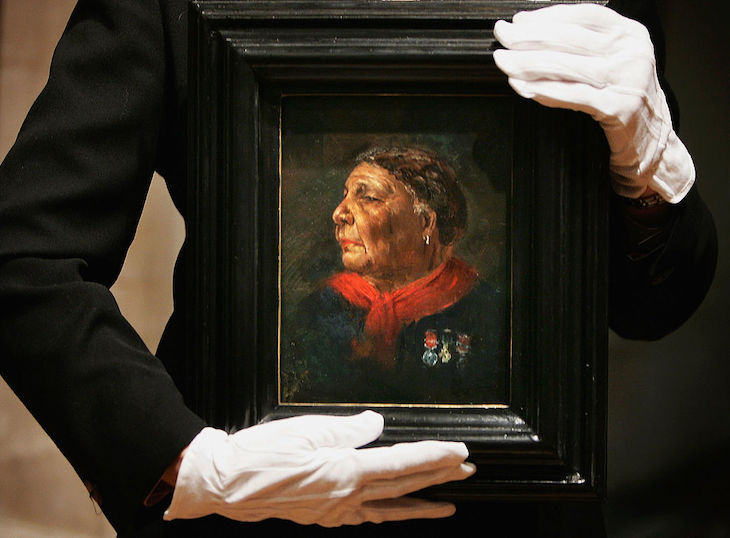
Florence Nightingale, born in Florence on this day in 1820, made her world measurably better. She counted the dead until the living had to listen. Her contemporary in Crimea, Mary Seacole, is now zealously celebrated alongside her – and for the wrong reasons.
Nightingale acted from duty, Seacole from entrepreneurial ambition
Seacole, Jamaican and mixed-race, improved her world because she was a successful small-scale capitalist: brave, exuberant, and possessed of a chutzpah that tended toward creative fiction. Nightingale was part of the Whig advance of history. Her work in data science and sanitation underlies the health improvements we enjoy today.
Seacole, through no efforts of her own, has been co-opted by those for whom history is a morality play about the evils of Western society. In reality, her success and her happiness came from embracing the opportunities Western society offered. She wrote a best-selling autobiography, which included grandiose and unsupported boasts of her medical achievements, and became masseuse to the Princess of Wales. Seacole flourished in a world that was biased against her. She profited personally and she was kind, bringing endless drinks to Crimean soldiers in much need of comfort. “She deserves much credit for rising to the occasion,” one review of her work concluded, “but her tea and lemonade did not save lives, pioneer nursing or advance healthcare.”
Seacole’s medical practice was as conservative as that of the formally-trained doctors of her day. Nightingale’s was radical.

Nightingale was raised by rich, liberal parents and taught to believe that privilege carried obligations. She trained, she studied, and she wrote. In Crimea, she showed the power of data to demonstrate the vast toll of death from avoidable conditions. Her famous polar-area diagrams made mortality visible even to politicians who would never read a table. After the war, she continued making the statistical case that mortality, in slum housing or workhouses or armies, was driven by poor sanitation and poor living conditions. In a world where theory masked reality, it was a feat of imagination to look past theory to data. We all have theories. Nightingale used data to get them peer reviewed by reality.
St. Augustine spoke of “God, who is mighty in mighty things; but mightiest of all in the very smallest.” One of the curious gaps in science is that of the centuries between the development of the microscope and of germ theory. In a world that didn’t understand microorganisms, Nightingale was unable to show why hygienic interventions worked. But science didn’t require you to understand why sanitation was good, so long as you could demonstrate it to be the case; the results of experiments and observations mattered more than the theories which explained them.
In America, the fight for hygiene was led by Oliver Wendell Holmes Sr. More than the unjustly famed Ignaz Semmelweis, who persuaded nobody, Holmes pushed hygiene in maternity hospitals and eliminated the avoidable deaths caused by its lack. Holmes, like Nightingale, noted the statistics which showed that poor hygiene killed. He was opposed by Charles Meigs, the obstetrician, who declared that it couldn’t be the case, since “doctors are gentlemen, and gentlemen’s hands are clean” – a fine theory, in the days before bacteria were understood, but given the lie by those willing to notice what actually happened.
Mary Seacole’s modern fame owes too much to those who judge virtue by the colour of someone’s skin
“The lessons of history don’t suit our wishes,” wrote Clive James. “If they did, they would not be lessons, and history would be a fairy story.” History is always distorted when you read it as a morality play. Mary Seacole’s modern fame owes too much to those who judge virtue by the colour of someone’s skin. Such is their devotion to drawing progressive lessons that they read them where they don’t exist, and obscure what’s actually there. Wanting to make the world a better place is an honourable desire, but to do that – as Nightingale’s interest in data showed – you have to see it as it is.
Nightingale’s devotion to nursing was the product of her society’s limitations. With first-rate intelligence and a superlative education, if she had wanted to enter medical science today she would have become a doctor. One can mourn the loss to nursing of the women who now make up the majority of medical students. But freedom has increased: women can more freely choose their own work. Nightingale acted from duty, Seacole from entrepreneurial ambition. Both motives are worth celebrating. Each woman courageously pursued what autonomy was open to her – but only Nightingale’s life expanded it for others. Her birthday is celebrated as International Nurses’ Day.
Soldiers called Nightingale the lady with the hammer, after she broke into a store-room to get medicines she needed. A male poet and a male journalist preferred the softer image of the lady with the lamp. Some of the most gifted men of her age wished to marry Nightingale. She illuminated her world, but her compassion rested on the iron will to see clearly. She saw what was there, and she smashed what stood in the way. Her suitors admired that, and she kept her hard-won freedom by turning them down.


Comments