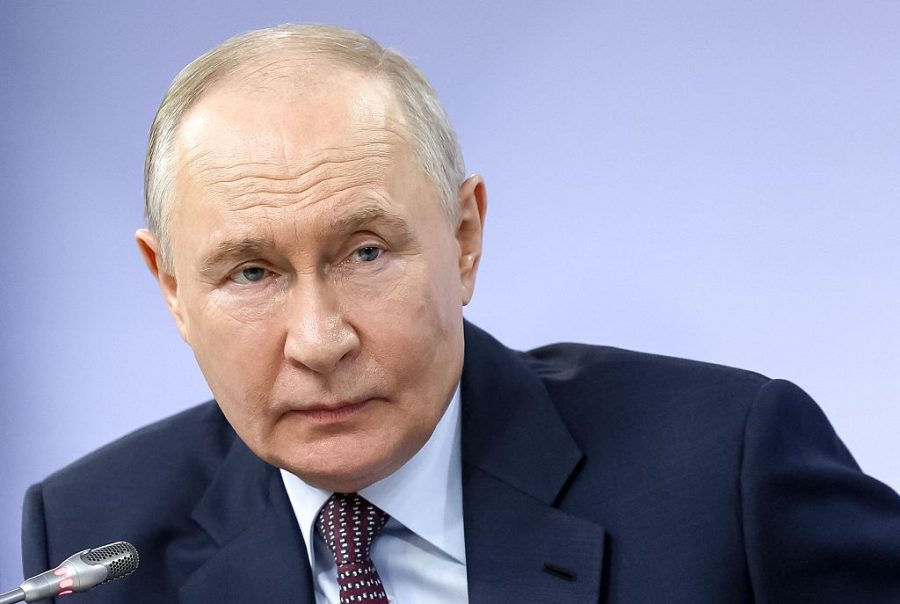
For the first time in 18 years, Russia’s Victory Day parade will have no tanks. There will be no missile carriers and no armored columns on Red Square. Several regions have canceled their parades altogether. Muscovites had been told to expect no mobile internet on the day itself or this evening. The Ministry of Defense has declared a unilateral ceasefire for May 8 and 9 and warned, in the same breath, that any Ukrainian attack will be answered by “a massive retaliatory missile strike on the center of Kyiv.” The Russian Foreign Ministry has helpfully advised foreign embassies in the Ukrainian capital to consider evacuating their staff.
The official explanation for the missing weaponry is the threat from Ukrainian FPV drones. That threat is real, and it is itself a humiliation: the center of the Russian capital can no longer be defended against a few thousand dollars’ worth of plywood and electronics. But the parade is not the cause of anything. It is a symptom of a quieter rearrangement inside the regime, in which power is shifting away from the technocrats who run the economy and towards the men who run Putin’s bodyguard.
The English-language shorthand “siloviki” is too broad to be useful here. The winning faction is narrower: the FSB (Russia’s domestic intelligence and security agency) and the FSO (the country’s federal protective service) – Putin’s praetorian guard. Their footprint has expanded faster in the past year than at any point since the early 2000s.
All of this would matter less if Putin were popular. He is not
This year, the FSB has been given back its own prison system, with seven jails handed over (including Moscow’s Lefortovo) and a new 4,000-place facility planned outside the capital. The Duma has granted it the power to order, rather than request, mobile internet shutdowns, with no reason required. As such, the orders to switch off central Moscow’s networks now come directly from the FSB.
The same agency has begun forcing major banks to install its surveillance equipment and excluding those that refuse from the list of apps allowed to function during outages – banking rules written without the Central Bank in the room. Industry estimates put the daily cost of the Moscow shutdowns alone at close to 10 billion roubles ($135 million). The economic ministries have spent two years arguing, with diminishing volume, that this is hollowing out the economy. They are losing every fight.

The mobile data outages tell the same story in miniature. The pattern of regional shutdowns does not track the front line of the war with Ukraine. It tracks Putin’s movements and the FSO’s exclusion zones around them. Anti-drone protection is the official justification; the real driver is a security perimeter being drawn ever wider around the body of one man. When Russians lose mobile data on a Tuesday morning because the principal is traveling, they are paying a daily price for a security calculus they cannot see and cannot question.
All of this would matter less if Putin were popular. He is not – or at least not as he was. The pollster Levada has the President’s approval at its lowest point since the full-scale invasion of Ukraine began in 2022. VTsIOM, the state pollster whose job is to flatter the regime, has registered seven consecutive weeks of decline. The ratings of the government and the Duma are at wartime lows.
True, Putin’s numbers remain stratospheric compared with those of most Western leaders, but they are declining, and that should worry the Kremlin. Its traditional response to falling support – social transfers, a televised symbolic victory, more arrests for corruption, a new highway opened by a smiling governor, a diatribe against the perfidious West – is running out of room. GDP contracted in the first quarter. Inflation has stuck. The front offers no rhetorical wins, and state propaganda, as everywhere else, is delivering diminishing returns over time.
Anxiety, amplified by the internet outages, is starting to show up in bank balances. Russians withdrew around 800 billion roubles ($11 billion) between March and mid-April. That is still less than 1.5 percent of the 67 trillion rouble (£902 billion) household deposit base across Russia’s banks, but the pace is rising. The cash that leaves the banks with erodes the deposit base the Finance Ministry needs to place its bonds, and pushes more small-business activity into untaxed settlements. If withdrawals accelerate, banks will be forced to compete for depositors with higher rates, which will squeeze lending further. The higher oil revenues that followed the war in Iran provide only a partial offset, since they accrue to the federal budget while the cash and tax leakage hits the broader fiscal base. The numbers are small. The trend runs only one way.
In any normal political system, that combination – declining ratings, a tired economy, no rhetorical victories – would push the leadership towards conciliation. In Putin’s, it might do the opposite. An expanded military phase is the cheapest available instrument for restoring the mobilization narrative, legitimizing further internal tightening, and redirecting public anger towards an external adversary. Sensing the Kremlin’s vulnerability, Ukraine will be tempted to intensify drone attacks and targeted killings, which will trigger fresh security panic in Russia and hand still more authority to the FSO and the FSB. Without a diplomatic breakthrough between Putin and Trump, the loop runs only in one direction.
What this means in practice is not a strategic offensive – Russia has neither the men nor the equipment for one at the moment – but more of what has been visible since the autumn, on a larger scale: scaled-up missile and drone strikes on Ukrainian energy and logistics, a fresh wave of mobilization under another name, higher military levies, and tighter security regimes in the border regions. Saturday’s parade will be brief, defensive, and held under a self-declared ceasefire that the Kremlin has already promised to break if provoked. It is an apt image of the regime as it now is: less interested in projecting power than in protecting the man who personifies it, and increasingly willing to pay any price to do so.



Comments