
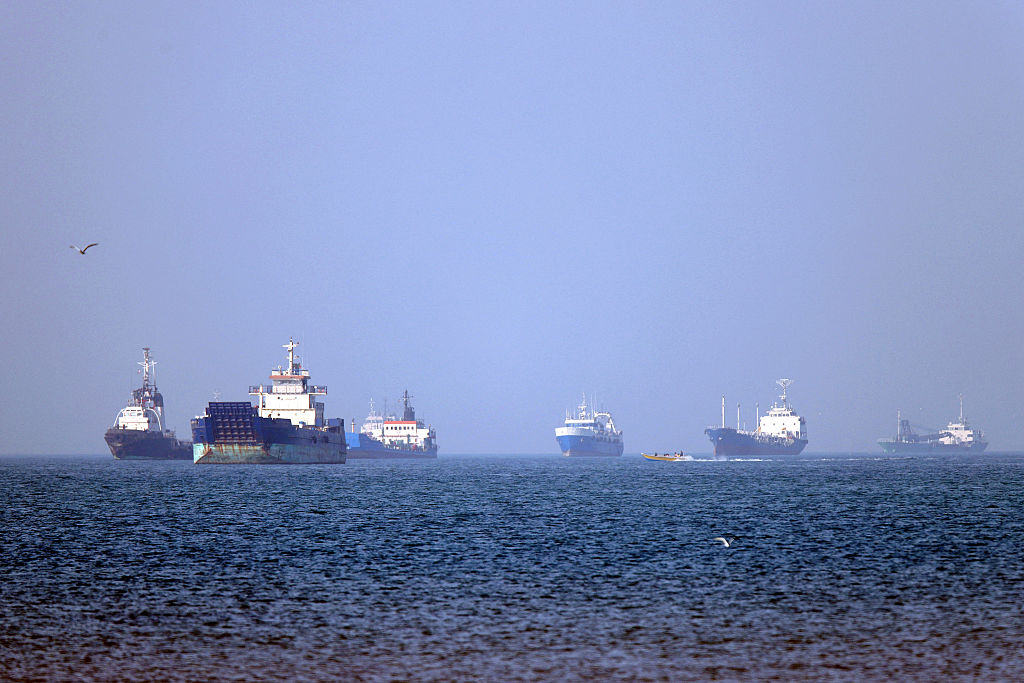
Is the fragile Iran war ceasefire over? It would appear so, with American and Iranian forces exchanging fire in the Strait of Hormuz. The renewed clashes follow President Trump’s launch of “Project Freedom,” which aims to use the US military to escort stranded ships out of the critical waterway. Trump said American forces had hit seven Iranian small boats, with the US military claiming to have intercepted cruise missiles and drones launched by Tehran.
Trump earlier warned that Iranian forces would be “blown off the face of the Earth” if they targeted US ships in the strait or the Persian Gulf. Tehran says it fired “warning shots” at US warships, and said it would attack any foreign force that tried to enter the strait. The Iranians also launched fresh missile attacks on the United Arab Emirates (UAE) for the first time since the ceasefire began in early April. The UAE said its air defenses “engaged” 19 Iranian missiles and drones, and accused Iran of attacking the Fujairah oil industry zone, one of the largest oil storage facilities in the Middle East.
Control of the Strait of Hormuz remains a critical factor in this conflict because it is the main supply route for shipping crude to the rest of the world. In peacetime, some 20 million barrels a day, or about a fifth of the daily global production, passes through the waterway every day. The strait also carries about a fifth of the global trade in liquefied natural gas. Iran’s control of the waterway has allowed it to hold the global economy to ransom. The Americans are determined to break Tehran’s stranglehold and, in the process, push it into making a wider peace deal.
The Americans are determined to break Tehran’s stranglehold and, in the process, push it into making a wider peace deal
What isn’t clear is whether the Americans have enough military assets in place to protect more merchant ships as they make their way through the narrow waterway. Pre-war, some 120 ships a day routinely made the crossing. Some analysts believe that the more ships the US tries to help navigate the waterway, the greater the potential risk. Lord Ricketts, a former UK national security advisor, warned that the US “can’t possibly escort every ship” through the Strait. He told the BBC that it would only take one or two ships being hit for the shipping industry “to lose all confidence in the possibility of safe passage.”

The Iranians will likely look to launch more attacks on loading terminals and oil facilities rather than strikes on the ships themselves. The Tehran regime is anxious to avoid anything that risks a direct confrontation with US military forces. The Iranians prefer to deploy incendiary language and dire warnings at this stage. The speaker of the Iranian parliament, Mohammad Bagher Ghalibaf, one of the senior negotiators in last month’s failed peace talks, warned America that “we have not even begun yet.” The same rhetorical bombast came from the lips of Iran’s foreign minister, Abbas Araghchi, who said the US “should be wary of being dragged back into a quagmire.”
No one should be taken in by this. Behind the scenes, private messages about a possible resolution to the war continue to be traded between both sides. President Trump has repeatedly insisted that the Iranians are desperately keen to strike a peace deal but have not done enough to satisfy his demands, in particular on renouncing their nuclear ambitions. It is certainly the case that Iran’s economy is on its knees and a prolongation of the war can only make matters worse. Meanwhile, Iran’s neighbors in the region can only watch on warily. Saudi Arabia again called for a “de-escalation” after the latest clashes, urging “diplomatic efforts to reach a political solution” in the war. Pakistan, which has played a critical role as a facilitator of peace talks between Washington and Tehran, is also pushing for both sides to return to the negotiating table.
So far, there’s been little tangible public progress. The vacuum is being filled with growing fear and uncertainty across the Middle East. If the war is indeed resuming, what form will it take this time? Who will bear the brunt? That is the question Iran’s gulf neighbors are asking, knowing all too well that they are most at risk from renewed hostilities. Iran may be falling apart economically but it still appears to retain a significant missile capability, posing a threat to ships and facilities in and around the Strait of Hormuz. President Trump has run out of patience and wants to break the Iranian regime’s stranglehold but his path is fraught with danger. The stalemate continues.




Comments