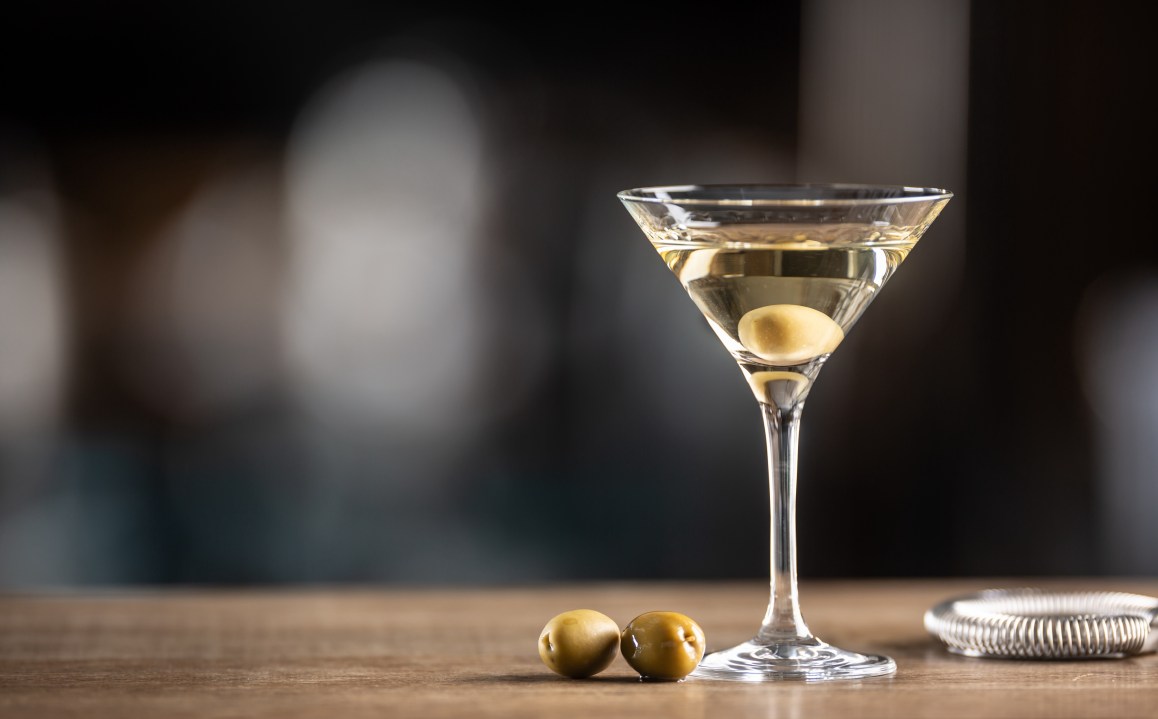
In P.G. Wodehouse’s Cocktail Time (1958) the characters are frequently ‘lapping up martinis like a vacuum cleaner’. Wodehouse was living in the US at this point, and this was the era of the three-martini lunch. In the ensuing decades, the classic cocktail took a bit of a back seat. But the martini has made a mighty comeback.

Not put off by Sir Raymond ‘Beefy’ Bastable denunciation of the modern youth endlessly sitting around drinking cocktails, I went therefore to find London’s best.
They are not always where you imagine. Archive & Myth is, ominously, underneath Leicester Square’s Hippodrome Casino. Gaggles of giggling ladies make their way past the nondescript entrance door, red-flushed faces evidence they’ve just stumbled out of Magic Mike whose bare torso can be viewed upstairs. The martinis are enlivened with everything from lichen liqueur to blackberry leaf Aleder. Sexy.
Murder Inc is a dive bar that looks like it could be in New York rather than Soho. They do what is purportedly the world’s only blended gin martini – so who needs to choose between shaken or stirred? The fun is not limited to London: in Manchester, Speak in Code does a mean martini, with pickled pineapple and shiso vermouth. Meanwhile Kwãnt in Mayfair has some of London’s most unusual martinis – their See the Sea features Fords gin and langoustine distillate.
Connaught Bar, like Dukes Bar in St James’s, prepares your drink tableside from a trolley for unrivalled theatrics. Emanuele Mensah, Connaught’s bartender, was crowned champion in last year’s Diageo World Class GB – the country’s bartending Olympics. He told me a perfect martini has just the right level of dilution to open up the botanicals without overpowering them: ‘A great martini is all about temperature, texture and balance. It should be cold, silky, and incredibly smooth.’
The temperature point is worth emphasising, for it is where most people trip up in making martinis at home. Store your vodka or gin in the coldest part of your freezer. Ditto the glasses. Getting the temperature right down to -18 Celsius is important not just for flavour – eliminating the harshness of the alcohol and bringing out the flavour of the botanicals – but also the viscosity.
The late Queen was said to drink a dry gin martini daily at lunch to help her get through the day
The revival of the martini is interesting. It is partly about a renewed appreciation for old-world aesthetics. The late Queen was said to drink a dry gin martini daily at lunch to help her get through the day. God bless her. Partaking in a clean, strong drink is to put two fingers up to all the low-ABV, Drink Responsibly nannying by the state. And in a world where men are taught to be ashamed of being men, the martini is a quiet rebuke. Bond is still – just about – played by a man, and he has not yet switched out the martinis for sugar-free kombucha.
There are some faint-hearted modern trends, like sip-sized martinis that are closer to a double shot than a full drink. Designed for timorous Gen Z-ers presumably, they do have the advantage of enabling you to experience world-class cocktails at a more modest price. The minis at Twenty8 Nomad are a fair £10 – their smoked Gordal olive brine dirty martini is the way to my heart. Right across from the Royal Opera House, it’s a great pre-show option.
In the 1990s and 2000s, everything from the cosmopolitan to the gimlet was being called a martini if it came in a v-shaped glass. There is now a renewed appreciation for the drink in its classic form. Though beware of all sorts of drinks calling themselves martinis that are nothing of the sort. An espresso martini – now drunk by teenagers when flagging in nightclubs – is not a martini. A Gibson (a martini garnished with pickled onions) is as far as the definition should be stretched. And if only because Mad Men’s Roger Sterling pulled them off in such style.
The vesper is another variation that is firmly regarded as being in the martini camp. For those still mourning the discontinuation of Kina Lillet in 1986 – a vital ingredient in the original as drunk by Bond in Casino Royale – you can recreate it well enough with Lillet Blanc and a dash of Angostura bitters. Interestingly, Bond takes it not in a classic martini class but in a ‘deep champagne goblet’. So feel free to experiment with non-V-shaped glassware without feeling you are being sacrilegious.
A great joy of the martini is the ease with which you can make one at home. The book on martinis by Alice Lascelles is something of a modern classic. In it, she advises a couple of cardinal rules: always use a frozen glass. And, once mixed, drink immediately.
Do not skimp on the garnish – for olives, Sicilian Nocellara or even better a can of Perello. If you take it with a twist, ideally use a fat Amalfi lemon, and then choose whether to discard or leave the peel in the glass. A good-quality garnish will repay you many times over.
The ratio of spirit to vermouth is the other key question. Hemingway favoured a brutal 15:1. As Lascelles says, it is not entirely clear why it became de rigueur to use ever decreasing amounts of vermouth. But over the years the bone-dry martini acquired an aura of sophistication. Churchill was said to bow in the direction of France as a substitute for Noilly Prat.
This job requires stamina. By the end of my martini trawl I was worse for wear and scared to look at another glass. Or, as Wodehouse says in Cocktail Time, ‘white and shaken, like a dry martini’.





Comments