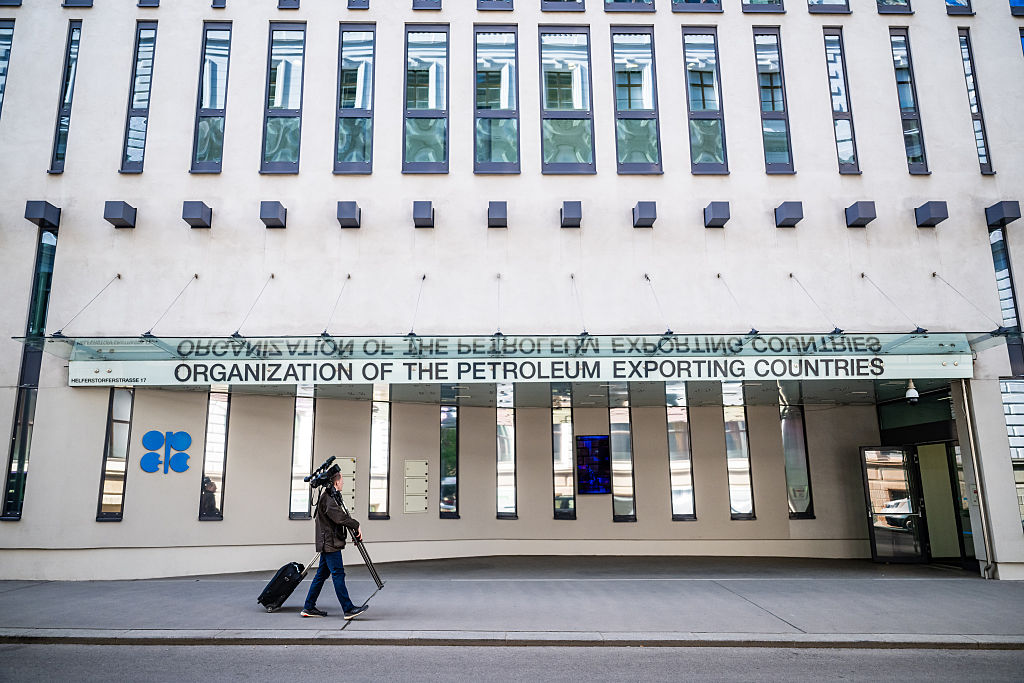
The United Arab Emirates (UAE) choosing to quit the Opec oil cartel after nearly 60 years of membership is, to use President Trump’s parlance, ‘bigly’ big. The UAE’s departure removes around 15 per cent of the cartel’s production capacity, with some analysts already describing the move as ‘the beginning of the end of Opec’.
Established in 1960 by Iran, Iraq, Kuwait, Saudi Arabia and Venezuela, Opec’s ostensive mission has been to defend the interests of major oil exporters. Its core membership expanded in the years that followed and now includes Algeria, Nigeria and the Congo amongst others, as well as ten non-Opec members in the broader Opec+.
On the surface, it’s a cohesive and disciplined organisation that coordinates production to keep steady oil revenues for its members. In reality, it has always been a tenuous and fractious alliance that just about holds together when convenient and nearly falls apart when it isn’t.
Opec has always been a tenuous and fractious alliance that just about holds together when convenient and nearly falls apart when it isn’t
Ever since its inception, it has been beset by chronic quota cheating. The cartel’s entire model relies on members restricting output by sticking to pre-agreed production quotas, but many simply ignore this. Countries like Iraq and Kazakhstan have a long track record of producing above agreed quotas. Compliance across the board has often been wildly inconsistent, especially when prices are up and there’s a strong incentive to cheat to sell more.
The UAE is only the latest in a long line of countries who’ve walked away after this tension between cartel rules and national interest became intolerable. Qatar quit in 2019 to shift its focus to natural gas, Ecuador left in 2020 over quota constraints, Angola did likewise in 2024 in a dispute over production quotas and Indonesia has suspended its membership multiple times. This is not a stable club.
Consensus is fragile, with endless disputes over baseline production levels threatening to derail any agreement and often delaying a deal for weeks. Over the past decade, there have been numerous standoffs between the UAE and Saudi Arabia. In 2021, Opec+ meetings ground to a halt after the UAE blocked a deal to keep propping up oil prices. The former was keen to increase production having invested heavily in new capacity while the Kingdom sought to manage the price through output cuts.
Since it launched its Vision 2030 development plan in 2016, Saudi Arabia has been under pressure to keep oil prices over $90 a barrel to balance its budget and fully fund mega projects like the high-tech Neom city on its Red Sea coast. This has created constant disagreement with Opec members that need maximum output to fund their economies.
These conflicts often devolve into full-blown price wars, where Saudi Arabia will tolerate temporarily low prices to either punish other Opec members for not falling into line or to defend its market share. In 2020, when Opec+ talks broke down after Russia refused to cut its production, Saudi Arabia flooded the market and the oil price collapsed. Russia was forced back to the table and Opec+ agreed massive coordinated production cuts. With such divergent interests and internal squabbling only resolved through brute force, it was inevitable that the group would eventually start to fragment and disintegrate.
Fed up of being brow-beaten into submission on quotas and remaining compliant while other members repeatedly broke the rules, the UAE has clearly recognised that the writing is on the wall for an organisation that President Trump has rightly derided for ‘ripping off the rest of the world’ through inflating oil prices.
As energy costs have developed into a political issue in recent years, membership of Opec has become increasingly toxic as its attempts to artificially tighten supply have been seen by the West as helping to fund Russia’s war effort and immiserating ordinary consumers.
Comments by UAE energy minister Suhail Mohamed al-Mazrouei on its decision, implying that the UAE would now be positioned to meet the world’s rising demand for energy, suggest that they understand that energy security and abundance is now a major priority for countries around the world. While much of the globe was previously wedded to the destructive dogma of net zero, reality has ensured that ‘Drill, baby, drill’ is fast becoming the global mantra. In such a world, price-fixing relics like Opec are being left behind.
With a public tired of high energy prices and the crushing effect this is having on the cost of living, markets are rewarding agile energy producers ready and willing to ramp up production. Outside of the Opec straitjacket, former members like Qatar have become dominant exporters of liquid natural gas (LNG) while the United States, with its historic anti-cartel stance, has gone from a net energy importer to the global energy superpower. Combined with non-Opec producers like Brazil and Guyana who have emerged as fast-growing offshore giants, Opec’s influence is being rapidly eroded by players outside of its control.
This will not have been lost on current Opec members who will be tempted to join the UAE in heading for the exit. They can see that the end is nigh for Opec, it’s only a matter of time.






Comments