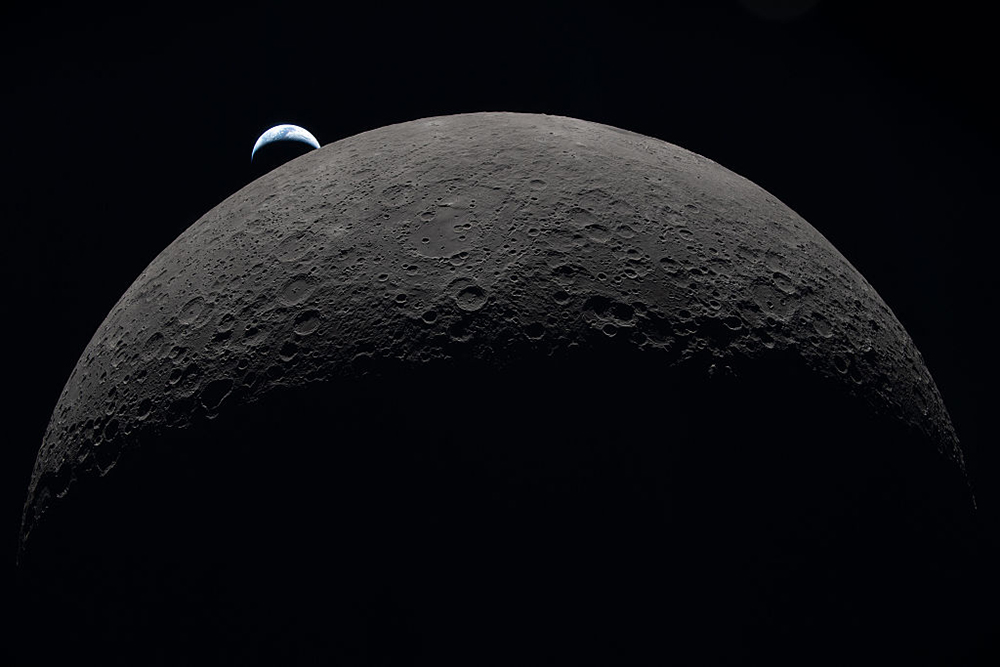

We Americans have been instructed to burst our buttons with pride over Artemis II’s drive-by of the Moon. But out here in cratering America, far from Mission Control, we remain buttoned-up.
This is not due to our skinflint nature or lack of imagination; nah, it’s just that Big Science – “corporate socialism,” as the late parsimonious populist Democratic senator William Proxmire of Wisconsin termed the space program – is spiritless, mechanical and inhuman.
In their distaste for massive undertakings – National Greatness, in DC-speak – members of the Leave the Moon Alone caucus are heirs to Henry David Thoreau, who said of a previous exercise in National Greatness: “As for the Pyramids, there is nothing to wonder at in them so much as the fact that so many men could be found degraded enough to spend their lives constructing a tomb for some ambitious booby, whom it would have been wiser and manlier to have drowned in the Nile, and then given his body to the dogs.” (Ol’ Hank may have slightly overestimated the degree of agency enjoyed by the workmen and conscripts of ancient Egypt.)
Peltier despaired at seeing this old friend pillaged and turned into a military outpost or mining camp
Updating Thoreau, the social critic Lewis Mumford called the 1960s space program “anti-human,” for it “required the total mobilization of the megamachine, commanding to the point of exhaustion all the resources of the state: it is both a symbol of total control and a means of popularizing it and extending it as an ineffable symbol of progress.”
In the United States of Amnesia, to borrow Gore Vidal’s phrase, the losers (“with a capital L!” adds our President) are flushed down the memory hole. Forgotten in all this ginned-up, Artemis II-driven nostalgia for the Apollo years are those who’d have preferred the estimable Neil Armstrong to take his one small step in his native Ohio.
“There is magic in the Moon’s mild ray,” sang the antebellum poet John Howard Bryant, brother of the thanatopic William Cullen Bryant. Those who protested the first US invasion of the Moon were generally of a poetic rather than prosaic bent.
For instance Robert Frost, another poet of New England, forecast that as those in charge “get more nuclear/ And more bigoted in reliance/ On the gospel of modern science”:
They may end up banishing me
To the penal colony
They are thinking of pretty soon
Establishing on the Moon.

Unaccountably, Frost never won the Nobel Prize, but a younger man who would, Bob Dylan, hearing the knock-knock-knocking on heaven’s door, warned: “Man has invented his doom/ First step was touching the Moon.” (From somewhat lower on Parnassus, Jim Morrison of the Doors foresaw “People walking on the Moon/ Smog will get you pretty soon.”)
In the getting dark, too dark to see division of space-invader skepticism, director Roman Polanski linked Apollo 11 to his wife’s savage killing by Charles Manson’s dope-addled myrmidons: “Sharon’s murder and landing on the Moon changed everything. When man walked on the Moon, some romantic idea of the Moon was over.”
Or was it? W.H. Auden, in his lament “Moon Landing,” took solace from the fact that the Eagle’s landing had not – yet – spoiled our lunar neighbor: “Unsmudged, thank God, my Moon still queens the Heavens as She ebbs and fulls, a Presence to glop at.” But how long, he wondered, would it be till “the von Brauns and their ilk” would make of it a “squalid mess”? At least, the irrepressible monkeywrenching novelist Edward Abbey observed of the Apollo missions, “no trace of that shamefully expensive and crassly exhibitionist techno-stunt is visible from Earth. Like Auden, most people still admire the grace and loveliness of the Moon, night after night, without ever giving a thought” to the billions of taxpayer dollars conflagrating on those Florida launch pads.
No living soul has ever loved the Moon as much as Leslie Peltier, a truly great American, a furniture and toy designer in little Delphos, Ohio, whose formal education ended in tenth grade but who was widely acclaimed as the greatest of all amateur astronomers. In his lovely 1965 memoir Starlight Nights, Peltier spoke against “the conquest of the Moon.” “The Moon and I have been firm friends for all these many years,” Peltier wrote, and he despaired at seeing this old friend pillaged and plundered and turned into a military outpost or mining camp or whatever role the avaricious and the militaristic will force upon it.
If the thought of a ravaged and defiled Moon became too much to bear, Peltier could slip out to his backyard observatory just beyond the lilac bushes and sit beneath the night sky, silence punctuated only by the sound of crickets and owls, and gaze in rapt wonder at the dear companion of all romantics, our Moon, long may she shine – unmolested.






Comments