The moon

A journey to the dark side of the Moon

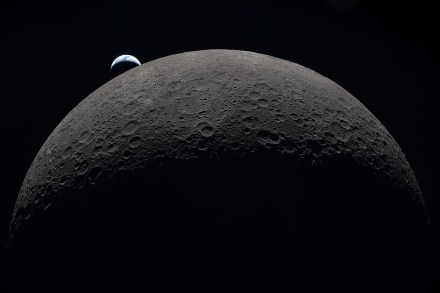
The climax of the Artemis II mission lasted just a few hours. The capsule, named Integrity, rounded the Moon, the crew becoming the most distant humans in history as they moved from its sunward side into its shadow. The familiar features of the permanently Earth-facing side made way for the more heavily cratered far side. This is not the Moon we know. The far side is different. It has a thicker crust, no major solidified lava plains and is more heavily cratered, like the aftermath of the final war. Before reaching it, the crew saw two Apollo landing sites: Apollo 12 touched down on Oceanus Procellarum (Ocean of Storms), and Apollo 14 landed on the plains of Fra Mauro, the target for the aborted Apollo 13 mission. There have been travelers here before, but not like this.

dark side moon

Reflections on the Moon

We Americans have been instructed to burst our buttons with pride over Artemis II’s drive-by of the Moon. But out here in cratering America, far from Mission Control, we remain buttoned-up. This is not due to our skinflint nature or lack of imagination; nah, it’s just that Big Science – “corporate socialism,” as the late parsimonious populist Democratic senator William Proxmire of Wisconsin termed the space program – is spiritless, mechanical and inhuman.

The mission to mine the Moon

There will come a time when the richest people who ever lived will be those who control outer space, in particular the Moon and the asteroids. There are vast resources out there, bound in giant rocks hurtling through space, and in the lunar dust. But the first steps will be taken by the brave, and perhaps the reckless in pursuit of a space dream. If you dream of space, nothing can stop you. Not the disagreement of others or the judgement of experts, neither short-sighted investors nor government regulations. One such dream will happen on the Moon’s surface in just a few months.The space company Astrobotic will attempt to land at the Moon’s south pole – a region of extensive shadows where ice may have accumulated and the site of the next US human landing.

The moon

Why Trump must build a nuclear reactor on the Moon

Sean Duffy, the secretary of transportation whom President Trump appointed last month as temporary leader of NASA, has issued a directive to fast-track efforts to put a nuclear reactor on the moon. “To properly advance this critical technology to be able to support a future lunar economy, high power energy generation on Mars, and to strengthen our national security in space,” he says.A small nuclear reactor on the moon is a good idea, but the directive is about more than that: it is about renewing America’s leadership in space exploration that, with its magnificent achievements receding into the past, looks vulnerable. Bill Nelson, NASA’s last leader, didn't mince his words when it came to the new rivals, China. “It is a fact: we’re in a space race.

The Moon

Was JFK any ‘good’ as a president?

How should we assess the value of a US president? In the case of John F. Kennedy, who died sixty years ago, the box denoting youthful vigor clearly gets a checkmark. Kennedy was just forty-six at the time of his assassination, which makes him younger than Hunter Biden is now. The box denoting the “vision thing” gets checked as well, if only because Kennedy saw the potential for beating the Soviets in the race to put a man on the moon, famously declaring, “We choose to do this, not because [it is] easy, but because it is hard; because that goal will serve to organize and measure the best of our energies and skills.” Also to be considered is the collective trauma of the events of November 22, 1963.

jfk

What exactly is the new space race all about?

The recent spate of articles about attempts by different countries to land vehicles on the Moon make it clear that a new space race is on. Just last month, Russia launched its first mission there in forty-seven years. And although the automated Luna-25 spacecraft spun out of control and crashed at the last minute, India’s heavily-instrumented Chandrayaan-3 landed successfully just four days later. NASA itself aims to return humans to the lunar surface in 2025 with its Artemis program. Remarkably, more than eighty countries, including Israel and the United Arab Emirates, have thus far established some kind of presence in space.

space