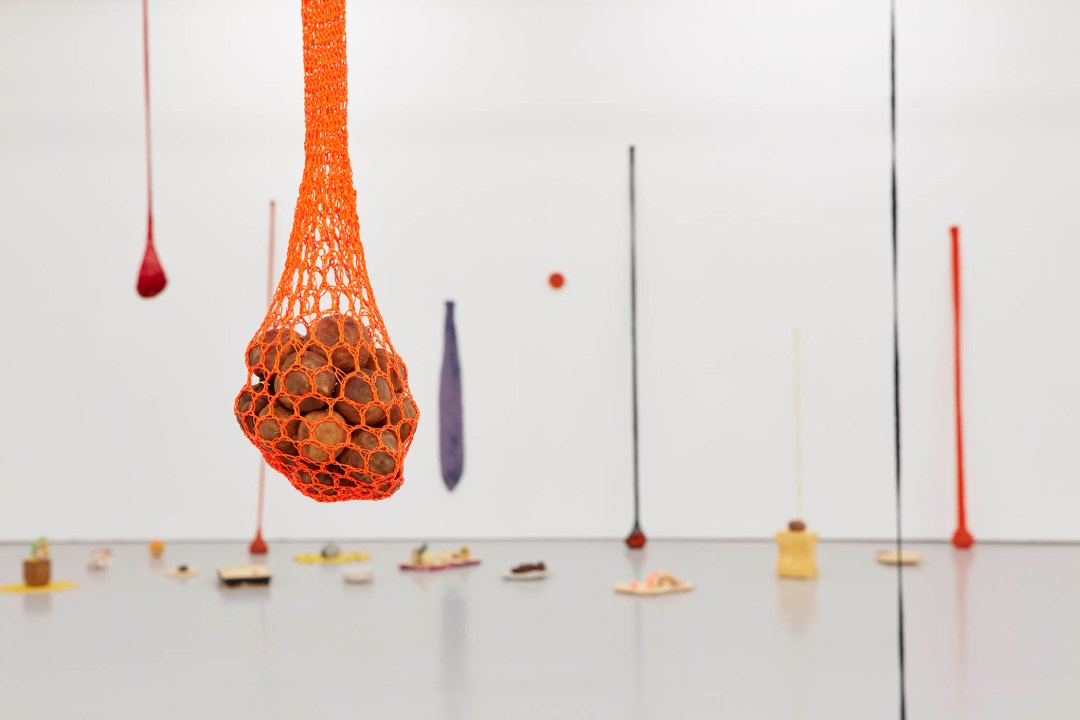
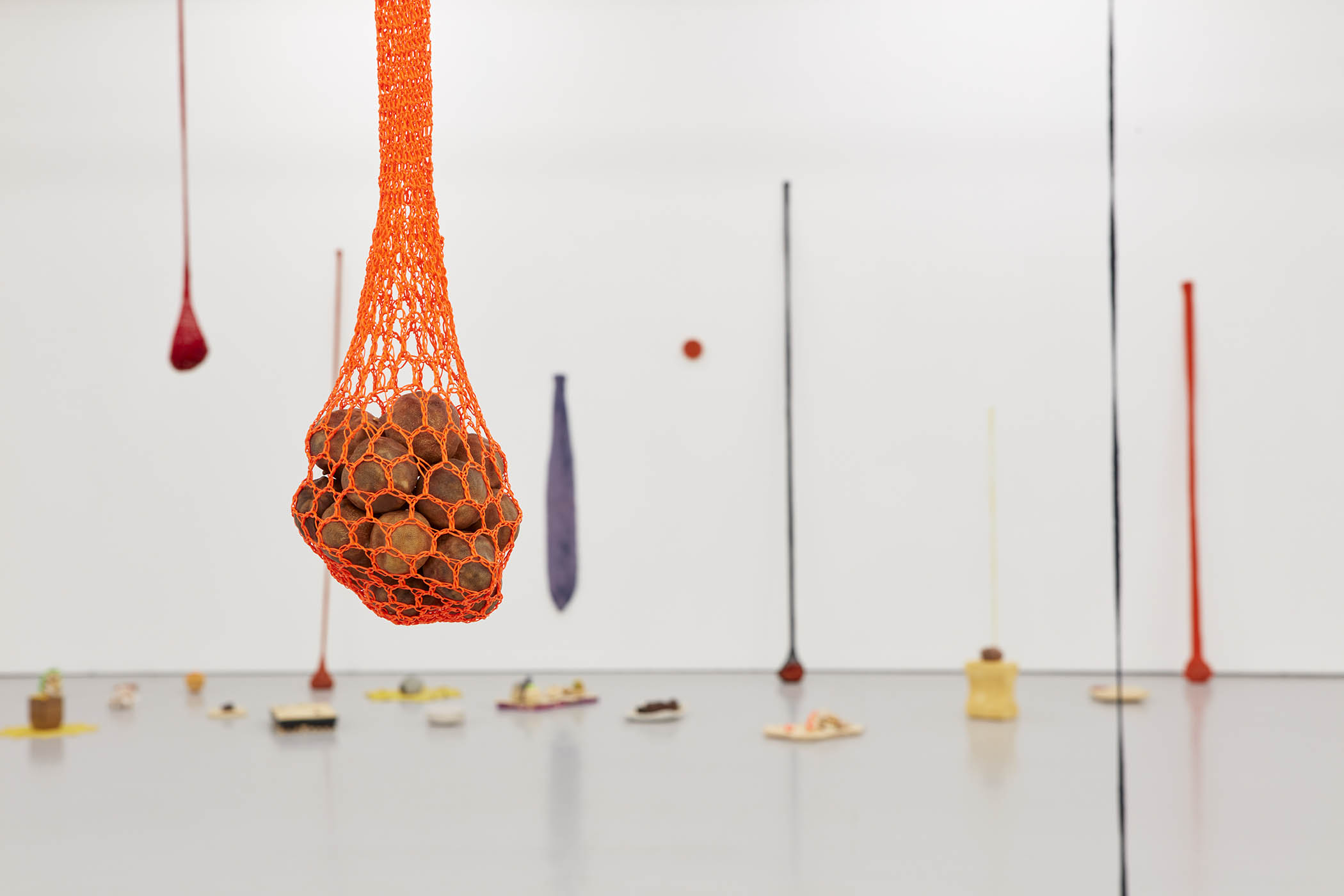
Veronica Ryan, OBE, RA, was born in Plymouth, Montserrat, in 1956 but moved to London as an infant. In 2022 she won the Turner prize. Why? It is this mystery that gives the visitor the necessary propulsion to make it round her retrospective Multiple Conversations at the Whitechapel Gallery.
The first stretch of works is presented as a montage: impromptu creations – often assemblages – run along the wall without titles. The display reflects Ryan’s tendency to have multiple works on the go and to switch between them. Plants force their way through some concrete-like substance that fills a tray to the brim; a 2×2 tableau of sewn-together teabags has the words ‘dissociate’ and ‘associate’ embroidered on them — the structure of the spreadsheet. Tea leaves are distributed across the bottom of each bag and one is tempted to take hold of the frame and rotate it from side to side.
Her work is often stone-like and purged of tension. Blandness seems to be the aim. When tension builds in the making of one work, it feels as if she switches to another nearby; once the tension subsides, she switches back.
‘Plastered House’, from the mid-2000s, for instance. A model of a house rendered in pictographic style, with a square base and a steeply pitched roof, which Ryan has shingled with plasters and fenestrated in a highly vernacular manner, with tiny, peculiarly placed windows and a skylight with what look like bars over it. It ends up resembling less a house than the fantasy of a private prison. The windows look in to total darkness, prompting thoughts of Josef Fritzl.
As here, the blandness is allied to an emo streak. This is salutary if somewhat out of place with the crocheted bags and avocado trays. Perhaps it is the out-of-placeness that makes her work look contemporary. What reads as rhetoric about global trade is more of a confession to being an acculturated globalist.

‘Still Life (Bottles)’, 2025, apparently addresses environmental concerns. Unlabelled bottles are cast in monochrome. The work’s slight message – as neutral as a BBC headline: that ‘waste is causing problems with our bodies, in clouds, in rain… to the seas’ – is clear only after reading the wall text. Where her work offers conflict, it does so internally, and on the evidence of this retrospective, once externalised, the conflicts become bathetic.
The show is arranged in roughly reverse chronological order. So we start with a depersonalised section of work – mostly drawn from her more recent output – and must bear this in mind while encountering the earlier works upstairs. ‘Disavowal (She Follows You Around)’, 2002, is a series of photographs of the artist in which oval shapes gradually overlap with, or engulf, the image of Ryan. They are like stills from an amateur horror film.
One section, containing works made in the 1980s and 1990s, is titled ‘Remembering, Repeating and Working Through’ – a reference to Sigmund Freud’s famous essay of the same name. This fits insofar as she is forensically backward-looking and has determinedly remained wedded to a small number of core themes. The problem is that while the exhibition contains a great deal of remembering and repeating, there is little evidence of much working through.


Comments