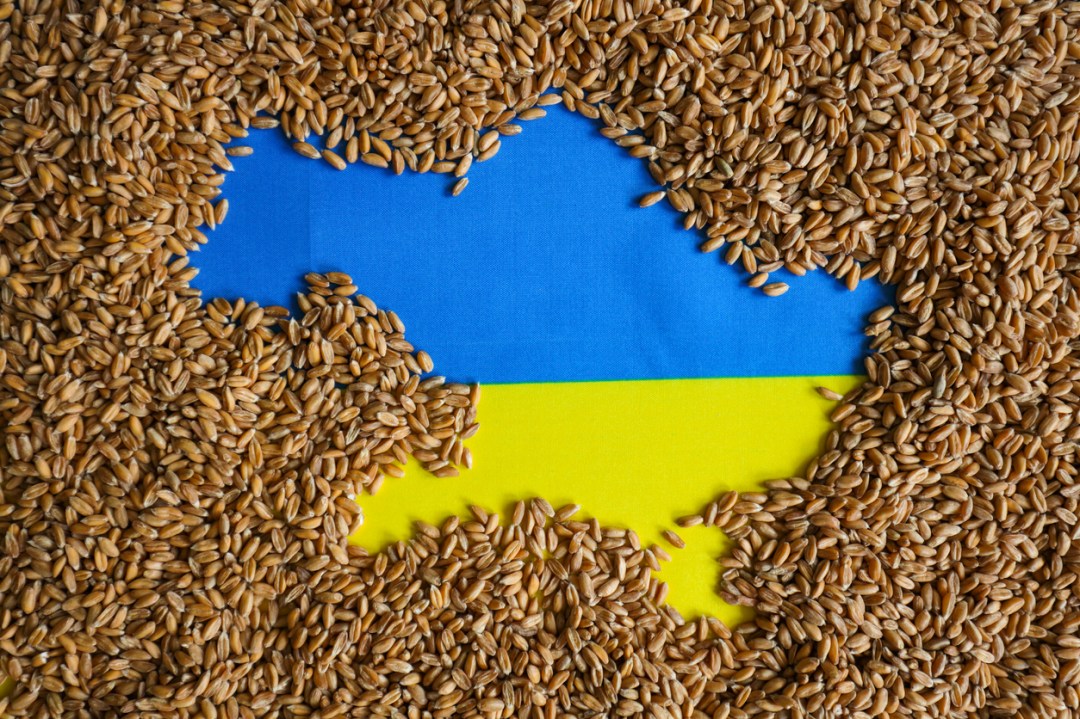
New wars bring new fundraising efforts. Since Russia’s invasion of Ukraine, Ukrainians who already lived in London or moved here as a result of the war have conducted a subtle but concerted gastronomic campaign on behalf of their country. Somehow, this avoids all shrillness – unlike the dreadful and relentless Cook for ‘Palestine’ movement.
The Ukrainian food scene doesn’t crow about good and evil but it takes a position on those questions anyway – of course. A wartime enterprise can’t do anything else. But with front people like the beautiful, tireless Olia Hercules, who has raised millions for her homeland through culinary ‘cultural diplomacy’ missions, it’s an altogether more skilful piece of food politics than other wartime campaigns.
My question, though, as someone who now can’t enjoy a great many good restaurants because of the anti-Semitism of their chefs, is: would Ukrainian food taste all the better for the righteousness of the cause? And, indeed, is it even good? Isn’t it just borscht and scary hunks of meat?
Olia Hercules emphatically says not but I needed to answer such questions for myself. So I paid a visit to Tatar Bunar, on Curtain Road in Shoreditch, a contribution to London’s post-invasion landscape. The dining room is both large and cosy, like a Vogue shoot of a Ukrainian granny’s cottage kitchen – pots, pans, baskets, linen and weave in natural hues; thick-grained wood and bookshelves. It’s run by Alex Cooper and Anna Andriienko, both of whom are urban restaurateurs rather than home-cooks from the countryside. Andriienko, who is Jewish, is a refugee – of sorts. Originally from Odesa, her family managed to stay put, despite being Jews, throughout the last century. She ran restaurants in Ukraine before, and goes back to Kyiv and Odesa frequently, an arduous journey via Poland or Moldova.
There is something Israeli about the Ukrainian enterprise: a survivor people, technologically brilliant, forced to innovate through adversity. I was somehow unsurprised when Andriienko told me she had been many times to Tel Aviv, where the foods of ancestral Jewish cultures throughout Europe and the Middle East are rendered more sensitively than anywhere else, including the original countries themselves.
There is better political eating to be done in tracing the map of new Ukrainian restaurants
Before wafting away to other duties, Andriienko suggested a menu that included forshmak (a pungent herring pate) on fried rye bread, and potato latkes. The dishes, brought by a waitress who had come to the UK on the family visa scheme, and whose brother had recently enlisted in the Ukrainian army, showed its Jewish-Ukrainian-Tel Aviv accents. It was unusually well composed for a London restaurant: the ratios of substance, texture to style and composition were well-calibrated. Pickled tomatoes, a Bessarabian salad, a beef shish, a bowl of large mushroom and cottage cheese dumplings and a fried cherry pastry somehow reached past the trend of mid-2020s omni-cool into that harmonious sphere that characterises self-conscious cultures.
For those of us keen to support Ukraine through consumption, the wine also offered great, surprising pleasures. A glass of Bisser Kolonist fizz was like a honeyish crémant but the highlight was the orange blend, ‘Biologist’, from the Lisnyki region made from an intriguing quartet of grapes: chardonnay, aligoté, traminer and sukholimanskiy.
Hackney may be lost to Gaza; its once-delicious menus poisoned by sick hipster ideology. But there is better political eating to be done in tracing the map of new Ukrainian restaurants. There is Mriya in Earl’s Court, which opened in 2022. SiNo is run by Eugene Korolev, a chef from Dnipro who served in a combat unit for a year and a half after Russia invaded and offers the likes of smoked potato with pike roe and hay cream, sauerkraut dumplings and cherry-glazed bbq catfish. ‘I had fought on the battlefield,’ Korolev has said, ‘but I felt I could have a different mission. Cooking is a form of soft power – I also work with our embassy and with the Ministry of Foreign Affairs in Ukraine, consulting on how to promote Ukrainian food culture and cuisine on an international level.’
Food has long been soft power and it is being kicked around with aggression over in the Middle Eastern sphere. When it comes to Ukraine, the output is of such high quality that support for it is almost too easy. As I chewed the light pastry encasing my lightly-spiced molten cherry compote, cooled with a dab of milk ice cream, I knew Olia Hercules was right: food is perhaps the most intuitive and fundamental avenue for cultural diplomacy, and those behind the push in Ukrainian food are conducting an irresistible, interesting and, at least for this greedy diner, a very effective mission.




Comments