
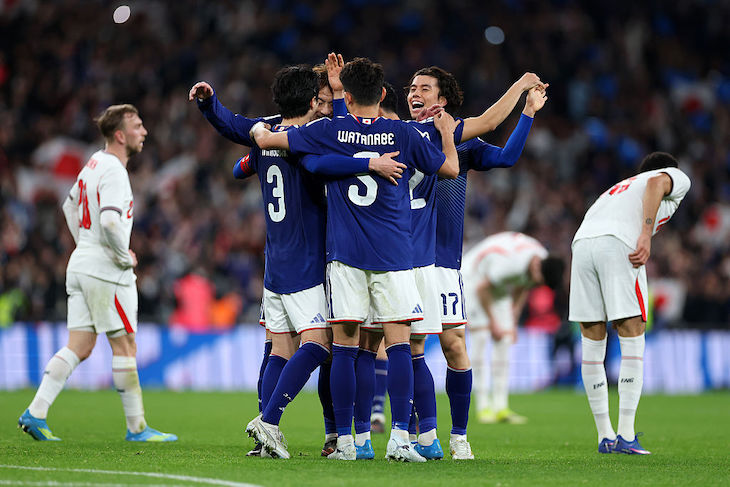
The Japanese national team put England to the samurai sword last night with a 1-0 victory at Wembley stadium. I am aware that opener might seem a bit corny, even offensively stereotypical, except that it does rather accurately conjure the rapid slashing passes that sliced through England’s defence for the winning goal. And it fits with the entirely honourable and respectful codified behaviour of the Japanese players, management, and fans. And as the Japanese call their own team ‘Samurai Blue,’ I plead not guilty.
Japan didn’t qualify for the World Cup until 1998
Right after the match, the Japanese manager Hajime Moriyasu was interviewed on the national broadcaster NHK. Immaculately dressed in what looked like a very good suit, his first comment was to compliment England (‘a very strong team’) before going on to downplay his side’s historic victory at the home of football. Next up was goal-scorer Kaoru Mitoma, who has a degree from the prestigious University of Tsukuba and wrote a thesis on dribbling. He was similarly self-deprecating. In Japan, the news was reported without great fanfare; it was the second item after the baseball.
A thoroughly impressive performance then on and off the pitch, and further evidence of the enormous progress the national team has made in a relatively short time. Football was essentially semi-pro until the formation of the J-League in 1993, and Japan didn’t qualify for the World Cup until 1998. Even now, football is still not the most popular sport in the country (baseball). Only South Korea can claim similarly rapid growth. Japan may not win the World Cup in the summer but nobody should be surprised if they come close (semi-finals?)

This rapid advance has not happened by accident. The Japanese Football Association formulated a strategy known as ‘Japan’s Way’ in 2022 which aimed to coordinate all areas of football in the country to win the World Cup by 2050. The document breaks down each component part of the winning formula, including detailed definitions of the ideal player in each position. It draws on examples from world football, including Germany’s ‘Golden Plan’ for post-war sports development, and is infused with a sort of pioneering idealism reminiscent of how best practice examples of a successful society were identified in the old world and forged in the crucible of the reinvented Meiji Japan (1868–1912).
Simplicity is key, and everywhere in the document the need to make success a team effort (the team being the entire nation) is stressed. The philosophy suits the Japanese temperament and has largely been adopted. Individual players are celebrated but it is never excessive, the players typically eschew the limelight and embrace anonymity. Tattoos, extravagant hairstyles, sports cars, and scandal are notable by their absence – as is political posturing. Clean-cut and courteous Japanese footballers are perfect son-in-law material.
They are not automatons though. One notable exception, the Japanese player who stood out and created a distinct personal style was the cerebral and suave Hidetoshi Nakata. A sophisticated polyglot and style icon, Nakata once checked out of the national team hotel to distance himself from teammates with whom he felt no rapport. But Nakata never played the prima donna, never asserted his personality in a way that damaged the team – no Roy Keane, he. He retired at 29 and now develops and markets his own brands of sake (rice wine).
Japan have beaten everyone now, including Brazil
The Japanese play to their strengths. A lack of physicality (Japanese men are on average two-to-three inches shorter than British men), coupled with an innate politeness (I once interviewed Japanese keeper Eiji Kawashima about his time in Dundee and couldn’t induce him to say a single bad thing about the experience, even the food), and consequent disinclination to indulge in the dark arts of the game has freed players to concentrate on just playing football. The game plan is habitually straightforward: to score more goals (usually through lightning-fast counter-attacks and skilful quick passing moves) – not concede fewer – than the opposition.
It evidently works, and when it works against supposedly superior sides who tangle themselves in knots trying to concoct the perfect formula (England last night) or engineer a complex strategy all the while handling multiple personality types, it fosters supreme confidence and that all-important Japanese quality, team spirit. In the early days, as former national coach Philippe Troussier noted there was a tendency to pay too much respect to their overseas opponents. But they have beaten everyone now, including Brazil thrillingly last year, and now England at Wembley. The current Japanese team fear nobody.
It is not just the players, though. The fans are part of the project and get frequent mentions in the ‘Japan’s Way’ document. The national team supporters are approaching Tartan Army levels of brand ambassador status. ‘The best thing about a painful experience,’ said a friend who attended the friendly against Scotland at Hampden Park last week, ‘they sang all game’. And although the repertoire consists mainly of one song, (‘Vamos Japan’) repeated ad nauseam they look absurdly happy, clearly finding football a source of endless fun. They have generated acres of positive coverage by their charming and inspiring habit of leaving the stadium in a better state than they found it. They would probably have cleaned up Mount Florida or North West London if asked.
Yet another lesson that could be learned by from instructive nights in Glasgow and at Wembley. Hopefully the FA and SFA were taking notes.






Comments