‘No one pretends that modern services will fill the churches. But adult converts ought to be able to step naturally into being worshippers. How absurd that a convert should be warned to undergo cultural orientation before he comes to church.’
These words of the arch-reformer Colin Buchanan in 1979 sum up the views of that post-1960s generation, who believed that all the prayer and thought which Anglicans had inherited was alien to the new generation. It was thought so alien, in fact, that a full cultural orientation would be needed to persuade people to come to church. Modernity was the answer to most questions, and most especially: ‘How do we get the young to come to church?’

Fifty years later, I am not sure anyone would call this experiment a success. Two generations of youth have taken one look at our ‘youth-friendly’ church and defriended it, with each new generation less inclined to religion than the last.
Until now. There is much evidence that young adults – and young men in particular – have been returning to church. Most interesting of all is that these young people seem to be craving authenticity and tradition – or ‘full-fat faith’, as many are calling it.
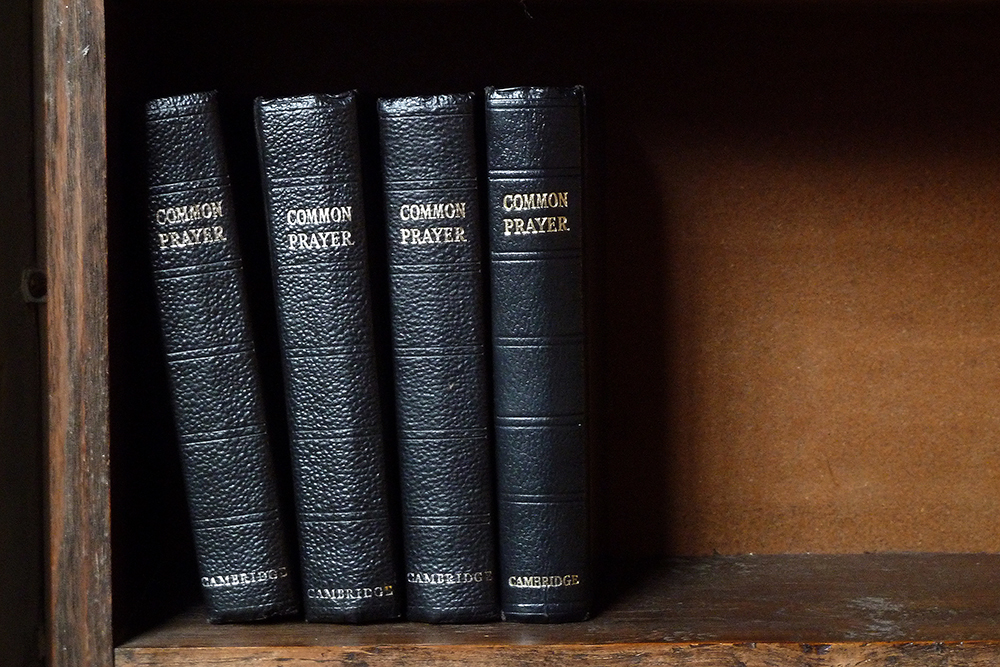
In the Church of England, one of the primary modes of full-fat faith is the old Prayer Book, and although this trend is certainly being manifested in other traditions too, it is to the Prayer Book and the language of the English Renaissance that many of the young are returning.
I can only speak for my own congregation, but since 2018 we have restored the Authorised Version of the Bible, introduced new Prayer Book Evensongs, and seen numbers skyrocket – especially among those aged between 20 and 35. We have had almost 150 confirmations since Covid and now a heartening number are considering ordination. And yet according to the sages of the 1960s this shouldn’t be happening. These young men and women should never have come near a church using ‘thees’ and ‘thous’, talking about sin or praying in a register more Shakespeare than Love Island.
But this is why they have come to us. At least, that’s what they say. A quick survey of our 100-strong young adults’ WhatsApp chat offered these thoughts. ‘BCP [Book of Common Prayer] services are beautiful because the language is poetic… contemporary language services feel like reading the NHS website,’ said one young woman. One lad in tech who started coming aged 22 said: ‘Evensong-in-the-City [our flagship ‘outreach’ service] is a service aimed at the young, but the use of BCP told me, “We take you and your faith seriously”, unlike other initiatives aimed at some bizarre and tiresomely patronising church bureaucrat’s conception of “yoof”.’ I cannot stress the resentment many feel at being talked down to by the church.
I also can’t stress how important sin is. The recognition of it, not the doing of it. The crusaders of the 1960s always said that the old words were far too negative, far too down on human nature. Well, anyone who’s endured the past 25 years is quite down on human nature too. I believe they call that ‘lived experience’.
Young adults are not looking for a mirror of their own daily life, but for ‘sacred anonymity’
One young man reflected that: ‘The BCP Communion Service has a sense of gravity. Approaching God in the Eucharist is an awesome and serious thing that requires spiritual preparation through the traditional confession, absolution, prayer of humble access, and so on. The common worship style feels as though it wants to purely emphasise God’s grace, without examining the uncomfortable reality of sin.’
The world is changing at a terrifying rate. A generation which has grown up with war, financial collapse and a plague can find solace in that which is anchored in eternity. ‘Using the same words that have been used by fellow Christians since the 17th century reinforces the notion that we are in living communion with one another, even hundreds of years apart,’ said another member of our congregation.
Moving from anecdote to evidence, the Prayer Book Society – once a refuge only for aficionados of lost causes – has had a glut of new members, including whole parishes. And not just in the rarefied air of London, but across the country, from the deprived St Saviour’s Leeds to Lincoln’s oldest church, St Mary-le-Wigford, which has the diocese’s youngest churchwarden. It was he who put forward the motion to start using the Prayer Book for all their services. The congregation has since doubled.
Holy Trinity & St Constantine in the desperately poor Diocese of Carlisle has re-introduced Choral Evensong and now gets 40 to 50 people a time. ‘It has become our most popular service,’ says Verity Ramsden, its director of music. ‘People of all church backgrounds come along, including some whose preference is for a more charismatic style of worship.’
These are more than just straws in the wind; there is now a substantial body of empirical evidence. Dr Kathryn King’s ‘Experiences of Choral Evensong’ project at Oxford University offers a rigorous rebuttal to the 1960s and 1970s and their obsession with intelligibility. She shows that young adults are not looking for a mirror of their own daily life, but for what she terms ‘sacred anonymity’. In a digital age defined by relentless self-exposure and performative social interaction, King found that the Prayer Book acts as a ‘technology of the self’ – a place the soul can breathe without the pressure of modern life.
Which means that a new generation is starting to realise that you can encounter the divine without needing to think in the register of an HR meeting. It is precisely the otherness which draws us into a world of understanding, which we find to our delight we share with our forebears and (with luck) our descendants. It seems as if Gen Z are coming to realise how the darkness around them might be lightened.



Comments