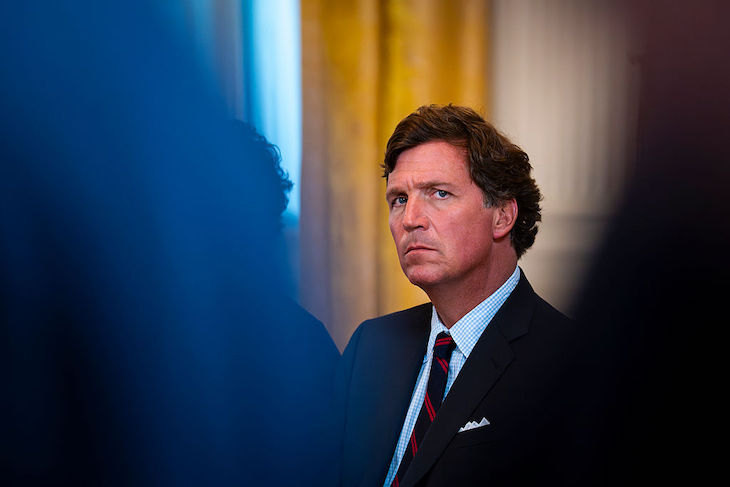
Tucker Carlson is one of the most influential and popular podcasters in the world. He is, not to put too fine a point on it, a podcasting sensation, a master of one of the most important of all modern broadcast mediums. Millions of followers hang on his utterances and appearances. Carlson has 2.6 million YouTube subscribers, 13.3 million followers on X, and 3.9 million on Instagram. But for all the popularity, there’s a problem.
Like Carlson, who was originally a mainstream Republican, Coughlin started out as a mainstream figure
Nearly a century separates Carlson from Charles Coughlin, yet the parallels are so striking as to be eerie. Coughlin – known at the time as Father Coughlin – was a Catholic priest who became one of the first public figures to realise the potential of broadcasting (in his case radio). In the 1930s, he was so huge a figure in American public life that he would get 30 million listeners for his weekly broadcasts. As one obituary put it when he died in 1979, Coughlin ‘held millions of American radio listeners in his thrall, playing to their fears while also stoking their prejudices.’
Like Carlson, who was originally a mainstream Republican, Coughlin started out as a mainstream figure. He was a leading supporter of Franklin Roosevelt in the 1932 election, coining the phrase ‘Roosevelt or Ruin.’ Coughlin was invited to speak at the Democratic National Convention and FDR used some of his phrases in his campaign.
But then Coughlin moved away from Roosevelt, falling out with the president after he accused him of being too friendly to the bankers. Coughlin used his fame to set up his own National Union for Social Justice in 1934, followed by a newspaper, Social Justice. Its pages became full of attacks on American Jews, with tropes about Jewish control of finance and politics. In 1938, he published a version of The Protocols of the Elders of Zion which accused Jews of trying to take over the world.
Coughlin’s broadcasts echoed his paper’s antisemitism. Commenting on the Kristallnacht attack on Jews in Nazi-controlled areas in 1938, Coughlin asked: ‘Why is there persecution in Germany today?’. His answer was to claim that ‘Jewish persecution only followed after Christians first were persecuted.’ He also praised the Nazis as the only effective barrier against communism.
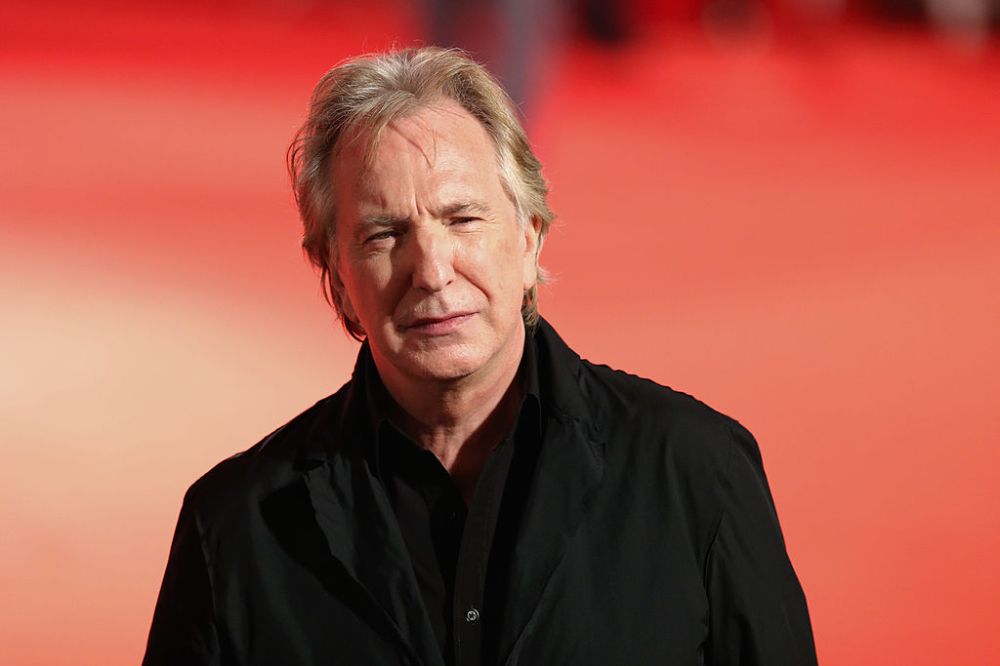
Carlson has not gone as far as Coughlin, but nonetheless there are uncomfortable parallels. The Tucker Carlson Show, which bills itself as a ‘beacon of free speech and honest reporting in a media landscape dominated by misinformation’, has featured some troubling guests. Notorious Holocaust denier Darryl Cooper has appeared. He was introduced by Carlson as ‘the most important popular historian working in the United States today.’ This is a man who suggested that the United States was on the ‘wrong side’ in the Second World War, and falsely claimed that millions of Jews in concentration camps ‘ended up dead’ only because the Nazis did not have the resources to care for them. Cooper told Carlson that Winston Churchill ‘was the chief villain of World War II’.
In October, Carlson hosted white nationalist Nick Fuentes, who has said ‘I think the Holocaust is exaggerated. I don’t hate Hitler. I think there’s a Jewish conspiracy. I believe in race realism’. And in February 2024, he ‘interviewed’ Vladimir Putin in Russia, although interview isn’t the right word for what was essentially a propaganda broadcast. There was a reason why the Kremlin granted Carlson access denied to other Western journalists.
Carlson today, and Coughlin in the 1930s, both understood instinctively how to use their respective new communications technologies to bypass the mainstream media and speak directly to a mass audience. Coughlin’s 30 million listeners – roughly a quarter of the US population at the time – puts him in a different league to Carlson, but we now live in an era of fractured media so direct comparisons are misleading.
Neither man started out as they ended up. Both began by championing forms of economic populism and the ‘forgotten’ working and lower-middle class, contrasting them with the prosperous elites. Where Coughlin gained popularity as a champion of the poor and foe of big business and finance, Carlson was described in 2020 by Politico – before his full-on move towards platforming extremists – as ‘perhaps the highest-profile proponent of ‘Trumpism’ – a blend of anti-immigrant nationalism, economic populism and America First isolationism.”
Both used claims that they were being silenced by the establishment to build their support. Coughlin was asked by CBS to tone down his broadcasts; he then devoted the entirety of his next hour-long programme to ‘exposing’ CBS’s attempt to censor him. Over a million people wrote letters of protest to CBS. Carlson used advertiser boycotts of his Fox programme, and his eventual firing by the network, to show how the elites were seeking to silence him, posting on Instagram about Fox: ‘And you’re lying to me. And the audience I used to speak to five nights a week, you are lying to them.’
It’s important to note that while Coughlin himself pushed antisemitism, Carlson ‘merely’ provides a platform for antisemites. But more broadly, while Coughlin took Jew hate from the fringes and made it a core part of his message, Carlson has taken fringe white nationalist conspiracy ideology and made it core to his programme.
The parallels are not exact, but Carlson is truly Coughlin’s heir.





Comments