
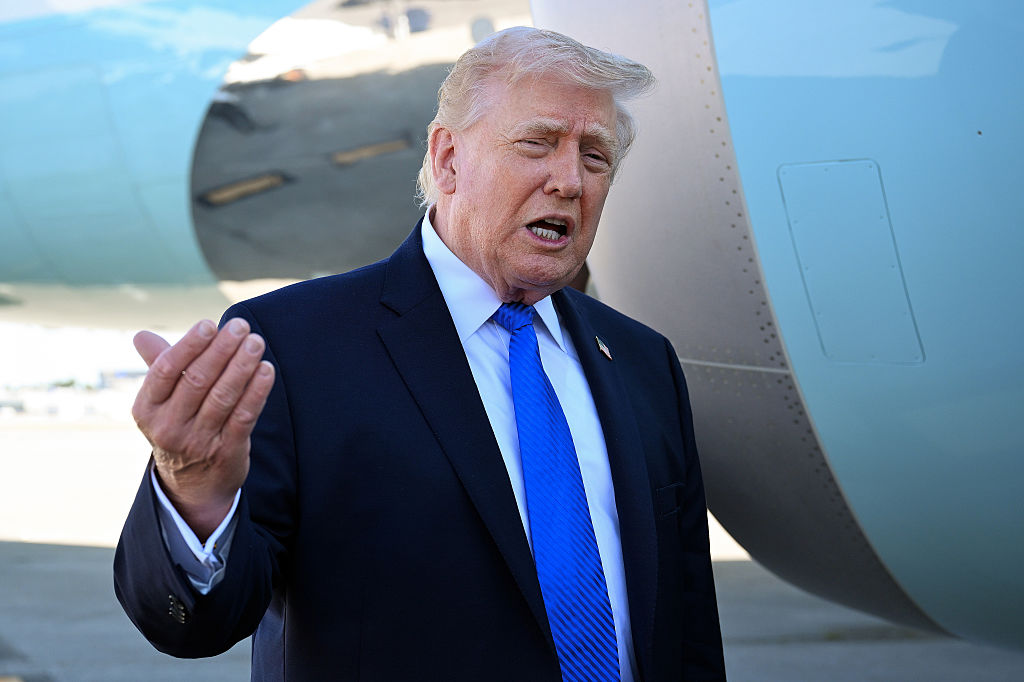
Less than 48 hours after issuing a 48-hour ultimatum for Iran to reopen the Strait of Hormuz or face strikes on its energy infrastructure, Donald Trump stepped back and granted the country a reprieve of five days – a now familiar pattern in Trump’s online diplomacy. In doing so, he dropped what can only be described as a different kind of bomb: an all-caps public declaration that negotiations with Tehran were already underway. No detail was given. Only the assertion that talks were ‘good and productive’.
Systems built on religious legitimacy do not simply vanish under external pressure. They adapt
The effect was immediate and disorienting. Confusion spread outward in concentric circles. Within Iran’s leadership, where pressure and suspicion already run high, this kind of ambiguity is corrosive. When signals shift without explanation, loyalty becomes a liability. Every official is forced to ask whether someone else knows more or has already moved first. No doubt this is part of Trump’s calculation.
Beyond Iran, the same dislocation took hold in a more familiar form. Politicians and commentators scrambled to interpret Trump’s move. It could be a sign of any number of things: strategic deception, energy price management, diplomatic breakthrough, miscalculation or capitulation. All these explanations surfaced at once, none could be confirmed. And that ambiguity is the point. This is how Trump keeps the world guessing.
Trump has never treated the media as a channel for conveying settled policy, he treats it as an instrument. His announcements shape expectations and trigger reactions. The press participates, often blindly, because the tempo is being set elsewhere. By now, there can be no doubt that this is part of Trump’s method, yet other actors, still playing by the old rules, have no choice but to react.
There is a cost to this approach. When objectives are undisclosed, success and failure blur into one another. Even apparent reversals can be reframed as steps along an unseen path. That opacity provides protection, because if no one can clearly define the goal, no one can decisively declare its absence or its failure.
The military campaign itself continues at scale. Trump likes to negotiate from a position of strength, after all. This is another part of his strategy. Thousands of targets have been struck, and Iran’s naval capacity degraded over several weeks. Iran, for its part, retains the ability to respond – though with diminishing intensity – successfully striking Tel Aviv this morning. With continued attacks on Israel and Gulf infrastructure, threats to mine the Persian Gulf, and evidence of actual mine deployment in the Strait of Hormuz, the conflict has not paused, it has thickened.
Until now, the declared language surrounding the operation has pointed towards regime change. ‘Unconditional surrender’ carries a specific historical weight. It suggests a governing system removed and substituted with another expected to behave differently. The simplicity of that aim is appealing. A new regime produces a new policy, and the previous threat dissolves. These negotiations cast doubt on that outcome being delivered. It already looked unlikely.
But the aim of negotiations and its logic hold only under certain conditions. It assumes that Iran’s behaviour is primarily pragmatic, that its interests can be recalculated, and that its survival incentives override its doctrine.
Iran’s governing structure is not merely political. It is anchored in a religious framework. Concession becomes something else entirely under those conditions. It risks being interpreted as betrayal. And that alters the incentives at every level inside the regime. It also explains a pattern observed over years: Iran’s capacity to endure pressure that would fracture more conventional states.
From that perspective, regime change appears logical. Remove Iran’s ideological core, replace it with a secular or at least pragmatic foundation, and it becomes manageable in familiar terms. Yet the counterargument sits uncomfortably close. Iran is not defined solely by its current leadership. It contains deep secular traditions, a complex social fabric, and multiple centres of identity. Removing the existing structure does not automatically produce coherence. The risks are obvious. A full dismantling of Iran’s governing apparatus strips away not only its leadership but its administration, policing and coordination. What often follows are militias, networks, and fragments of the old order, all competing, making control harder, not easier.
There is also a psychological dimension that is harder to quantify but no less real. Systems built on religious legitimacy do not simply vanish under external pressure. They adapt. Martyrdom and resistance can intensify precisely at the point of apparent defeat. If a new authority is perceived as externally imposed, it inherits that resistance.
Even success carries complications. A secular Iranian successor may not automatically be compliant. Nationalism has its own appeal. Nuclear capability, regional influence and prestige do not belong exclusively to one system.
Which brings the focus back to method. A maximalist outcome for the war, total erasure followed by reconstruction, carries immense cost: infrastructure destruction, human loss, economic collapse. A state can be broken more quickly than it can be rebuilt, and the interval between those two conditions is where instability thrives.
An alternative path exists, though it is less dramatic. It involves pressure combined with selective preservation. Maintaining elements of the administrative ‘nervous system’, civil servants, technocrats, local governance, while forcing behavioural change at the top. Replacing absolutism with calculation. Encouraging reciprocity rather than demanding submission in absolute terms. It is slower, less decisive in appearance, but more likely to produce continuity.
Whether that is the path being pursued by Trump remains unclear. Even reactions from Benjamin Netanyahu, reportedly surprised by the announcement of talks, are ambiguous. The record of coordination between Washington and Jerusalem suggests a closer alignment than public responses imply.
Meanwhilie, the war proceeds, with strikes continuing and pressure accumulating. Negotiation, if it is occurring, is taking place under fire. With Trump, the two tracks are not separate: they reinforce one another.
Energy markets hover in the background of all this. Sustained uncertainty exerts its own influence on prices. Extending timelines, introducing pauses, signalling potential de-escalation, all can serve as distractions and diversions to stabilise or suppress price spikes. Time, in this context, is a strategic asset, and Trump is constantly looking for ways to buy more as the military operation continues at full speed.
None of this should invite complacency. Trump’s approach is inherently high-risk. Its consequences are borne most directly by the population inside Iran, where the prospect of a clean transition to a stable, democratic, non-sectarian order remains distant. That vision requires more than the removal of a regime. It requires the construction of a shared identity, across divisions that do not disappear on command.
Trump’s instinct tends toward movement rather than resolution. Deals over doctrines. Improvement over perfection. He speaks in absolutes, yet operates through increments. Others are deployed to soften the edges, to explore channels, to test positions, while he maintains pressure. What this combination yields, and how quickly, cannot yet be determined.




Comments