
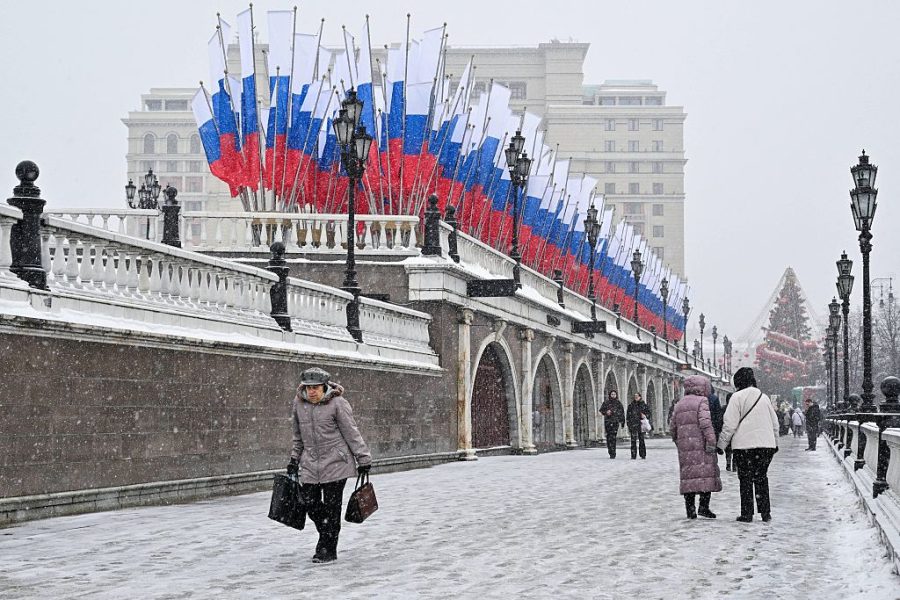
From the modern metropolises of Moscow and St. Petersburg to Arkhangelsk on the permafrosted northern coast and Khabarovsk on the Chinese border, for over a week now, Russian cities have been experiencing unprecedented interruptions to mobile internet coverage. Ostensibly for security reasons, the rumor mill has inevitably cranked out all kinds of alternative explanations, from fear of a coup to preparations for a comprehensive imposition of state control on the “runet,” Russia’s online world.
Notions that Vladimir Putin fears some imminent coup can most quickly be laid to rest. There is dissatisfaction with the continuing war and its economic consequences, but nothing to suggest anything more serious. Besides, one thing this system is well geared to do is deter and foil coups, with multiple well-armed security forces watching and balancing the others.
It is just another example of how the war in Ukraine is coming home to Russians
The official explanation is that this is being done to prevent incoming Ukrainian drones from using the mobile internet for guidance. It is certainly the case that many of the drones being launched against Russian cities do use these signals, and that they are indeed facing a spate of attacks. According to the authorities, on Monday night, 206 drones were jammed or shot down, 40 of them heading towards Moscow.
Does this mean that this is the new normal, though? According to Andrei Svintsov, deputy chair of the parliamentary committee on information policy, this is merely a temporary phase. The interruptions are largely the result of “traffic routing changes,” he said, as internet provision is reconfigured to allow the authorities “to block targeting technology in the event of a possible terrorist attack” (as the Russians describe Ukrainian activities). Svintsov has promised that this will only take another week or two at most.
On one level, this sounds like a perfectly rational approach to a real threat (assuming it works). However, as the Kremlin continues to try and block sites whose content it finds inconvenient and shut down or strangle messaging apps not under its control, there is an inevitable fear that any “traffic routing changes” are actually geared toward furthering its grip on the internet.
Russians are still meant to be able to access “whitelisted” sites and services, including government webpages and Max, its favored domestic messaging app. In practice, though, this rarely seems to work, and people have been unable to pay online, navigate by maps or even communicate.
The price of this disruption for what is a strikingly online nation has been expensive. The business newspaper Kommersant estimated that each day’s disruption in the city of Moscow alone cost local enterprises up to a billion rubles ($12 million). Courier services, taxis, car-sharing services and shops are the most seriously affected, but even the city’s internet-linked parking meters stopped working. There is a growing chorus of voices publicly asking who will compensate businesses and their clients for losses related to the outages.
Resourceful Russians have started buying up walkie-talkies to keep in touch with family and friends, while a reported 73 percent rise in sales of pagers seems largely connected with restaurants looking to keep in touch with delivery couriers. This is no real answer given just how far Russians consume internet services and how far the government now expects citizens to use what are strikingly efficient and user-friendly online portals to do everything from schedule repairs to update documents.
It may be that the Kremlin is indeed simply looking to foil Ukrainian drones and that soon it will have sorted out the changes, and everything will work swimmingly. This is no easy feat, though, and there is widespread skepticism about the official reassurances. More serious are the fears that this is something rather more general, a nationwide system of internet monitoring and censorship.
After all, there appears to be a determination by the end of the year to block the VPNs (virtual private networks) used to bypass government controls and anonymously access foreign sites. Since the 2022 invasion of Ukraine, the Kremlin has banned Instagram, Facebook, X and YouTube (even though, thanks to VPNs, these are still widely used). It is now putting pressure on Telegram as it tries to drive traffic to Max, which it is better able to monitor. Even before then, it employed technical means to spoof GPS signals near critical targets. Someone in Red Square might appear, according to their phone, to be at Vnukovo airport to the southwest or even, in the most extreme cases, distant Crimea!
One way or another, though, Russians are accustomed to fast, cheap online connectivity. The state’s efforts to tighten its grip on the runet, whether for immediate security needs or as an excuse for more serious censorship, are causing unexpected disruption and protest. It is just another example of how the war in Ukraine is coming home to Russians in ways the Kremlin did not seem to anticipate and is having trouble mitigating.


Comments