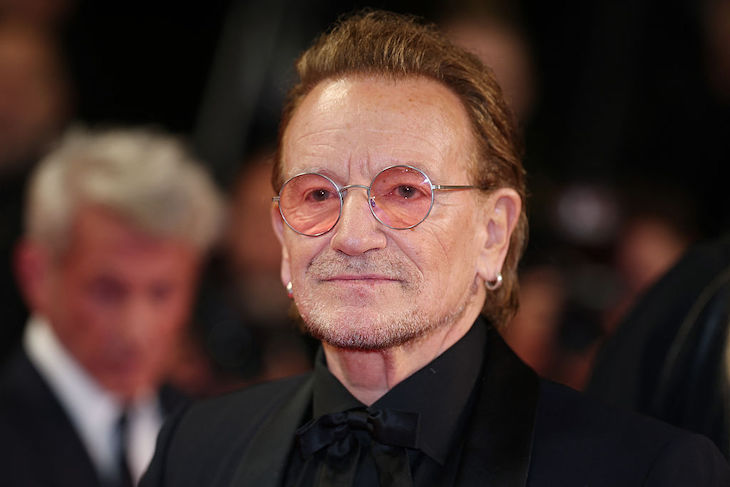
The European Union now has its very own honours list, grandly named the European Order of Merit – with gongs dished out to Bono and Angela Merkel. Volodymyr Zelensky, the Ukrainian president, and Lech Walesa, Poland’s first president after communism, also made the cut in the inaugural honours roll call. ‘With the European Order of Merit, we honour those who did not simply believe in Europe, but who helped build it, said Roberta Metsola, the European Parliament president. This honours system is a sign of the inflated egos of some leaders in Brussels. After all, should the EU really be dishing out gongs?
The EU deserves to become a laughing-stock for this solemn but palpably bogus attempt to create an honorific tradition
The European Order of Merit is not just any old honours system either; it’s a hierarchical and almost chivalric one. Serious honorific climbers, like Mary Robinson, the former Irish president, are made Honorary Members; and, if they catch the eye of the Brussels establishment as particularly deserving, they can become Distinguished Members.
As well as Zelensky and Merkel – who was booed when her name was read out – prizes were dished out to a collection of slightly superannuated politicians and heads of government of EU states. A few EU ex-bigwigs, including an erstwhile (though unmemorable) president of the European Central Bank, also found their way on to the list. Slumming it below these big cheeses were varied congeries of loyal servants of the great and good, a few human rights lawyers – and a Wisconsin basketball legend called Giannis Antetokounmpo (who, despite having being born in Nigeria and living in the United States, also happens to be Greek). For anyone interested, there is to be a grand ceremony in May for their formal investiture.
No doubt this is all taken very seriously indeed in Brussels. Nevertheless it all still seems faintly ridiculous. It’s difficult to escape just how nakedly ideological the EU’s honours system is. Euro-gongs are not so much honours in the traditional sense as state-sponsored awards for supporting, and loyally promoting a particular approved world-view; essentially, this resembles fashionable if boring political progressivism and Euro-enthusiasm. The formal decision of the European Parliament last year to set up the system admitted as much: the very object was to provide a way to pick out people who had made a notable contribution to European integration and the promotion of European values.
There is also a dreadful air of progressive earnestness about the whole process. Top-ranking Meritorious Members Lech Wałęsa and Angela Merkel seem to have been chosen on the basis of having caught attention a considerable number of years ago as respectable fixtures in the European firmament. They won simply because they showed a vague commitment to anti-communism and at least non-opposition to Euro-expansion. Well done. Zelensky was presumably added because he would have been impossible to leave out, and could plausibly be said to have promoted European unity by mooting EU membership for Ukraine.
This also applies lower down. The middle rank seems to have been reserved as a means of accolading and rewarding senior but underwhelming public figures who could be shown to have more or less loyally toed the Brussels line. Have you ever been bowled over by Valdas Adamkus, Aníbal Cavaco Silva or Sauli Niinistö, ex-leaders of Lithuania, Portugal and Finland respectively? Me neither.
The lowest rank looks like a perch for a combination of worthy progressive foot-soldiers in the progressive movement, plus a few celebrities who might lend the whole operation some limited glitz. Bono presumably got in as a high-profile celeb with a useful record of social activism who had providentially nailed his colours to the European Union mast in 2014; Giannis Antetokounmpo, now very successful and on the way to being a rags-to-riches billionaire, apparently for his contribution to vague virtues such as human dignity, equality and social inclusion.
The real difficulty facing Brussels, however, is that no matter how bombastic its titles and glitzy its ceremonies, an honours system only really works as an adjunct to an existing state and popular institutions connected with it. The British one survives because it is part of the ancient English and later British state, coupled with its slight eccentricity; it can include those whose sole contribution is to the general joy, rather than any formal determination of merit or contribution to social activism. Even the French order of the Légion d’Honneur, instituted by Napoleon as revolutionary and supposedly merit-based, built heavily on the pre-existing French system of chivalric honours it supplanted.
But this process doesn’t work the other way round. Just as the Major-General in the Pirates of Penzance didn’t create an ancient pedigree by buying a grand house with pictures of likely-looking ancestors attached, you can’t create a state with organic traditions by setting up a baroque system of grand-sounding titles for those who support some set of supposed common values that you have just invented. Unfortunately, that’s just what Brussels is trying to do with this scheme. And, like the Major-General who admitted that his ancestors were only his by purchase, the EU deserves to become a laughing-stock for this solemn but palpably bogus attempt to create an honorific tradition.
But be kind. Don’t tell the Euro-enthusiasts. If they want some harmless if serious-minded fun, let them have it. It’s the only decent thing to do.





Comments