

A Labour MP, reflecting on the problems the Prime Minister faces over the war in Iran, observed this week: ‘Keir got it right, but things keep going wrong.’ His point was that Starmer kept Britain out of the Israeli-American air strikes, a position popular both with the parliamentary Labour party and the electorate, yet the impact of that conflict has laid bare three serious problems at the heart of the British state.
First, there has been a fracturing of relations between Starmer and Britain’s defence chief, Air Chief Marshal Sir Richard Knighton. Second is the vulnerability of the economy to energy price shocks. Third is Ed Miliband’s net-zero crusade, which has put further pressure on the cost of living, Starmer’s biggest domestic problem.
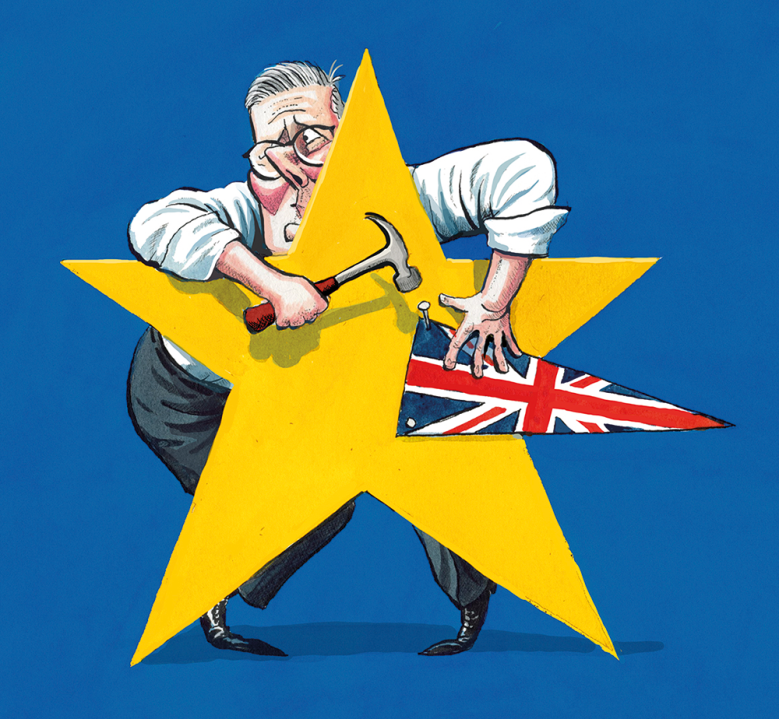
But ministers also believe the conflict has created an opening to do a deeper economic deal with the European Union – one which the Prime Minister and his chief negotiator Nick Thomas-Symonds plan to get rolling next week.
‘Warships are part of diplomatic theatre. They’re symbols as much as they are weapons’
The leak of discussions at a National Security Council meeting on Friday 27 Feb-ruary – the eve of the bombing of Iran – exposed Starmer’s failure to initially persuade his ministers to let the Americans use the bases at Diego Garcia and RAF Fairford to attack Iran’s missile sites.
It can now be revealed that a fault line also opened in that same meeting between No. 10 and Knighton. Jonathan Powell, the National Security Adviser, asked Knighton whether Britain should send warships to the eastern Mediterranean. ‘What about the carrier?’ he pressed, referring to HMS Prince of Wales. Knighton replied: ‘We don’t need the carrier. We have an aircraft carrier – it’s called Cyprus.’ But the failure to send a warship proved to be a disastrous political judgment that enraged Cyprus, Jordan and the UAE. ‘Warships are part of diplomatic theatre,’ says one insider. ‘They’re symbols as much as they are weapons. And nobody has said that to the Prime Minister.’
It has led to what may be a fatal collapse of confidence in Knighton. As an RAF man, he is seen as too dismissive of the Royal Navy’s ability to ‘show the flag’ and reassure allies. A senior security source reveals that in another top-level meeting last weekend: ‘Powell and other people were saying: “Should we put a range of options on the table for the Prime Minister to have a look at?” And the chief of the defence staff said no. No. 10 is very, very cheesed off. He’s actually not very competent.’
Others point out that Knighton (who has never been to war and has served overseas only once, in Italy) was only given the job to sort out the Ministry of Defence budget, a task at which he had failed before the Iran war began. The Defence Investment Plan is already six months late and there is no sign of it being published soon. ‘They didn’t want another TV tart,’ says a defence source. ‘He’s a process man, not a war fighter. He was appointed as a bean counter, but he has failed to count the beans.’
Knighton’s performance has not been helped by Starmer’s inexperience in military matters. ‘The Prime Minister does not know which questions to ask to force the range of answers that he needs to make all the decisions he might want to make,’ says a defence veteran. Knighton has only been in the job since September but there is already speculation that he will not serve the usual four-year term.
‘The truth is that he’s lost the confidence of No. 10,’ says a well-placed source. ‘Do I think they’re going to fire the chief of the defence staff tomorrow afternoon? No. Do I think he stands a good chance of requesting early retirement? Yes, I do. He has failed to give the Prime Minister military capability, but also diplomatic and political credibility.’
If the military rift is the most acute problem, the most chronic is the government’s lack of money. When the conflict broke out, Rachel Reeves spent the entire weekend in the Treasury. She would have done so anyway, since she was presenting the Spring Statement to parliament, but aides say ‘90 per cent’ of her time was devoted to preparing for the economic shocks of the conflict. She told her team: ‘At the moment, this is a conflict between nations. It’s soon going to become an economic question.’
Crude oil has topped $100 a barrel for the first time since 2022. The Office of Budget Responsibility predicted this week that the oil price shock would put inflation back up to 3 per cent. However, Treasury officials stress that, at the moment, this is a ‘disruption to existing supply’ rather than a ‘permanent cut-off’, as happened when Russia invaded Ukraine. A close aide warns: ‘If it is a permanent, longer-lasting disruption, there will be consequences.’
Reeves has established an Iran response board within the Treasury, which includes the financial secretary Spencer Livermore, Neil Amin-Smith (the chair of her council of economic advisers) and permanent secretary James Bowler, along with several Treasury director generals.
The government’s immediate response has focused on preventing profiteering, assessing the impact on households reliant on heating oil, and working with the G7 to stabilise supply. It might also need to intervene when the energy price cap is next calculated in July, since that will determine costs in the autumn, when people turn their heating back on.
Pressure is building between the Treasury and Miliband over the headlong pursuit of net zero. The energy secretary has overseen the end of new North Sea oil and gas production, leaving the UK increasingly reliant on foreign supply, including Qatari gas. While he is right to say that the price of oil (though not gas) is set on the international market, Reeves would be grateful for the income that selling both would create. Miliband has also cancelled a large-scale nuclear energy project that was planned by the Tories.
In a Commons statement on Monday, Reeves said: ‘I recognise the role that North Sea oil and gas will play in our economy for years to come.’ Last week, after a meeting with oil and gas executives, she signalled that she wants to remove the Energy Profits Levy on the sector, which is driving
up prices.
Claire Coutinho, the shadow energy secretary, says: ‘Ed has made three big bets. That we don’t need our own oil and gas production. That clean electricity is more important than cheap electricity. And that renewables are a better bet than nuclear to get you away from gas pricing. He has been proven wrong on all counts.’
Doubts about Miliband are shared at the top of government, according to those familiar with No. 10 discussions. Starmer, the work and pensions secretary Pat McFadden, and the former chief of staff Morgan McSweeney were all sceptical about his approach. ‘No. 10 realised last summer that none of this was going to bring down bills,’ a source says. ‘Ed promised £300 off energy bills and he had no idea how to deliver it. He’s been making electricity expensive. It’s gone up £200 under him. Morgan, Pat, even Keir – nobody thinks that he’s right.’
What is the way out of this mess? Having fallen out with Donald Trump, Starmer is convinced that a new deal with the EU is his get-out-of-jail-free card. Thomas-Symonds will be in Brussels early next week for the Parliamentary Partnership Assembly, where he and Maros Sefcovic, the European Commissioner for Trade and Economic Security, will hold bilateral meetings. These will push forward existing negotiations – due to wrap up at a summit in June or July – and start a second phase of talks. A senior government source says negotiations over an ‘SPS deal’ on food and animal products are ‘generally going well’, as are talks on a joint emissions trading scheme, something which ‘starts to seem much more important’ in the context of Iran.
Doubts about Miliband are shared at the top of government, according to those familiar with No. 10
The Iran war has focused minds. The EU is showing greater ‘willingness’ for the UK to join a recently announced Ukraine loan scheme worth about €90 billion to support Kyiv’s war effort and reconstruction. It includes a new mechanism that allows companies from ‘trusted partner’ countries, including Britain, to supply equipment funded by the loans. However, Britain may need to contribute financially to the EU’s borrowing costs if it wants its defence industry to benefit. ‘There is an opportunity there for our defence sector to supply loads of stuff,’ the source says.
The most controversial moment will come when Starmer makes clear his plans to seek ‘sectoral alignment’ with EU rules to get better access to the single market. This will not, as many Labour MPs are demanding, mean re-entry into the customs union, but the charge is still likely to be levelled that Labour is taking Britain back into the EU’s regulatory orbit. ‘We want to do something more ambitious around single market alignment,’ the source says. ‘It’s very much not the customs union, but we’ll look at where we are already aligning and where it’s in our interest to do so.’
Ministers believe the turbulent state of the world has caused the EU to rethink its approach towards post-Brexit Britain. ‘I can remember people saying the UK’s not important to the EU, you’re pretty low down the priority list,’ says the source. ‘That situation has significantly changed. The change in the geopolitical environment means they’re much more willing now to look deeper into the UK relationship. There is a window of opportunity.’


Comments