
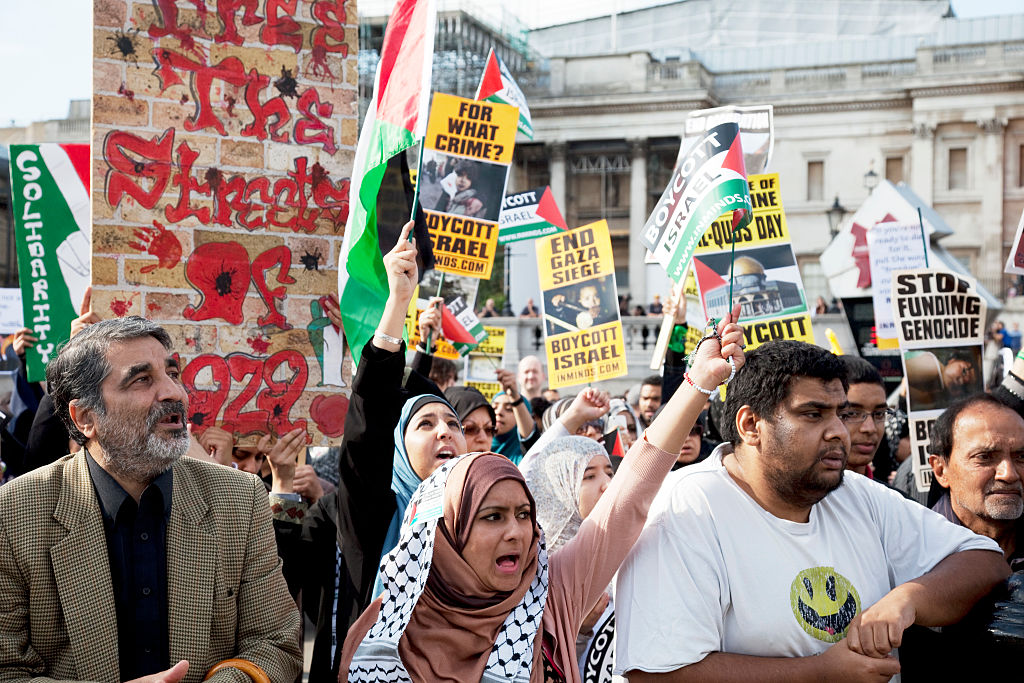
The government has approved a request from the Metropolitan Police to ban the annual Al-Quds day march in London, which was due to take place this Sunday. The Home Secretary, Shabana Mahmood, said the decision was necessary to prevent ‘serious public disorder’. The Met cited the expected scale of the protest, the likelihood of large counter-demonstrations, and the wider tensions generated by the conflict in the Middle East.
Each year the same scenes returned: Hezbollah banners, chants celebrating the ‘resistance’, speakers denouncing Zionism as an open expression of hostility towards Jews
The march itself will not take place. A stationary protest may still occur under strict conditions. While this is a significant decision, it is also absurdly late.
For decades the Al-Quds march has been an annual fixture on London’s streets, typically held towards the end of Ramadan. It traces its origins to 1979, when Ruhollah Khomeini declared an international day of protest against Israel following the Iranian Revolution. In London it has been organised primarily by the Islamic Human Rights Commission and has taken place for roughly 40 years.
Every year the same arguments were made. Every year the same warnings were issued. And every year the British state concluded that nothing could be done. Until now.
The Home Office and the police say the threshold for banning a march is extremely high. That is true. The power is rarely used. It requires a judgement that serious disorder cannot be prevented through normal policing. Yet anyone familiar with the Al-Quds march knows that the problem was never confined to crowd management or rival demonstrations: the problem was the event itself.
From the beginning it was designed as a political ritual aligned with the ideological project of the Iranian revolution. That was not hidden. It was explicit in its founding declaration and explicit in its symbolism. ‘Al-Quds’ is the Arabic name for Jerusalem. The idea that such a march – part of a corrosive global mobilisation against Israel, carefully designed as a statement of solidarity with movements aligned with Tehran’s regional ambitions – should make its way freely through the streets of London was always patently absurd.

For years participants carried the flags of Hezbollah through the streets of the British capital. Placards and chants regularly indulged in rhetoric that opposed Israel’s existence. Jewish organisations and many ordinary observers pointed to signs invoking conspiracies, equating Zionism with Nazism, or celebrating terrorist groups committed to Israel’s destruction. Occasionally there were arrests for racial hatred or for expressions of support for terrorist organisations. More often there were none.
The march became a space where anti-Semitic rhetoric appeared in public with such confidence it was then no surprise that the post October 7th hate marches would become so casually accepted, too. Each year the same scenes returned: Hezbollah banners, chants celebrating the ‘resistance’, speakers denouncing Zionism as an open expression of hostility towards Jews.
For all the ‘free speech’ arguments thrown back at us when we complained, London did not look like a confident liberal democracy defending free expression by allowing the march. It looked instead like a state tolerating intimidation in the name of neutrality. A state which didn’t really care about the fear of its Jews, nor the damage being done to its wider population through the tolerance and open support for threatening Islamic extremism.
Supporters of the march pretended it was a family-friendly protest in support of ‘Palestinian rights’. Yet the political character of the event was never ambiguous. Its ideological origin lay in the revolutionary doctrine of the Islamic Republic of Iran. Its imagery and slogans repeatedly echoed that lineage. In a way, that does indeed perfectly reflect the mainstream Palestinian ideology and cause.
The Iranian regime has not exactly been subtle about its ambitions. Tehran funds and arms terrorist proxies across the Middle East. Its leadership openly calls for Israel’s elimination. It conducts influence operations abroad and intimidation campaigns against dissidents. British security services have repeatedly warned of Iranian plots and hostile activity inside the United Kingdom. None of this came to light this week. The regime did not wake up this year and decide to become a threat. Nor did the Al-Quds march suddenly become problematic.
For 40 years London hosted an annual demonstration whose ideological roots lay in a revolutionary state openly hostile to Western democracies and openly committed to Israel’s destruction. This raises an obvious question: why now? The ideology behind the march has not changed. The symbolism has not changed. The Iranian regime’s hostility towards Israel and Western democracies has not changed. The warnings from Jewish communities about the atmosphere created by the event have not changed either.
What has changed is that thanks to the Israeli and US military action in Iran, and thanks to over two solid years of open warfare on Israel by Iran and its regional proxies, the geopolitical climate has grown so volatile that the political cost of inaction has become impossible to ignore. In other words, Britain has acted when the problem has already metastasised, making the overall disease much harder to eliminate completely.
The ban on the Al-Quds march, therefore, deserves two judgements at once: it is correct, and it is an indictment. Correct because no society with a scrap of self respect should allow its streets to be used as a parade ground for movements celebrating violent proxies and normalising anti-Semitic and anti-Western rhetoric. An indictment because it took four decades for the British state to reach a conclusion that was obvious long ago.
Yet only now has Britain acted – a perfunctory and performative gesture so late it almost makes it look weaker. Whether the damage already done can be reversed is another question entirely.





Comments