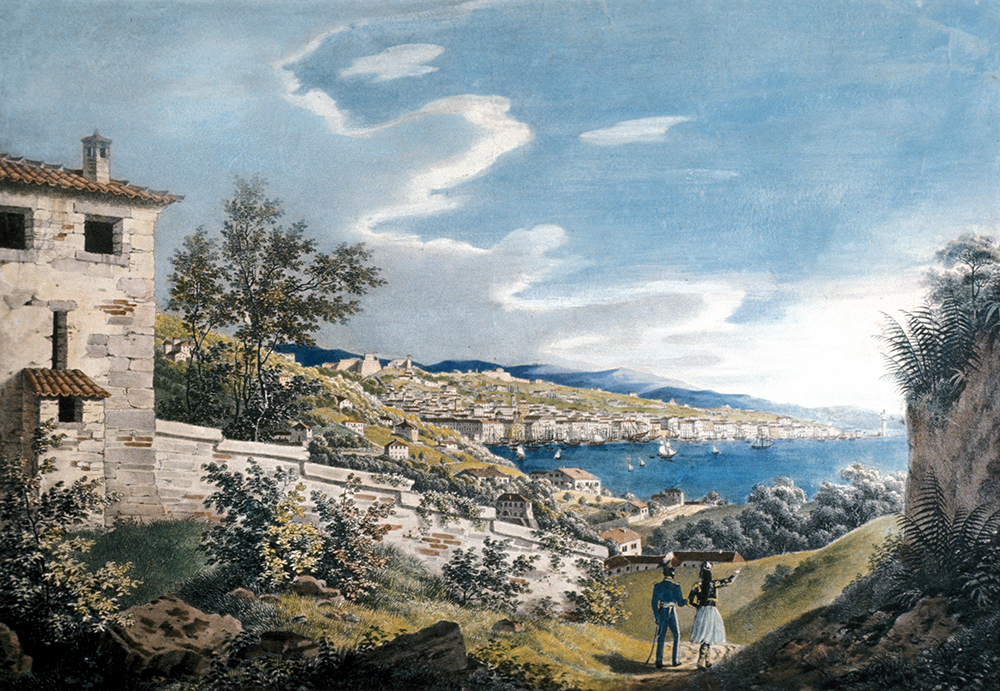
Michael Arditti’s impressive and immersive family saga begins in Salonica (now Thessaloniki) in 1911 and follows the fortunes of the wealthy, powerful Carrache family who are part of the Sephardic Jewish community. They have lived in the city for two centuries and employ more than 1,000 people.
The father of the family, Jacob, is ‘a well-known liberal’ who ‘would never compel his children to do anything against their will’; but he is outraged by his daughter Esther’s flirtations with socialism. So what will happen when he discovers his son Leon’s relationship with a nightclub singer?

He also worries about his other three children: Ruben is reckless, Bella is artistic and Irène is overlooked. Meanwhile, his factories are being closed by strikes; but these domestic tensions are swept aside when the ruling Ottomans are driven out of Salonica by the Greeks.
The family flee to France and the scene shifts to Jacob’s funeral in September 1939. Soon his children are scattered – to Marseilles, Manchester, Argentina and the Nazi death camps. The novel’s third section moves forward again, to Paris in 1961, and a new generation troubled by the past.
When Ruben’s son Pascal sets out to understand how his father survived the war he uncovers information he would rather not know. For Leon’s daughter, Gabrielle, who endured the camps and moved to Israel, humiliation continues. A man who sees her tattooed arm asks: ‘Why is it only the pretty ones who survived?’
Through these varied stories, Arditti proves himself to be a brilliant and sure-footed storyteller. He is able to establish place, character, politics and conflict in a few short pages. He is also adept at leaving a scene early, then picking the narrative up later from a new perspective. There is a depth of research which makes every location feel authentic. There may be moments when the history becomes a bit overwhelming, and one of the final resolutions is fractionally heavy-handed, but overall this family saga is an exceptional achievement.
Perhaps Arditti’s greatest strength is that he is wonderfully devoid of sentimentality. His view of family is brutal. What we see here is not love but fragile and fractious loyalties forged in fear and hardship. Yet family remains as an anchor. As Jacob’s wife says: ‘Isn’t family the only map we need?’





Comments