Bring me my bow of burning gold; or failing that, the opening notes of Elgar’s Second Symphony. That’s how I’ve always imagined them anyway, those three swelling B flats – a mighty drawing back of the bow before Elgar propels his arrows of desire into the restless heart of this greatest of British symphonies. Thinking back, though, I’m not sure I’ve ever felt quite that tension in a live performance – not from Pesek in Liverpool or Barenboim at the Proms, and not from this most recent encounter, with Mark Wigglesworth and the Bournemouth Symphony Orchestra in Bristol. So where am I getting it from? Recordings, presumably, and the long-embedded imprint of two boyhood idols, John Barbirolli and Vernon ‘Tod’ Handley.
You felt as if you’d actually lived through something huge, beautiful and infinitely sad
But that’s the problem with recordings, isn’t it? They’re the musical equivalent of pornography, and we’re all addicts these days. Allow a particular recording to become a habit, and it can stunt your capacity for a natural, responsive relationship with living music. Sure enough, after those first (at most) three seconds, Wigglesworth’s Elgar Two was very fulfilling: passionate, restless and paced in one commanding hour-long arc, so that when he reached those extraordinary final pages where the cloud-capped towers dissolve, you felt as if you’d actually lived through something huge, beautiful and infinitely sad. And why else do we listen to hour-long late romantic symphonies?
The symphony was the main (but not the only) reason for attending this concert at the Bristol Beacon, where the BSO’s newly established residency appears to be going great guns. A packed, attentive and noticeably youthful crowd in a handsome new hall; the sight of the BSO filling the stage in full Elgarian panoply – it does the heart good, this sort of thing; makes you feel better about the world. Wigglesworth is in his second season in charge of the BSO, and on the strength of the Elgar, it feels like the relationship is bedding in. The ensemble playing was focused and confident; the sound of an orchestra at ease with itself.

That, in turn, let Wigglesworth do heroic things with the symphony – steering a tumultuous course through the first movement (but letting the cellos sigh their hearts out in Elgar’s more desolate moments), and taking the scherzo at a daringly fast pace. No suggestion of respite, here, in the woodwinds’ tender little quadruplet phrases. They were tiny scraps of hope, grasped at and then whirled away. The violins streamed downwards from the climax of the Larghetto with big, expressive portamenti; gloriously frank and lush. Wigglesworth’s textures were transparent enough, and his phrasing sufficiently flexible for us to hear the harps quietly embroidering the harmony from within. The veiled string phrases in the movement’s closing bars evaporated like mist
into silence.
The first half of the concert comprised Beethoven’s Violin Concerto, which gave further proof of Wigglesworth’s rapport with his orchestra (and particularly their timpanist, who is an outright poet). Wigglesworth placed phrases with classical deliberation. Big tuttis evoked Haydn, and the slow movement had the lilting gait of a sarabande. But until the finale, it was all very slow and restrained, which in fairness reflected Wigglesworth’s sensitivity to his soloist Clara-Jumi Kang. Kang is a thoughtful and refined player, which is great if you like your violin tone as delicate as gold filigree and your Beethoven handled like antique glassware. It’s this kind of reverence that renders so many Bach recordings unlistenable, although it should be said that the Bristol audience rewarded her with a near-ovation.
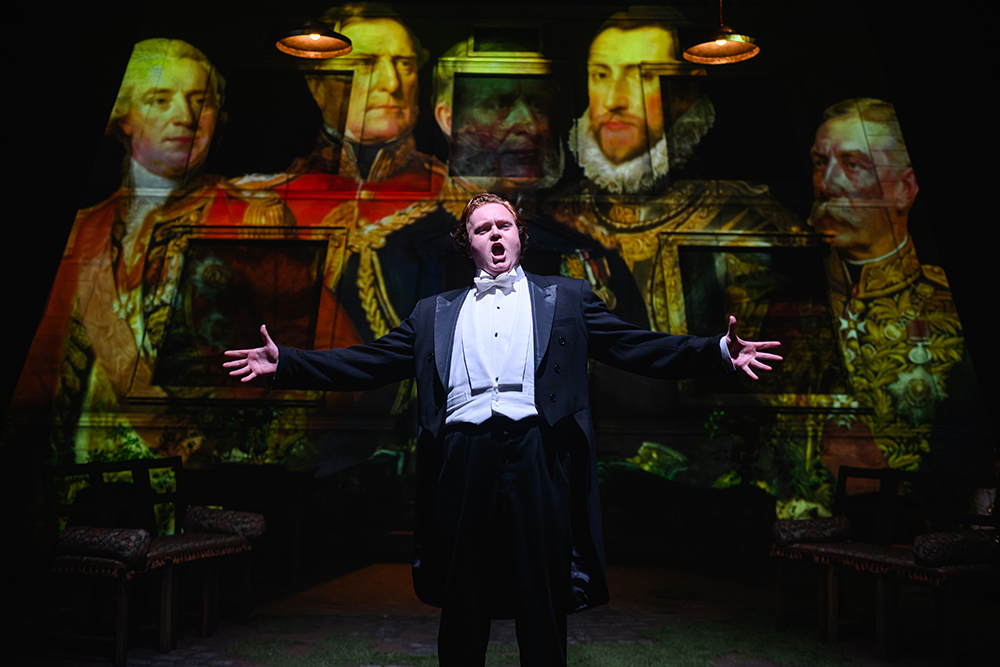
At the Guildhall, the student opera this term was Britten’s Owen Wingrave, in a production – directed by Martin Lloyd-Evans and conducted by Dominic Wheeler – that would have been impressive from any professional touring company. The Silk Street Theatre had been reconfigured around an apron stage, with the audience on three sides and the looming, eerily lit facade of Paramore Hall (sets were by Laura Jane Stanfield) hanging over proceedings until it lifted clear to reveal an unseen world in a final, fantastic coup-de-théâtre.
The main dramatic problem with Owen Wingrave is the priggish title character, a student rebelling against his military family who discovers (to paraphrase South Park) that it isn’t enough merely to be a pacifist: you have to be insufferable to everyone who doesn’t think like you, too. Sonny Fielding, as Owen, projected such vocal and physical dignity that you almost sympathised. Against him, Tobias Campos Santinaque was engagingly boyish as his schoolmate Lechmere and Gabriella Giulietta Noble simmered with venom and officer-class steel as Owen’s soon-to-be-ex-love interest Kate. The student orchestra was cool as ice, and as with all the best Britten stagings, the whole felt like more than the sum of some very impressive parts. Incidentally Owen Wingrave, like Tippett’s New Year, was originally commissioned for television. Imagine. Imagine a civilisation like that.




Comments