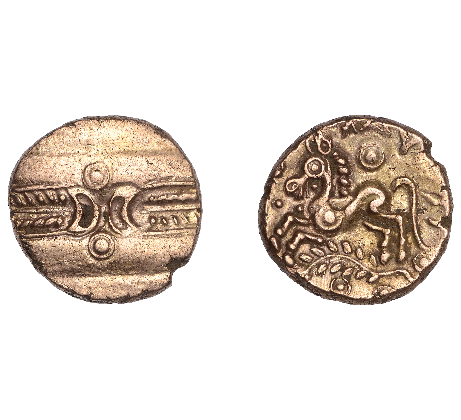
In 2024 a detectorist found some gold coins in Suffolk. The discovery was declared legally treasure. If a museum wanted the coins, the finder would have been rewarded with a sum equivalent to their market value, but none did, so he’s selling them, at an auction estimate of £20,000 to £26,000.
Here’s the problem. It costs a lot of public money to record detected antiquities
You might think everyone would be happy. Archaeologists have learnt something new. The detectorist will pocket a sum from his hobby, which he will share with the landowner. And he’s promised to donate a portion of the proceedings towards local research. But some archaeologists are decidedly unhappy. When you hear their objections, you might find yourself agreeing with them.
Tens of thousands of detector finds are reported every year, many of historic importance. A few are very valuable. This particular find has raised the archaeological ire, because of who made it. Tom Licence has been metal detecting since he was a boy, and writes for a detecting magazine. But in his day job he’s professor of medieval history and literature at the University of East Anglia, the author of a book about Victorian rubbish dumps, and a fellow of the Society of Antiquaries. In other words, for archaeologists, he’s one of them. And archaeologists do not sell the past.
Licence made his discovery near the village of Shimpling, south of Bury St Edmunds, with archaeological precision. He scoped the location for likely finds, learnt about the field’s history from its owner, and then gridded out a search area. His detector picked up 17 coins, which he reported to the Portable Antiquities Scheme. This is a recording, reporting and advisory project centred at the British Museum, with 45 liaison officers across England and Wales. The Suffolk officer told the coroner about the hoard, and the treasure process began. Back in the field a few months later, Licence found another coin, recognised as having come from the same hoard.

The 18 coins contain around 44 per cent gold and 17 per cent silver; the rest is copper. Fourteen were minted under the name Dubnovellaunos, and four Addedomaros, at least two Iron Age chiefs or kings. They are known from other coins to have been active in Kent and Essex, a few decades either side of the birth of Christ. The new finds will aid our understanding of this period. Sixteen of them will be auctioned by Noonans, one at a time, on March 4.
Archaeologists are naturally protective of our heritage, seeing it as irreplaceable for understanding the past. With ever-improving technology, the humblest artefacts can now reveal extraordinary insights. Archaeologists of course enjoy making discoveries themselves (just watch the BBC’s Digging for Britain) and their concerns about metal detecting might look like sour grapes. Licence did everything right, but the thought of an Antiquaries fellow selling antiquities has led to a debate about the whole system of collecting and reporting finds.
Here’s the problem. It costs a lot of public money to record detected antiquities, the great bulk of which are not covered by the Treasure Act. This pays for British Museum curators – seven full-time on treasure alone – liaison officers in regional museums and council offices, conservators, courts and more. When treasure is declared, there may also be a reward to pay. All of this, as Tessa Machling, an archaeologist and specialist in gold recently learnt from a Freedom of Information request, adds up to a confirmed £8.7 million a year for taxpayers and philanthropists – she estimates a cost of at least £10 million.
The metal detecting community pays nothing towards that sum. They do, however, occasionally get rewarded, and can keep – or sell – their finds. Detectorists gain but contribute nothing, Machling says, who told me that until recently she’s ‘been shouting into the void’ about this.
The fact that detectorists can keep their finds can also lead to strange, but legal, outcomes, such as ancient coins being perforated to make earrings. Ian Richardson, who leads the treasure team at the British Museum, told me about a hoard of Bronze Age ingots found on the Isle of Wight. The finder planned to melt them down to create jewellery.
Finds liaison officers, says Machling, are ‘underfunded, overworked and lacking legislation’. She would like metal detectors to be licensed, with a small fee and a commitment to follow agreed standards.
In England and Wales, outside treasure, finds reporting is voluntary. In Scotland, everything must be reported and is automatically Crown property. You can be fined or imprisoned for violations. Other countries rely on a mix of law and goodwill, Judging the relative merits of control and freedom is hard.
There are arguments against a more punitive detecting system. Our Portable Antiquities Scheme is widely admired by overseas archaeologists. Surveys suggest that only 10 per cent of National Council for Metal Detecting members record their finds. If we enforce reporting that could mean even fewer discoveries being made public.
In 2024, 1,540 treasure items and nearly 80,000 other antiquities were recorded here, each with a story to tell. Some of the best items were then acquired by museums. Add in the social benefits of time spent outdoors with detectors, even occasionally watching the bids from the back of an auction room, and this seems quite a bargain for £10 million. And if licensing is rejected, perhaps the way to smooth things over between detectorists and archaeologists is to make up the shortfall with a little more public funding.






Comments