If the Equality Act 2010 made discrimination illegal, then why we have seen the rise of persistent and widespread discrimination against white males across the public and private sectors?
Today, some form or other of anti-white social engineering can be found in practically any institution you care to name. Famously in 2023, the RAF, in a bid to make ‘the few’ even fewer, discriminated against 31 ‘useless white male pilots’ in a recruitment scheme. But we can add the NHS, universities, all manner of coveted white-collar grad schemes and internships, the Premier League, GCHQ and local councils.Or just take what we’ve seen in the police. In 2024, three white officers were passed over for promotion by Thames Valley Police because of their race; last year, West Yorkshire Police temporarily blocked applications from white candidates in a diversity drive; only last month, it emerged that two male officers had been fired from a team by Suffolk Police on the grounds of ‘operational reasons linked to gender balance’.
It seems that in multicultural Britain, some ‘protected characteristics’ are more protected than others
It seems that in multicultural Britain, some ‘protected characteristics’ are more protected than others.
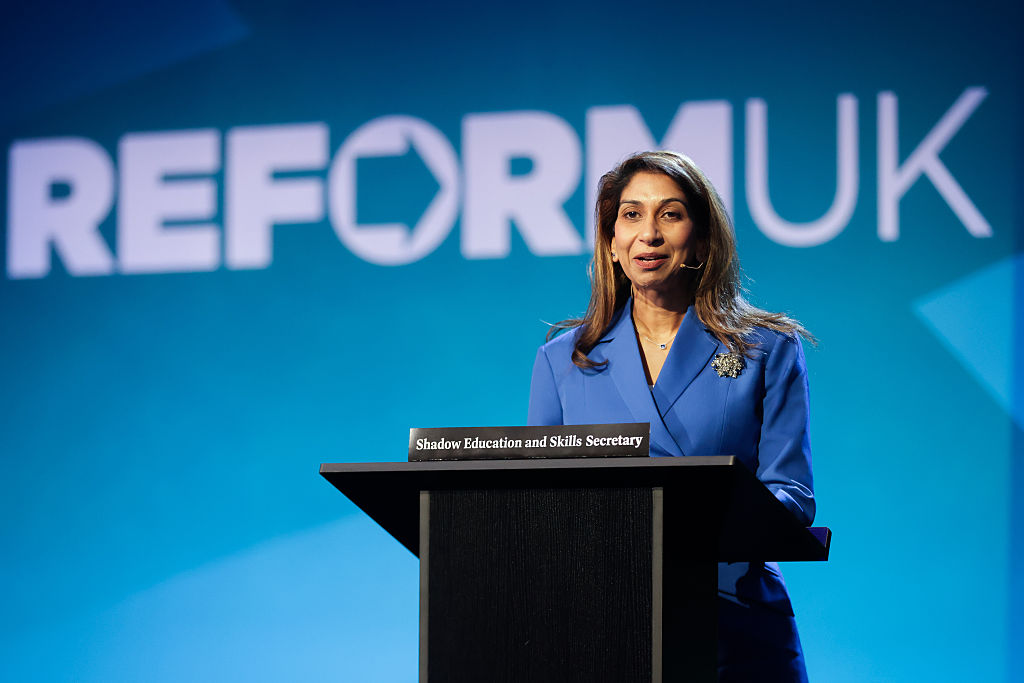
It is welcome news, then, that Reform has this week announced plans to scrap the Equality Act on ‘day one’. Suella Braverman, unveiled on Monday as Reform’s new shadow education, skills and equalities secretary, said Britain is being ‘ripped apart by diversity, equality and inclusion’.
In her new brief, the former Conservative home secretary will take aim at the equalities state and ‘build a country defined by meritocracy not tokenism’. In schools, this will mean a ‘patriotic, balanced curriculum’, where in particular Braverman has pledged to root out transgender ideology in the classroom, including banning the so-called ‘social transitioning’ of pupils. She also fired a warning shot at universities, some which she says have ‘descended into hotbeds of cancel culture [and] anti-Semitism’, rely too heavily on foreign students, and ‘keep conning young people into worthless degrees’.
This is undoubtedly red meat for the base – Braverman’s Equality Act proposals prompted the loudest cheers at Monday’s London press conference – but it is important to be maximalist in principle. Previous attempts from the right to take aim at the equalities bureaucracy, most recently spearheaded by Kemi Badenoch as equalities minister, have misfired by failing to address the problem at its philosophical root. The problem is not just that EDI initiatives are costly make-work schemes with little evidence base to them – it’s that the racial gerrymandering they are trying to achieve is itself a bad idea.
‘The problem with the Equality Act is not poor implementation’, explains Alka Sehgal Cuthbert, director of campaign group Don’t Divide Us, ‘It is that it embeds identity politics.’ Indeed, it was always telling that despite Mrs Badenoch’s reputation as an anti-woke firebrand, she presided over the diversity bureaucracy as equalities minister – and created a good deal more of it. Braverman, meanwhile, now in teal, wants to abolish the equalities brief altogether.
There are important reasons the Equality Act has to be changed. For one thing, it has encouraged untold vexatious complaints in the workplace. A recent report by Don’t Divide Us found a seven-fold increase in employment discrimination claims around race between 2016-17 to 2023-24, despite just 5 per cent of claims being successful over the whole period. The Act’s focus on personal identity and victimhood encouraged a grievance culture, it found, which far from easing racial tensions was only exacerbating them further.
In particular, it is the Act’s Public Sector Equality Duty and ‘positive action’ wheezes which have made it a vehicle for systematic discrimination against less politically favoured groups – whites and men. While the Act outlaws ‘positive discrimination’, where minorities are explicitly hired preferentially, it doesn’t outlaw ‘positive action’, where minority groups get special outreach programmes, which we’re supposed to think is fair and unobjectionable. But as those would-be airmen know, this is really a distinction without a difference. If you’re giving a leg-up to some groups to increase ‘diversity’, you’re not giving them to others. ‘Institutions should be held accountable for treating people fairly rather than hitting artificial demographic targets’, says James Orr, Reform’s new head of policy.
Necessary as it is, Reform’s anti ‘equalities’ crusade is sure to rile the left. An unsubtle Guardian headline on the press conference anticipates the line of attack: ‘Farage insults female reporter as Braverman says Reform UK wants to scrap Equality Act.’ On Monday’s Newsnight,a testy Victoria Derbyshire repeatedly grilled new shadow home secretary Zia Yusuf over which particular discrimination protections Reform was looking to scrap. In reality, though, while critics will no doubt try to paint Equality Act reform as extreme, the policy hits a healthy middle ground. Orr explains: ‘The Equality Act consolidated pre-existing legislation on disability, sex and race discrimination. Reform UK supports the predecessor legislation and unequivocally opposes discrimination based on protected characteristics.’
It was Harriet Harman who introduced the Equality Act, in the death throes of the Brown government. During the recent row over the Garrick Club, Harman declared that, after her revolution, Labour’s idea of equality is now ‘a recognised public policy objective’ – and what’s more, that ‘all those in public life should be committed to that objective’. But do ordinary Brits really share Labour’s dreams of a totalitarian equalities state? I’d imagine not. It’s high time a major party took a chunk out of it.





Comments