
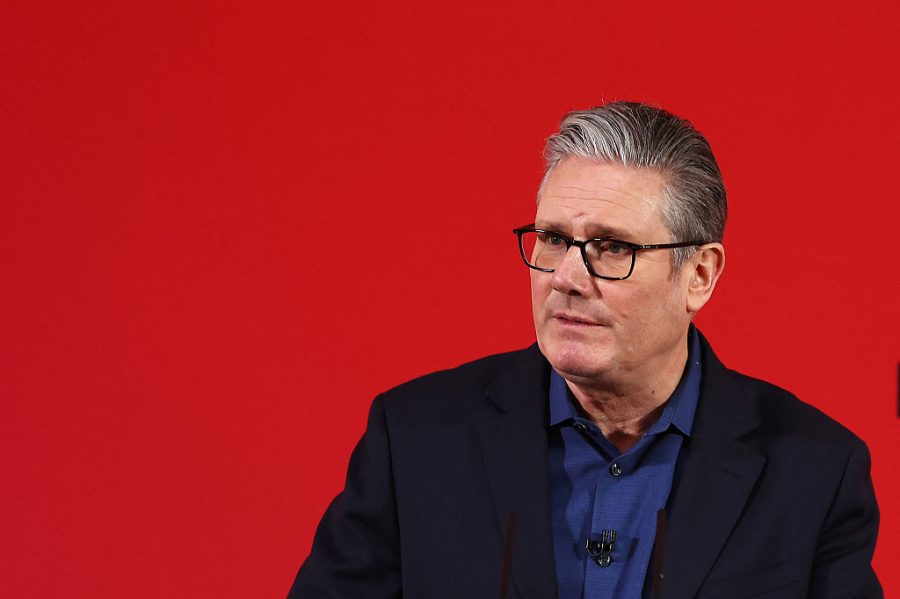
By the end of last week, it was clear the Prime Minister is a goner – the debate moved to the pace of his demise. That sped up yesterday with the resignation of Morgan McSweeney, his chief of staff. Starmer’s prospects looked very bleak indeed when I turned on the Today programme this morning to hear a defence of the PM being mounted by Baroness Smith of Malvern.
I wouldn’t pretend to understand the government’s communications strategy, but it doesn’t exactly scream confidence when the most senior spokesperson offered up for the morning media round is a junior skills minister from the Lords. A few hours later, the man in charge of that media strategy (and the fourth person to hold the job in 12 months), Tim Allan, jacked his job in and followed McSweeney out the door.
There’s a world in which, in just a few months, Keir Starmer could claim his plan is beginning to work
After just five months in the position, Allan said: ‘I have decided to stand down to allow a new No.10 team to be built.’ But, as James Heale explained on Coffee House, there is speculation that the real reason for his departure could be because of embarrassing messages between him and Peter Mandelson that are about to be released. In any event, Allan’s departure increases the speed of the political treadmill Starmer is barely managing to avoid hurtling off.
Then came the first big Labour name to go over the top. The party’s leader in Scotland, Anas Sarwar, held a press conference and called for the PM to go. This was, we were briefly told, to be followed by a similar statement from the Welsh First Minister but in the end Eluned Morgan decided against it.
Then came a succession of centrally dictated tweets kicked off by Justice Secretary David Lammy calling for calm and stating that now was not the time to change prime minister. A spokesperson for Baroness Smith even felt the need to say: ‘Angela doesn’t post on X but of course Keir has her full support.’ Starmer, it seems was safe for now.
So, what’s next? Starmer is, this evening, addressing a meeting of the Parliamentary Labour Party in which he will have to give the best speech he’s ever given if he’s to have even the remotest chance of turning things around. If, as seems more likely, the speech is a flop we could see an even hastier exit.
When it comes to timing, I suppose the real question is whether the PM’s rivals move to depose him before his own conscience decides enough is enough. I should probably leave political predictions to my colleagues in the lobby but if you’ll allow me to make a guess, I reckon it’s far more likely Starmer decides to fall on his sword in the coming days or weeks than that someone like Wes Streeting goes over the top.
Over in my own economics beat though, the question all my contacts are pondering is, obviously, what whoever comes next means for them and by extension: all of us. As Anas Sarwar spoke, the 10-year gilt yield – the ones crucially used in Office for Budget Responsibility forecasts – shot up to a four-month high and the pound slumped as markets worried about an economic lurch to the left. But once the cabinet’s tweets were all counted present and correct, the sell-off eased and yields returned to normal. In the end there has been barely any move in the market when you compare open to close.
So, what do markets really think? Among those I’ve listened to there seems to be two schools of thoughts: a soft-left candidate will be neutered by the markets into committing to fiscal stability and end up bringing in more of the same. Or they junk the fiscal rules, go full-blown old Labour tax and spend and try to weather any storm that creates in markets.
Whichever comes to pass, the new occupants of Nos. 10 and 11 must wrestle with the most underappreciated – both in the City and SW1 – aspect of last November’s budget: just how much of a work of fiction it was. If the plans unveiled by Reeves just months ago are to be believed, then over the next five years we’ll see £59 billion more spending and £77 billion more taken in in taxes. But here’s where the Chancellor asks you to suspend your disbelief: two-thirds of that spending happens in the next three years while three-quarters of the extra tax is due in the final two.
Are we really going to pay for massive spending increases with taxes rises that voters will really start to notice in the next election year? I have my doubts.
But there’s a third point that bond traders and economists alike are keen to make: why not just hold on? Because the truth is Morgan McSweeney was right when he said the country is about to turn a corner – albeit not a very sharp one.
By April inflation could be back down to 2 per cent, next month the Bank of England is more likely than not to again cut interest rates, net migration will continue to fall and we could even have some GDP growth to celebrate. There’s a world in which, in just a few months, Keir Starmer could claim his plan is beginning to work.
But economists are often too focused on just the numbers and ignore the admittedly irritating importance of vibes. And markets are missing the key vibes point: once a PM’s political disease is presumed fatal, he will surely soon be dead. Which leaves possible a world in which a soft-left candidate is able to implement the fiscally loose policies that some think impossible because of adverse market reactions.
If inflation – which is ultimately more important to bond traders than fiscal policy – does come down sharply, and if growth does pick up, then a soft-left candidate may find themselves with enough market wiggle room to enact measures that might involve tweaking the fiscal rules without a full-blown meltdown. So, the third point traders have been discussing today as a potential saviour for Keir Starmer may actually prove cruelly ironic. The corner Morgan McSweeney spoke about may genuinely be approaching – lower inflation, rate cuts and growth. It’s just unlikely Starmer will be the beneficiary of it.
Watch the latest Reality Check with Michael Simmons on Spectator TV:





Comments