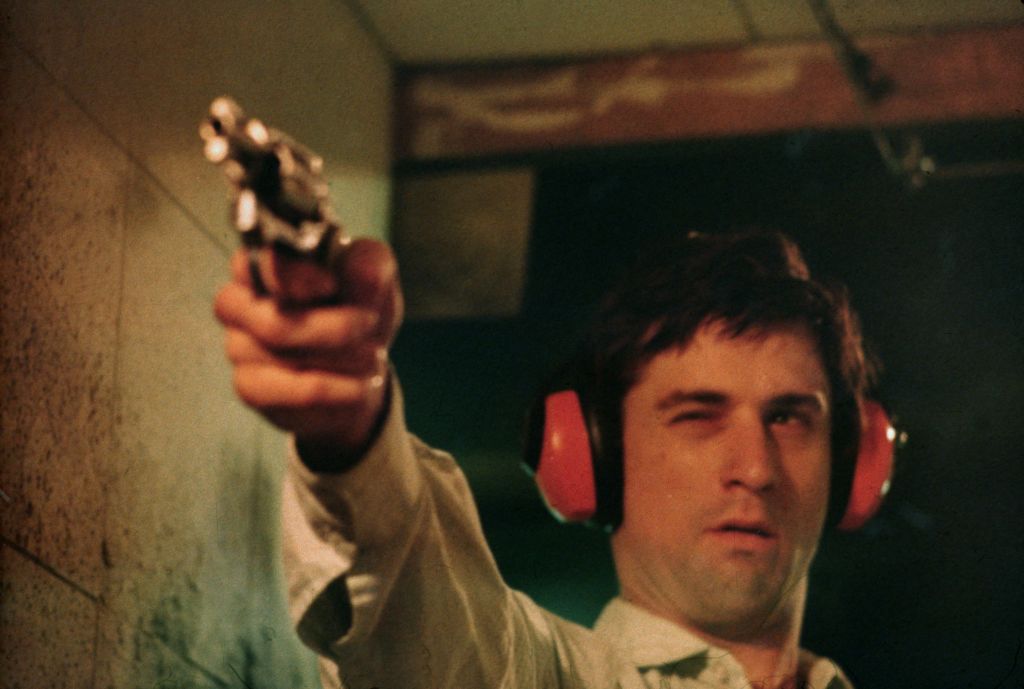
Even if you haven’t seen the movie, you probably know the macabre legacy of Martin Scorsese’s early masterpiece Taxi Driver. Released 50 years ago this month, the tale of the eponymous cabbie Travis Bickle, played by Robert De Niro, still has something potent to say about what can happen when a brooding loner finds himself adrift amid the menace and jammed chaos of New York’s streets with a .44 Magnum for company.
Perhaps one of the reasons Taxi Driver resonates with so many people is because of this human void that lies at its center. At one time or another, we’ve all felt as alone as Travis Bickle. Fortunately, most of us are better at dealing with it than Bickle, whose haunting line, “Someday a real rain will come and wash all the scum off the streets” signals a climactic orgy of screen violence that delivers both a visceral shock and a sense of relief of the “It had to happen, and it’s happened” variety.
At one time or another, we’ve all felt as alone as Travis Bickle
For at least two individuals, however, the human time-bomb played by De Niro proved to be the trigger that unleashed their own unmetered psychosis, with tragic real-life results.
One of those paying $2.40 to watch Taxi Driver during its run at the Elgin Theater in Manhattan in the spring of 1976 was a pudgy, 22-year-old New Yorker named David Berkowitz. Like Travis Bickle, he was an insomniac, socially inept military veteran, and for several months that year he was actually working as a cab driver. Being an injustice collector, Berkowitz had several misgivings about his circumstances in life. Then, as he claimed but later recanted, he came to believe that his neighbor’s black Labrador was instructing him to go out and seek victims to kill.
In due course, having bungled his first attempt at murder using a knife, Berkowitz switched to a handgun and began prowling the suburban streets at night, looking for prey. Over the next year, he killed six people and injured at least 10 others. Following his arrest in August 1977, Berkowitz told a reporter of the imagined debt he owed to Scorsese’s film.
“I had a cab, and I was actually patterning my life after Taxi Driver,” Berkowitz reflected, as though this had merely been a sort of professional hommage on his part. “I saw myself exactly as the De Niro character: a loser, living in a cramped little apartment. That was me in the movie!”
Another thing Berkowitz shared with his fictional counterpart was that strangely American cult of celebrity that allows its outcasts to become just as famous as its achievers. In the somewhat incongruous happy-ending coda to Taxi Driver, Bickle ends up a hero, finally validated, at least in his own mind, for having cleaned the scum off the streets, while Berkowitz, in turn, would prove far from averse to sharing his story with the outside world. It’s largely thanks to him that 40 US states currently carry so-called Son of Sam – named for Berkowitz’s Labrador-owning neighbor, Sam Carr – laws on their books specifically designed to keep convicts from profiting financially from their crimes.
The other ghastly perversion of Scorsese’s movie came when another pudgy-faced drifter, this one named John Hinckley Jr., became obsessed with the actress Jodie Foster, who famously plays a pre-teen hooker in the film. Like Charles Manson before him, Hinckley was a frustrated folk singer, and, like Berkowitz, another sad advertisement of what can happen when paranoid delusions meet with gun ownership. Over the years, his plan came to revolve around the idea of assassinating the US president in the belief that this might impress the object of his desires. Hinckley wasn’t fussy about which president. In October 1980, he was arrested at Nashville airport with three handguns in his luggage while Jimmy Carter was speaking elsewhere in the city. He was fined $50 and released the same day.
Five months later, Hinckley managed to shoot Carter’s successor in office, Ronald Reagan, outside the Washington Hilton. The attack left Reagan with serious injuries and permanently paralyzed press secretary James Brady. A Secret Service agent and a police officer were also wounded. Jodie Foster was not impressed. So far from being attracted to Hinckley, she’s commented on her reluctance to ever act in live theater lest another deranged fan appear in the audience. Hinckley himself was released after 41 years’ confinement in a psychiatric hospital, and is now attempting to resume his career as a musician and artist, although his reception thus far has not been encouraging from the ranks of either the record industry or the public.
One way or another, it’s a lot of grief to be associated with a movie that helped to breathe new life into what constituted the accepted idea of a box-office hit, in this case by giving the audience an immersive sense of what being trapped in a steel cage on wheels with strangers for anything up to 80 hours a week might feel like. Still, the film should be remembered less for the homicidal maniacs it inspired, and more for what it says about the sense of isolation that seems to be part of the human condition.
Whatever you make of Taxi Driver, its cinematography remains wonderfully evocative. One of the movie’s indelible images is of Bickle’s yellow cab passing slowly through the steam of the Manhattan streets – a Hades metaphor if ever there was one – accompanied by a suitably brooding score by Bernard Herrmann. In another twist, Herrmann finished recording Taxi Driver’s music just hours before his death from a heart attack at the age of 64, a somehow fittingly morbid footnote to a film that seems to have been touched by more than its share of shadow.


Comments