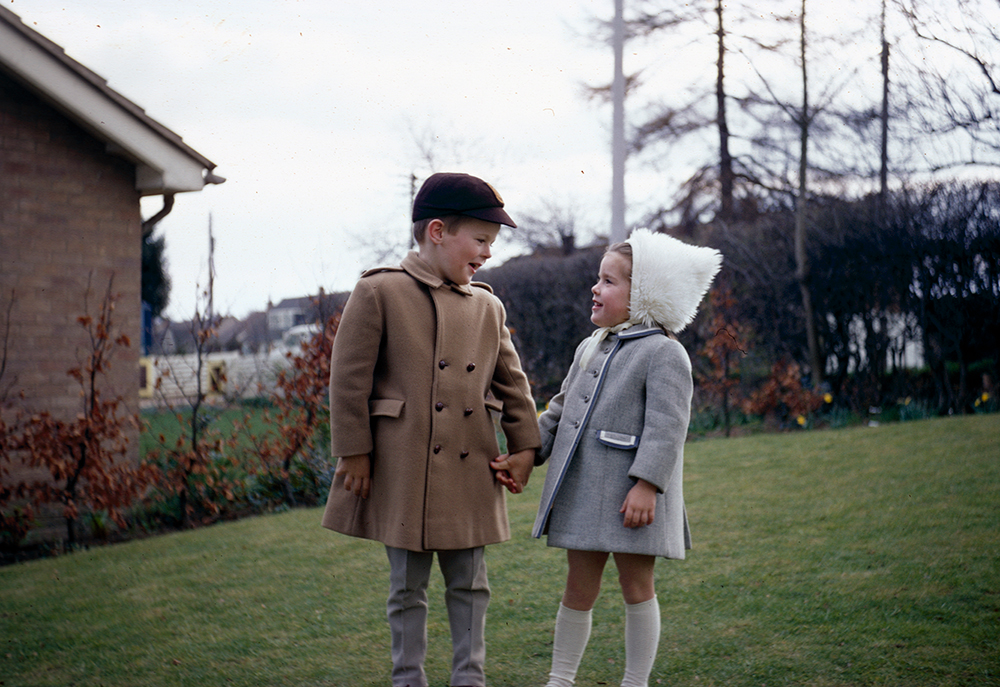
Growing up in the 1960s at 288a Main Road on the outskirts of Northampton, Mark Haddon spent hours alone in the bathroom, the only lockable room in the house, trying to figure out the universe. In this dark, sui-generis memoir he writes:
Even now, insoluble conundrums such as ‘Why was I born as me and not someone else?’ and ‘If the universe is expanding, then what is it expanding into?’ come packaged with images of a shampoo bottle in the shape of a fat sailor with a twist-off head.
The author of The Curious Incident of the Dog in the Night-time has a scientifically inclined mind in which small physical details, such as that sailor’s twist-off head, get permanently lodged. On his bedroom wall, Haddon had the Weetabix Solar System Wall Chart with information about each planet. Under Pluto it said, disappointingly: ‘Not enough is known about Pluto.’
Not that (as Haddon himself admits) he has an especially good memory. He is excellent on the random selectiveness of what we happen to remember. Of a whole post-school Interrail trip from Norvik to Thessaloniki, the only images left in his mind are ‘some generic civic shrubbery and the inside of a hot tent’.
Outside the family bathroom – for example at the bar stools in the kitchen, too high for children and too concave for adults – life was not happy. Haddon’s father was an architect who designed abattoirs, so all the juvenile drawings Mark and his sister Fiona did were on the reverse side of old plans depicting killing rooms and blood-drainage channels. Their mother, Maureen, threw the drawings away. She thought books counted as ‘mess’: ‘Childhood drawings didn’t stand a chance.’ It was she, utterly emotionally disengaged from both her children and taking no interest in their achievements, who made their childhoods feel loveless and bleak.
Mark’s mother, utterly disengaged from her children, made their childhoods feel loveless and bleak
The pre-title page of this ‘memoir in full colour’ (words included on the Kodak-yellow jacket designed by Haddon) shows an old photo of roses in a vase, underneath which are the words ‘An Exorcism’. Haddon squirts out excoriating snapshots of his mother, each one perhaps helping to exorcise the memory of her for him and his sister, to whom the book is dedicated. ‘What does it mean, the injunction not to speak ill of the dead?’ he asks. ‘And does speaking ill mean telling lies or telling the truth?’
Their mother was particularly vile to Fiona, a sweet-looking little girl in a hairband, photographed on her bike outside number 288a. A typical example was that her parents didn’t visit her for a week when she was in hospital with meningitis. ‘Your father has golf in the morning,’ their mother explained on the telephone.
I marvelled at Maureen’s tight-lipped pronouncements, which carried on into old age. Rolling her eyes at an affectation of the young, she said: ‘People didn’t die from things in our day. They just died.’ She disliked strong Northampton accents, tattoos, anyone who was overweight and women in employment.
But there’s a deeper darkness to Leaving Home than an unloving mother. As anyone who has read Haddon’s unforgettable short story ‘The Pier Falls’ will recall, he takes a perverse pleasure in envisaging catastrophe. One rivet fails, and from that moment the whole Brighton-style pier heads towards collapse in a single afternoon, causing a large death toll. In this lavishly illustrated memoir, Haddon shows us the inside of his catastrophising, depression-prone mind.
Hypochondria and fear of flying are chief components. Getting pins and needles after a long bike ride in early adulthood, he was convinced these were early signs of MS. For two years he was haunted and sometimes overwhelmed by panic about it. He felt ‘like one of those animals being forced down a narrow pathway towards the killing room’. (His father’s architectural niche was not ideal for a son with this imagination.) Actually, having a triple-bypass operation a few years ago had the effect of ‘inoculating’ him against the terror of death. He does rather bang on about his health, though. My least favourite sentence was: ‘And then I got Covid for a second time.’
The fear of flying is delicious. Haddon is unable to work for weeks in advance of a flight, and ‘the fear of the return journey has soured many holidays for me’. Once, he saw a plane take off from Rome’s Fiumicino airport with one of its engines on fire. ‘I wondered if I was hallucinating. It was what I expected to see every time I went to an airport.’ He illustrates the inside of his mind in this regard with a drawing of a nosediving plane with flames coming out of its propeller, and two speech bubbles. In the passenger section someone is saying ‘Can I have the chicken?’ while in the cockpit someone else is saying ‘Oh fuck’.
The sui-generis nature of this memoir is, first, that it’s not in chronological order, and is divided into short sections, each a macabre vignette from Haddon’s past, adding up to the larger picture. Second, it’s illustrated with a mixture of private photographs and Haddon’s arresting drawings – reminiscent of the drawings in The Curious Incident which celebrated the hyper-literal mind of a boy ‘on the spectrum’.
Sometimes I wasn’t sure what the drawings were meant to represent. One, in the section describing working as a carer for an evangelical Christian with advanced MS, is of a man with blood flowing out of his nipples into a puddle on the floor. Another, in a section on Haddon’s fascination with Georges Perec, is of a beer-drinking, cigarette-smoking bear with blood-soaked face and paws. They’re all intriguing, unsettling and Francis Bacon-esque.
On the subject of celebrity, he offers this salutary reminder to other writers:
I’ve learned that artistic success, however big, gives you nothing to work on this morning, and it’s doing new work this morning that makes one feel at home in the world.



Comments