
Donald Trump’s tendency to exaggerate and make up figures as he goes along is for some people a symptom of the ‘post-truth society’. But for the president himself it is a useful rhetorical tool which helps draws attention to things which might otherwise get less of an airing.
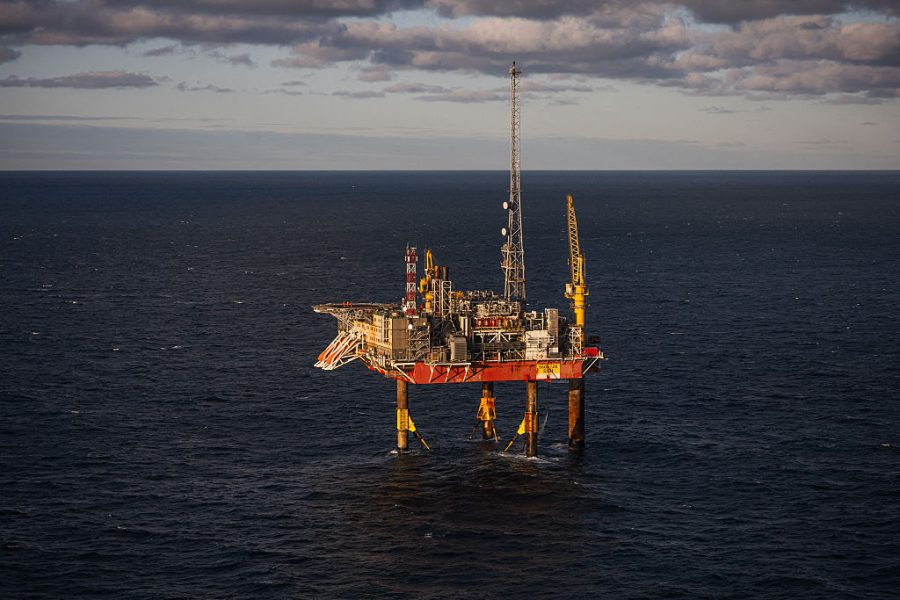
Yes, it is a gross exaggeration to say, as Trump did in his speech at Davos yesterday, that Britain has ‘500 years’ worth of oil in the North Sea. The trouble for his critics, though, is that the essential point he was making – which is that Britain is denying itself valuable energy resources in the shorter term, to the detriment of the economy and national resilience – is rather harder to deny. By making a fanciful assertion, Trump has helped expose an equal fib: that the North Sea is depleted to the extent that it is not worth drilling there any more, other than to lay the foundations for offshore wind farms.
We are forced to import resources which we could be producing ourselves
First, the figures. The North Sea Transition Authority (whose very name spells out the bias of UK energy policy) annually estimates remaining reserves in the North Sea. In its last bulletin, published in October, it suggested that there are 2.9 billion barrels of oil equivalent (BBOE) of ‘proven and probable’ reserves left. This covers both oil and gas, although the resources are roughly divided into 70 per cent oil and 30 per cent gas. This figure has been widely quoted, along with the statistic that over the past six decades we have already extracted 47.7 BBOE of oil and gas. Together, they give the impression that it is pretty well all over for the North Sea.

Except that ‘proven and probable’ reserves is just the top layer of a much more extensive strata of hydrogens known or believed to be lurking under the North Sea. It is the stuff which has been well-surveyed, for whose extraction the infrastructure largely exists and which the oil industry is pretty well ready to extract right now.
Beneath that comes 6.2 BBOE of ‘contingent resources’ – which consists of oil and gas which has already been discovered but which is not yet in a position to be extracted. After this comes 4.6 BBOE of ‘prospective resources’ in areas of the seabed which have been mapped. Finally, comes an estimated 11.2 BBOE of ‘plays’ – which is oil and gas believed to be hidden in areas which have not yet been mapped.
The further you go down this strata of potential resources, the more uncertain things become. The final two figures may turn out to be an over-estimated, but then again they could be a gross under-estimate. Indeed, the quantity of plays and prospective resources counted by the North Sea Transition Authority has grown by over a billion barrels in the past year alone.
There is, on current knowledge, every chance that it will be possible to extract a decade’s worth of oil, maybe much more. Then, of course, there are Britain’s untapped shale gas reserves. In 2013 the British Geological Survey estimated that there could be 47 years’ worth of such resources lying beneath the Bowland Shale, which runs across the North of England. Not all of this would necessarily be recoverable, but then the estimate didn’t cover other potential shale gas basins.
The chances of Britain producing substantial further quantities of oil and gas are, however, not great under current policy. Fracking is currently banned, while the North Sea industry is being killed off by high taxes and the refusal by Ed Miliband to grant new licences. It is all in the name of achieving net zero, but in the short term at least it merely means we are forced to import resources which we could be producing ourselves.
We are paying, as well as polluting, more than we need to. We have become reliant on liquified natural gas (LNG) which is expensive to transport. The liquefaction and regasification process consumes around a tenth of the energy contained within it. As Trump quite correctly identifies, denying ourselves our own oil and gas does not make a lot of sense from either an economic or environmental perspective.






Comments