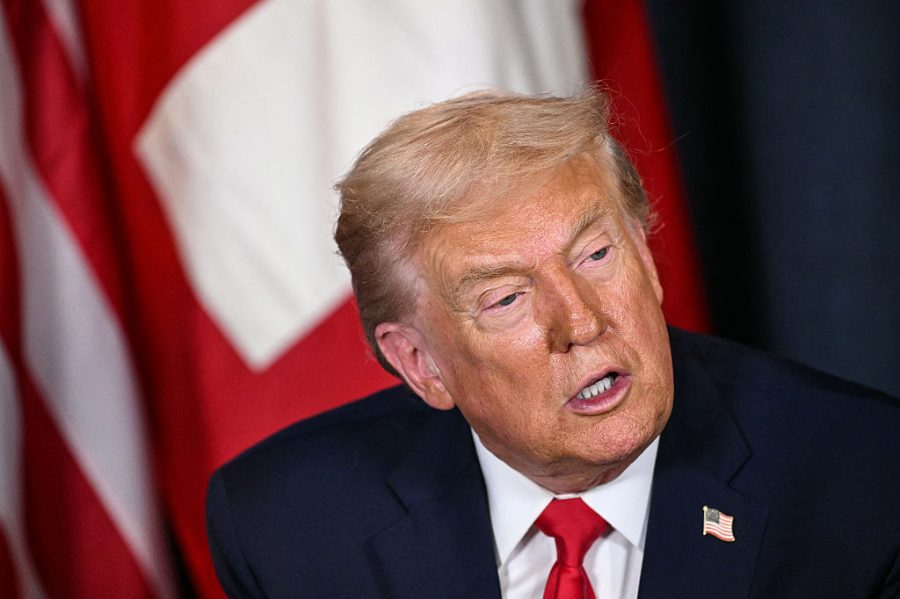
When Donald Trump stood up at Davos today and repeated his ambition to acquire Greenland, he did more than revive one of his own fixations. He offered a live demonstration of how the world now works. Here was a US president discussing the future of allied territory in the language of interest, security and leverage, not law or precedent. He may have ruled out the use of force, but that did not alter the underlying point: power, not process, was doing the talking.
If anyone still doubts that the post-Cold War rules-based order has given way to something more transactional and harder-edged, Greenland should put the matter beyond dispute. It was an unmistakable reminder of hierarchy, one the liberal order was meant to have erased. Even close allies sit downstream of American priorities when those priorities are asserted bluntly enough.
A day earlier at the same gathering, Canada’s prime minister Mark Carney had described the damage now being done to the alliance-based system the United States once upheld. That system, he argued, depended more on habit and restraint than on genuine consent, and both are fading. Nostalgia, Carney warned, is not a strategy. Trump’s Greenland intervention showed what that erosion looks like in practice.
Trump’s Greenland gambit showed how power is now exercised
There is an irony in the Canadian’s commentary. Carney has long been cast in British debate as the archetype of technocratic liberalism, a defender of global markets, supranational rules and frictionless integration, and a prominent critic of Brexit. Yet his message at Davos was not a plea to restore the old system, but an insistence that its illusions be discarded. Sovereignty, he argued, matters again. Economic integration is increasingly weaponised. Resilience must be built deliberately among states with the capacity to act. When even the former custodians of liberal globalism are making this case openly, the argument has moved beyond ideology. It has become structural.
The question for Britain is what follows. One instinctive response to a harsher world is to look for shelter in familiar institutions, above all the European Union. Another is to continue invoking a rules-based order that no longer constrains behaviour in practice. Trump’s Greenland intervention should puncture both reflexes. Denmark is an EU member. Greenland is European territory. Neither fact mattered when American interests were asserted directly. Institutions registered concern, but they did not alter outcomes.
This is not an argument against cooperation with Europe. It is an argument against mistaking institutional comfort for strategic protection. The EU offers process, regulation and reassurance, but it is poorly equipped to shield its members when power is exercised bluntly. Nor is China a refuge. Beijing – where Sir Keir Starmer will shortly visit – offers access and scale, but only at the price of leverage, dependency and narrowing freedom of action. For a country with global interests and exposure on multiple fronts, neither represents shelter. They are arenas in which power is contested, not sanctuaries from it.
This logic extends well beyond Britain. The emerging system is not neatly bipolar, but is increasingly shaped by a more openly unilateral United States and by a China determined to pull others into its orbit. Trump did not invent American unilateralism. He stripped it of euphemism. Beijing, for its part, offers protection only to those willing to align. In such an environment, advanced middle powers face the greatest risk. They are too open to insulate themselves, and too capable to accept subordination.
Acting alone, these states are exposed. Denmark’s experience regarding Greenland makes the point starkly. Acting together, they become system shaping. This is the case for a middle powers group: not a treaty alliance, not a rigid bloc, and not a values club, but a standing caucus of capable states able to coordinate interests and positions before they are diluted in larger forums. The aim is not to block great powers, but to negotiate with them from a position of collective strength rather than isolated dependence.
Any such grouping has to start from interests, not ideology. One of the illusions of the old order was that shared values could carry the weight of cooperation even when interests pulled apart. In practice, values proved negotiable, and often disposable, including by the United States itself. What matters now is not rhetorical alignment but practical outcomes. Democracy, the rule of law and openness survive when they are backed by real cooperation, trusted markets and credible security arrangements.
The operational core of this approach should be ally-shoring: the deliberate re-alignment of critical supply chains, defence production, capital and technological dependencies towards a small group of trusted states. It is not a slogan about decoupling from China or the US, but a practical effort to limit exposure where leverage can be applied. Greenland shows why this matters. Dependence can be exploited by allies as readily as by rivals.
In practice, ally-shoring means shared defence procurement, common industrial bases and forces able to operate together without automatic reliance on any single patron. In economic and technological policy, it means aligning standards, investment screening and export controls early enough to shape markets rather than absorb rules set elsewhere. Politically, it means shared exposure that creates leverage in both directions, reducing vulnerability not only to Beijing, but to unilateralism in Washington as well.
Britain is unusually well placed to lead this effort. It retains defence credibility, intelligence reach, regulatory capacity and one of the world’s most important financial centres, alongside diplomatic connections that bridge Europe, North America and the Indo-Pacific. Leadership here does not mean dominance. It means organisation.
This is where Britain’s post-Brexit role should sit. Not as a nostalgic defender of a vanished order, and not as a supplicant seeking comfort in institutions designed for a different era, but as a coordinator of states that share both interests and exposure. Trump’s Greenland gambit showed how power is now exercised. Carney explained why. The middle powers group is how countries like Britain respond.
If Britain and its peers fail to organise themselves deliberately, the shape of the next order will be decided for them. In the absence of such a grouping, advanced middle states face a narrowing set of choices: align with a more unilateral America, accommodate a China seeking to pull the world into its orbit, or accept strategic marginalisation. Building a middle powers group is therefore not idealism. It is self-preservation.






Comments