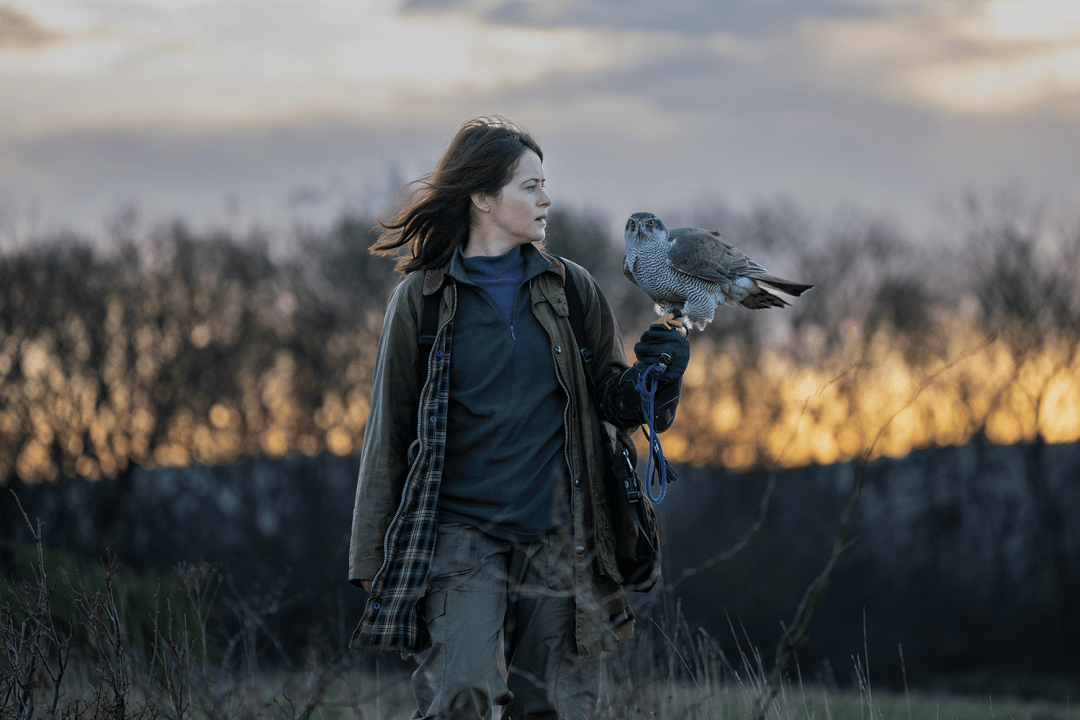
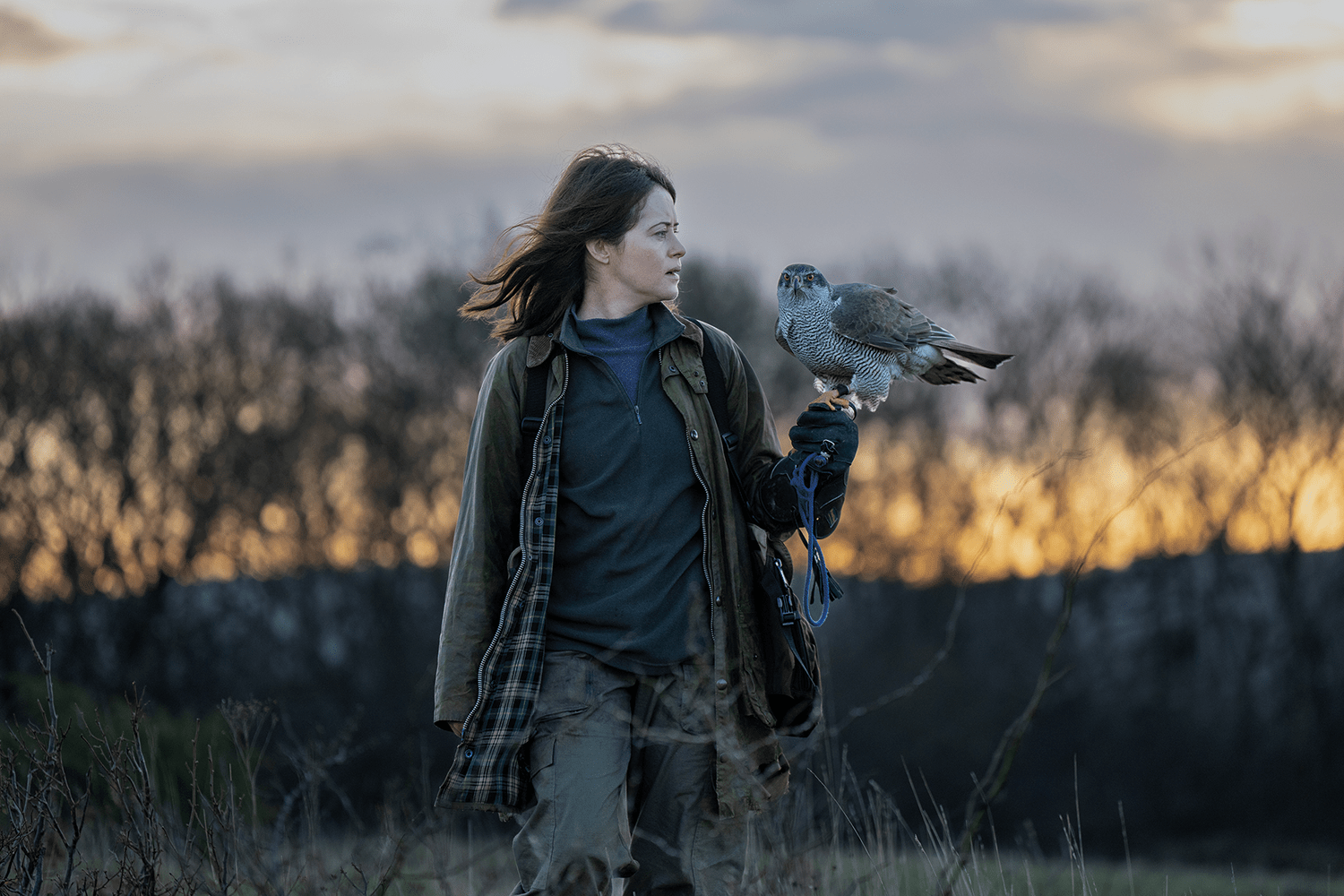
H is for Hawk is an adaptation of the bestselling memoir by Helen Macdonald who, following the sudden death of her beloved father, channels her grief through the training of a goshawk, Mabel. The film stars Claire Foy, who is superb, as is the nature photography, but is it right, keeping a wild animal captive, and depriving it of its natural behaviors because it helps you in some way? What’s in it for this gorgeous bird, I kept wondering. The cruelty is never addressed. This is solely about human need. We’re not even told who plays Mabel, so I can’t say what she has been in before or whether she has won any awards. (I would hope so; she is magnificent.)
Directed by Philippa Lowthorpe from a screenplay co-written with Emma Donoghue, it opens in 2007 with Helen as a research fellow at Cambridge University when her father, a Daily Mirror photographer, has a fatal heart attack. Helen adored her father (played by Brendan Gleeson in the flashbacks). He was, it seems, something of a polymath, and keenly interested in birds, among many other things. He always had his camera and a pair of binoculars about him. He had introduced her to falconry as a child. Helen is devastated – so much so that she doesn’t see that her mother (Lindsay Duncan) might be bereaved, or her brother (Josh Dylan). Either that or she is too self-obsessed. Let’s give her the benefit of the doubt.
She fixes on having a bird to train and it has to be a goshawk, even though, as her experienced falconer friend Stuart (Sam Spruell) tells her, ‘They’re the wildest and maddest raptors… Do you want to deal with a highly evolved psychopath?’ She does. She won’t be palmed off with a merlin as ‘that’s a lady’s bird’. Although it’s never explicitly stated, she needs a project so challenging that she can be subsumed. She needs an escape from her emotions, to lose herself. She buys Mabel – a goshawk costs around £500; I’ve no idea why it’s allowed – and sets her up in her college home. It’s just her and Mabel as Helen withdraws further from the world. Mabel mostly sits in Helen’s living room, tethered to her perch, ankles in chains, wearing one of those creepy hoods that blocks all vision. Why this doesn’t pain Helen, I don’t know.
There are many ways in which this film is excellent. Foy is excellent. She learned falconry and her handling of Mabel feels instinctive, while her portrayal of grief, depression and desperately forcing life back into some shape goes down to the bone. She is never showy, and it’s the same with Lowthorpe’s direction, which keeps everything raw and intimate. Lowthorpe is also never judgmental, unlike some people I could mention. (Why should Mabel give up her life for Helen?)
We’re not told who plays Mabel, so I can’t say what she has been in before or whether she has won any awards
It’s also never Hollywood. There are no flashes of sudden insight or similar. Instead, over the two hours, Helen slowly emerges as Mabel travels from being a thrashing, hostile presence to one who can be let free to hunt now she’s trained to return to the glove. The scenes of her flying free – goshawks hunt low to the ground with the speed of a missile – are up there with anything you might see in an Attenborough documentary and are so wonderful you wish it could be like that for her all day every day. (Judging comes easy to me.)
In other words, the film does a brilliant job in telling this particular story. But if you are #TeamMabel your empathy many not be where the film wishes it to be, and your enjoyment may be diminished. It’s a career-best for Foy, who will doubtless win many awards. I hope the unnamed bird gets one too.


Comments