
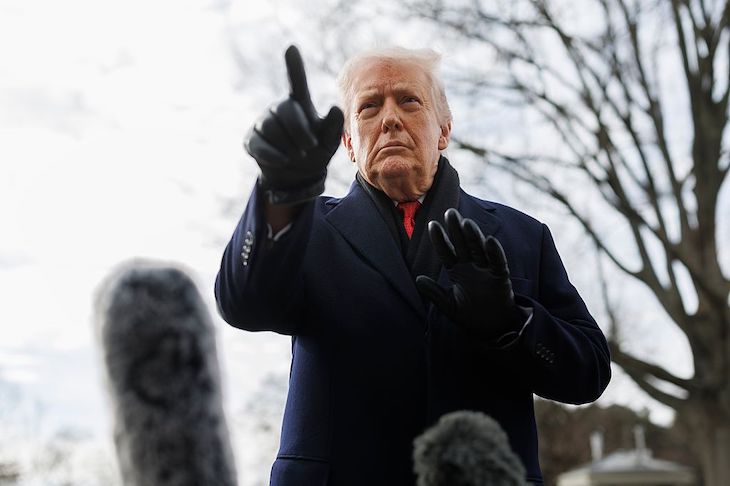
European politicians had little rest this weekend after Donald Trump’s announcement on Saturday that he would be imposing punitive tariffs on the eight countries that had sent troops to Greenland last week. From February 1, 10 percent tariffs will be slapped on goods entering the United States from Britain, Denmark, Norway, Sweden, France, Germany, the Netherlands and Finland. They had, Trump said, “journeyed to Greenland for purposes unknown” and he accused them of playing a “very dangerous game.”
Denmark has stated that Greenland is not for sale; Trump is unlikely to back down
By sending troops to Greenland on Thursday, those eight countries had only done what Trump implied he had expected of them. Since before his return to the White House last year, the American president has lamented the neglected state of Greenlandic security. In recent weeks, Trump has claimed that the island’s defenses amount to “two dogsleds as protection, one added recently.”
Since Christmas, Trump has become more vocal about his desire to annex Greenland to the US, claiming it forms a crucial component of his “Golden Dome” satellite defense system. He has repeatedly said that China and Russia also have their sights set on the island and that ships and submarines belonging to both countries are “swarming” off Greenland’s coasts – something experts have found little evidence of. Only America, Trump has claimed, is capable of defending the island. As such, if by June 1, a deal is not reached “for the complete and total purchase of Greenland” between Denmark and the US, the tariffs imposed on the eight nations who sent troops to the island will increase to 25 percent.
This deterioration in the relationship between Europe and America follows an unsuccessful summit on the subject in Washington last Wednesday between Marco Rubio, J.D. Vance and the foreign ministers of Greenland and Denmark. Emerging from the meeting, Denmark’s Lars Løkke Rasmussen declared that it had ended in “fundamental disagreement.” “We didn’t manage to change the American position. It’s clear that the president has this wish of conquering Greenland,” he added.

The following day, Denmark said it would be boosting its military presence on the island. Seven European allies also sent a cohort of troops, whose mission was to scope out ways to bolster Greenland’s security “in light of Russian and Chinese threats in the Arctic.” Their findings would form the basis for a series of NATO exercises conducted later this year.
In a sign of just how serious the crisis has become, Trump’s tariff announcement provoked an unexpectedly strong reaction from the countries affected. After crisis talks on Saturday, they issued a joint statement on Sunday afternoon, warning America that the president’s threats threatened a “dangerous downward spiral” – language that would be repeated in statements by other European officials, including Commission chief Ursula von der Leyen and Finnish president Alexander Stubb. Keir Starmer declared that “applying tariffs on allies for pursuing the collective security of NATO allies is completely wrong,” reportedly reiterating this on the phone to Trump later on Sunday evening.
What Trump said in response has not yet been reported. Nevertheless, Starmer’s words drew mocking from Kirill Dmitriev, one of Putin’s key negotiators with the US over Ukraine, who tweeted, “Panicking Starmer calls Daddy’s tariffs ‘completely wrong’.” Dmitriev spent Sunday afternoon posting gleefully about Europe’s response – using a VPN to circumnavigate Russia’s ban on X in the process.
Much remains unclear about how Trump’s threatened tariffs would affect Europe. The EU operates a so-called “common external tariff,” meaning that any product leaving the bloc is tariffed at the same rate, regardless of which country it has left. It is possible for America to impose country-specific tariffs on EU members, although this would require it to enforce strict “rules of origin” checks that would be logistically taxing. What is clear, however, is that, if they come into force, these tariffs will essentially rip up the EU-US trade deal agreed – but crucially not yet ratified – between America and the bloc last year.
These tariffs will essentially rip up the provisional EU-US trade deal
Yesterday evening, ambassadors from all 27 EU member states met in Brussels to discuss how to respond to Trump’s threats. Several members of the European Parliament (MEPs) have said they will be calling for the bloc to scrap the trade deal with America. French president Emmanuel Macron has said he will ask the EU to implement its “anti-coercion instrument.” Dubbed the bloc’s trade “bazooka,” this measure was specifically designed to push back against third countries trying to exert economic blackmail over member states by curbing the import of goods and services.
There are other measures Europe, together with Britain, could enforce, depending on how much they are willing to ratchet up the tension. This includes cutting America out of European defense procurement, banning or hiking taxes on American tech firms such as X and Meta, introducing targeted tariffs on products from politically important states (e.g. bourbon from Kentucky) or even booting American troops out of military bases across the continent.
Similarly, Britain could scrap its trade deal with America, also hashed out last year but not yet completed. In a more drastic measure, King Charles’s state visit to the US – expected in the Spring – could be scrapped. For Trump, a notoriously die-hard fan of the royal family, this would be an effective, if enraging, method of communicating just how damaging his tariffs are for the transatlantic relationship. It appears that any option Britain and the EU go for will involve some degree of self-inflicted pain. Nevertheless, it appears Trump has pushed Europe too far: doing nothing, so far, is not on the table.
In the wake of Venezuela, when Trump authorized a military operation at the start of the month to abduct president Nicolas Maduro to face justice in America, Europeans are wary. Just last week, the US president refused to rule out taking military action against Greenland – a move which would essentially see NATO’s strongest member attacking a smaller, weaker one.
For now, Starmer and his European allies will do their best to engage with Trump through diplomatic channels. NATO chief Mark Rutte also spoke to the president over the phone yesterday, as anxieties mount over the degree to which Trump’s actions signal an irreparable breakdown in the alliance. Denmark has stated that Greenland is not for sale; Trump is unlikely to back down. With less than two weeks to go before his new tariffs kick in, Europe will spend this time hashing out a plan they hope will avert certain economic damage – and wondering if they still have an ally in America.


Comments